Bambu Lab’s A2L launch is easy to read as another consumer 3D-printer drop. The better engineering question is whether a larger desktop machine changes the builder’s checklist: calibration, footprint, motion stability, material workflow, and how many extra functions should be trusted on the same platform.
What happened
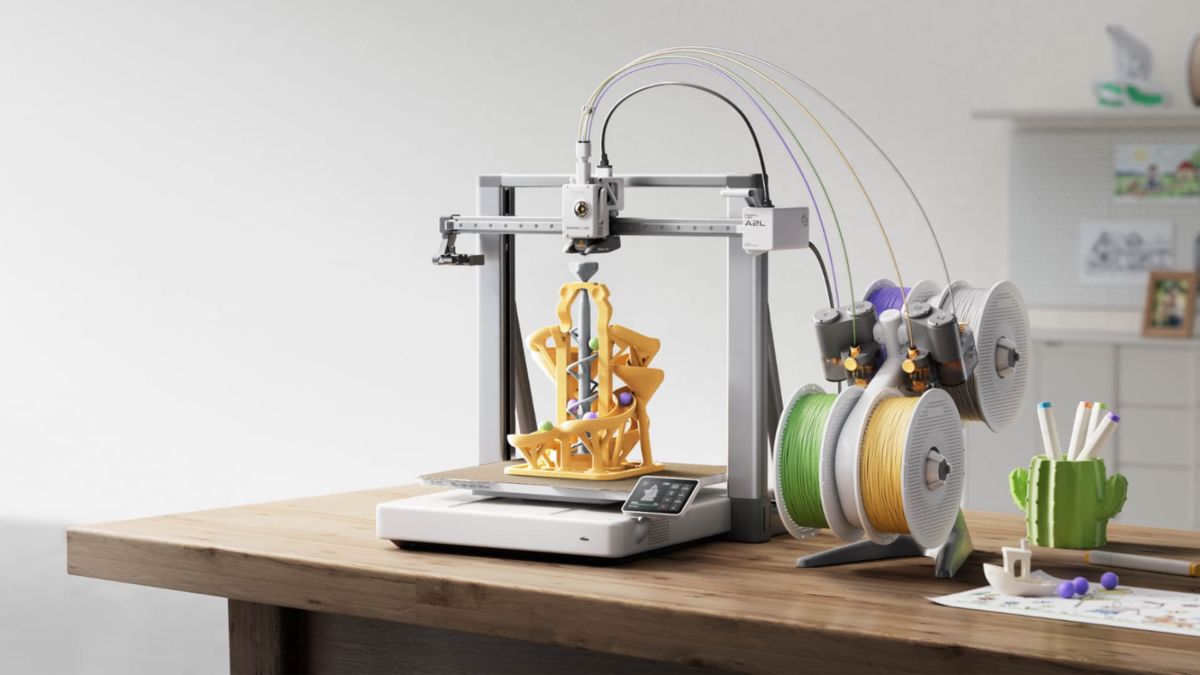
Bambu Lab says the A2L and A2L Combo became available globally starting June 1, 2026, with Japan and Korea following on June 2. The company’s launch post positions the A2L as an “extra large” addition to the A Series, while the product page highlights a large-format printer with add-ons including multi-color, blade cutting, and pen plotting.
Why it matters
Large-format desktop printing is not just about making bigger decorative parts. It changes how builders approach fixtures, robot brackets, STEM field elements, enclosure panels, jigs, and multi-part assemblies. A printer with more bed area can reduce glue joints and fasteners, but it also raises the penalty for poor first-layer setup, bed flatness issues, filament management, and long-print reliability.
Technical breakdown
The A2L story has three engineering threads. First is build volume: a larger printable area can simplify mechanical designs if dimensional accuracy holds across the bed. Second is workflow expansion: multi-color, cutting, and pen-plotting features suggest the machine is being pitched as a broader desktop fabrication station, not only an FDM printer. Third is stability: larger moving systems must control vibration, belt tension, gantry alignment, and bed motion over longer travel distances.
Those are exactly the areas buyers should test before treating any large-format machine as a production tool. Print a full-bed calibration pattern, a tall bracket, a dimensional robotics plate, and a long-duration functional part. Then inspect corners, hole spacing, layer consistency, ringing, and repeatability after several heat cycles.
Builder, STEM, and industry impact
For maker labs and school robotics teams, a larger printer can be more valuable than a faster small printer if it reduces part splitting and assembly time. The tradeoff is space, noise, maintenance, and supervision. Teams should budget for a stable table, dry filament storage, spare nozzles, bed-surface consumables, and a standard calibration routine before kickoff season arrives.
Risks and unknowns
TVG has not performed hands-on testing of the A2L. The open questions are long-term motion accuracy, real-world reliability of add-ons, support for abrasive or engineering materials, noise in classroom environments, slicer profiles for large functional parts, and how well the machine recovers from failures during long prints.
TVG Take
The A2L is most interesting as a checklist moment. Large-format desktop printers can unlock better robotics and maker workflows, but only when teams treat them like lab equipment: measured, calibrated, documented, and maintained. If the machine’s stability and add-on workflow hold up under independent testing, it could be a useful bridge between hobby printers and more expensive shop-class fabrication tools.
What to watch next
For readers tracking the same engineering lane, these related TVG Report pieces add useful context:
- Portable Monitor Specs That Actually Matter for Maker Labs and Field Teams
- Bambu Lab’s A2L Makes the Desktop Printer Race About Build Volume and Workflow
- Drone vs. Action Camera for Field Documentation: A Buyer Evaluation for Robotics and Maker Teams