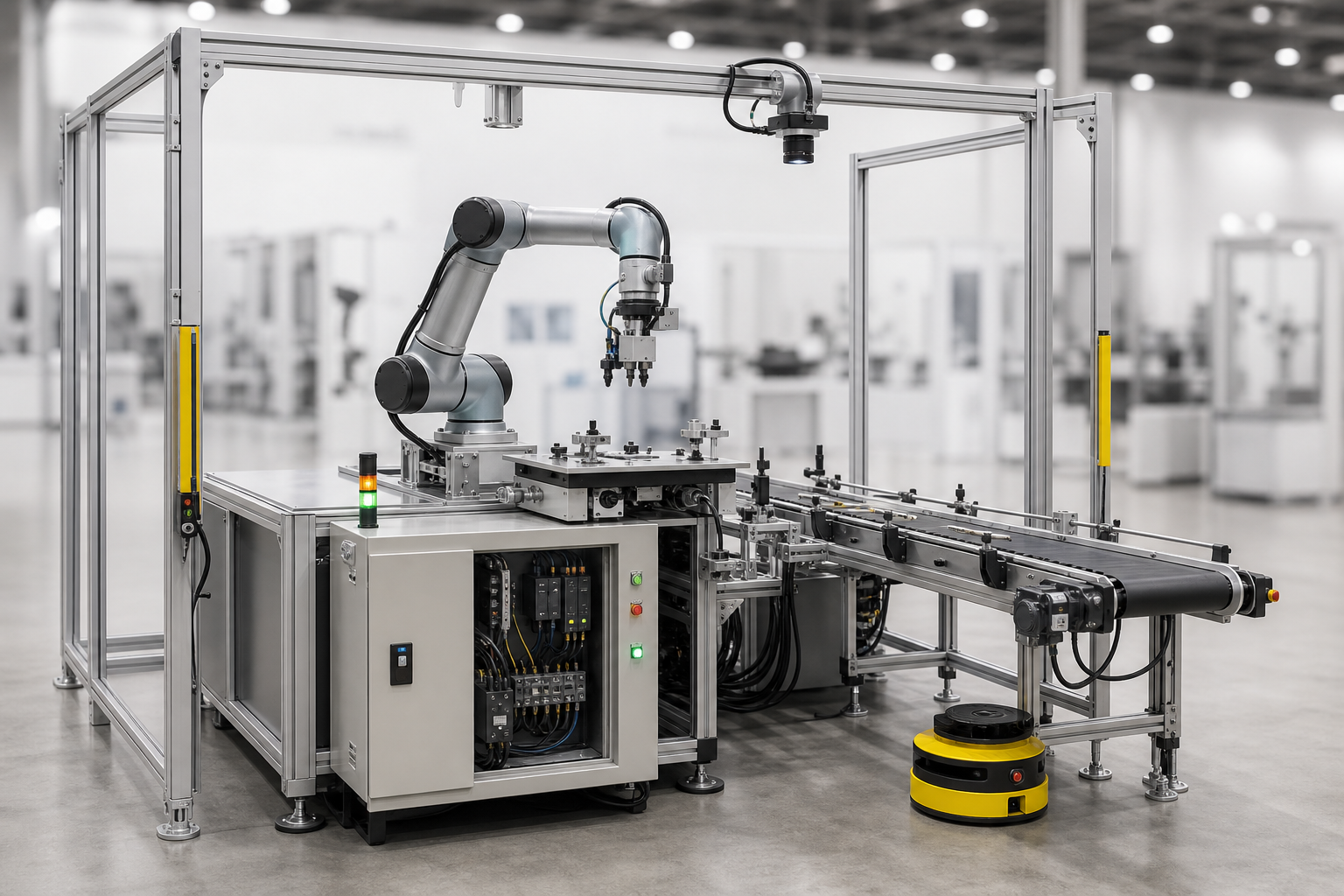
Automate 2026 is still more than a week away, but the signal from exhibitor pages and supplier announcements is already clear: the show floor is being framed less as a robot-arm showcase and more as a full automation stack, from motion systems and controls to cobots, machine vision, AI, conveyance, and factory software.
Why it matters
Automate lists the 2026 event for June 22–25 at McCormick Place in Chicago and describes a floor built around robotics, AI, motion control, vision systems, and related automation technologies. The exhibitor directory advertises more than 1,000 industry-leading automation companies.
That scale matters because automation buyers rarely succeed by choosing a robot in isolation. A production cell also needs material flow, sensing, safety, end-of-arm tooling, controls, data integration, maintenance planning, and a deployment path that operators can actually support.
Technical breakdown
Two pre-show announcements show the kind of engineering mix TVG readers should watch. Bosch Rexroth says it will exhibit factory automation systems at Booth #2810, including conveyance, linear technology, and control systems. Its announcement calls out TS conveyors, including the TS 7plus for payloads up to 3,000 kg, as well as control and linear-motion demonstrations.
Kassow Robots is highlighting 7-axis lightweight cobots for applications such as welding, palletizing, machine tending, and other industrial tasks. The extra axis is not just a spec-sheet flourish; in tight cells, awkward approach angles and fixture interference often decide whether a cobot deployment is clean or compromised.
The useful lens for Automate 2026 is integration density. The most interesting booths will not simply show faster axes or nicer teach pendants. They will show how robot motion, vision, conveyors, safety, software, and operator workflows fit together with fewer custom one-off bridges.
Builder, STEM, and industry impact
For manufacturers, the buying question is shifting from “which robot?” to “which system can be owned by our team after the integrator leaves?” That puts documentation, diagnostics, spare parts, training, and controls openness on the same level as speed and reach.
For makers and STEM robotics teams, Automate is a useful preview of professional design tradeoffs. Competition robots and lab projects can learn from the same stack thinking: define the material flow, select sensors based on failure modes, make service points reachable, and build software that exposes what the machine is trying to do.
For small shops, the practical takeaway is to look for modular automation that can start with one pain point, then expand. Conveyance, machine tending, quality inspection, and packing often produce better first projects than a broad “automate everything” mandate.
Risks and unknowns
Show-floor demos compress reality. They often use ideal parts, controlled lighting, tuned fixtures, clean networks, and expert operators. Buyers should ask vendors for cycle-time assumptions, changeover time, safety category, maintenance requirements, uptime evidence, and examples from production environments similar to their own.
AI language will also be everywhere. The useful question is not whether a product says AI, but where the model sits in the control loop, how failures are detected, whether humans can override it, and what data is needed to keep it performing after installation.
TVG Take
Automate 2026 looks like a stack-validation event. Robots remain the headline, but the real engineering value is in the parts around them: conveyance, control, sensing, safety, software, and support. TVG readers should treat the show as a chance to compare complete cells, not isolated components.
The winning vendors will be the ones that can explain how their systems behave on a bad day: a misplaced part, a dirty lens, a sensor dropout, a jammed conveyor, or a new operator on shift. That is where automation leaves the demo stage and becomes infrastructure.