NVIDIA has released synthetic training datasets and a fine-tuning recipe for Nemotron 3.5 Parse, giving developers a route to adapt its compact page parser to specialized documents. The November 26 update separates two practical choices: teaching it the right structure and speeding up the generation of that structure.
The underlying model arrived on October 17, and its optional DFlash2 speculative decoder became available on November 4. The new material explains how to build on those releases.
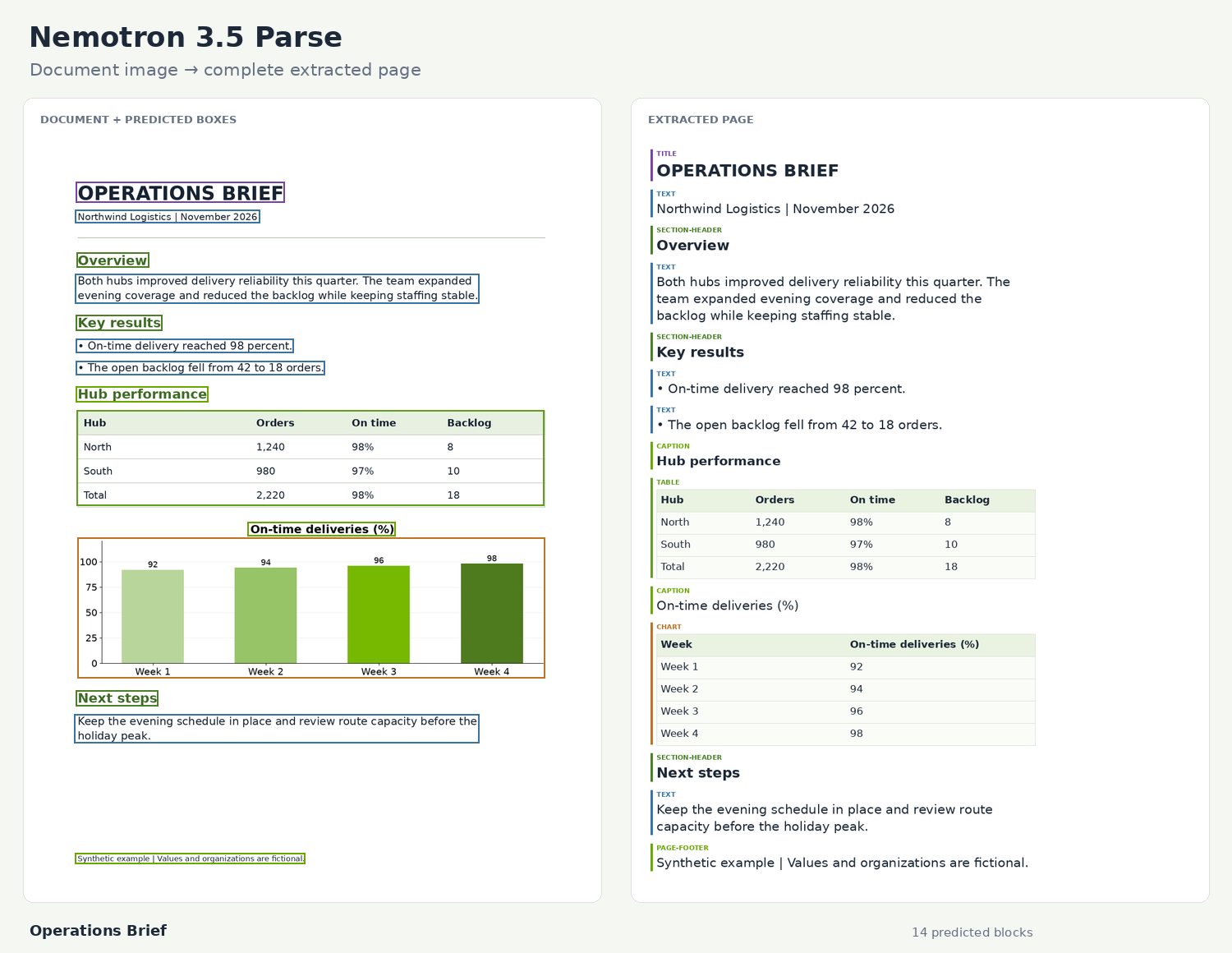
The 0.631-billion-parameter parser converts page images into content in reading order, element classes and location boxes. Tables and charts become structured records. NVIDIA’s fictional operations brief illustrates the relationship: boxed regions on the page map to extracted headings, paragraphs, table cells and chart values.
Figure: NVIDIA. Synthetic example; values and organizations are fictional.
Teach the structure, then reward complete answers
NVIDIA reports three synthetic datasets: 9.98 million chart examples, 1 million table examples and 7.9 million multilingual OCR examples. They pair rendered images with known labels, giving developers material to fine-tune a parser or generate variations for a particular document type or language.
The recipe starts with supervised fine-tuning: show the model a page and the structured answer it should produce. That teaches the relationship between visual layout and output. A table’s row and column relationships matter because a correctly transcribed number in the wrong cell changes its meaning.
Next comes reinforcement learning with verifiable rewards, using Group Relative Policy Optimization, or GRPO. The model generates candidate extractions, and checks reward correct content, usable structure and natural completion. This allows more than one valid representation while discouraging repetition or unfinished answers. For a specialized workflow, developers supply their own image/label pairs and checks for what counts as correct.
Faster decoding is a separate control
DFlash2 uses an 89.3-million-parameter draft model to propose up to 32 tokens ahead; the target parser verifies the proposals together. This reduces sequential generation work, but the benefit depends strongly on request load.
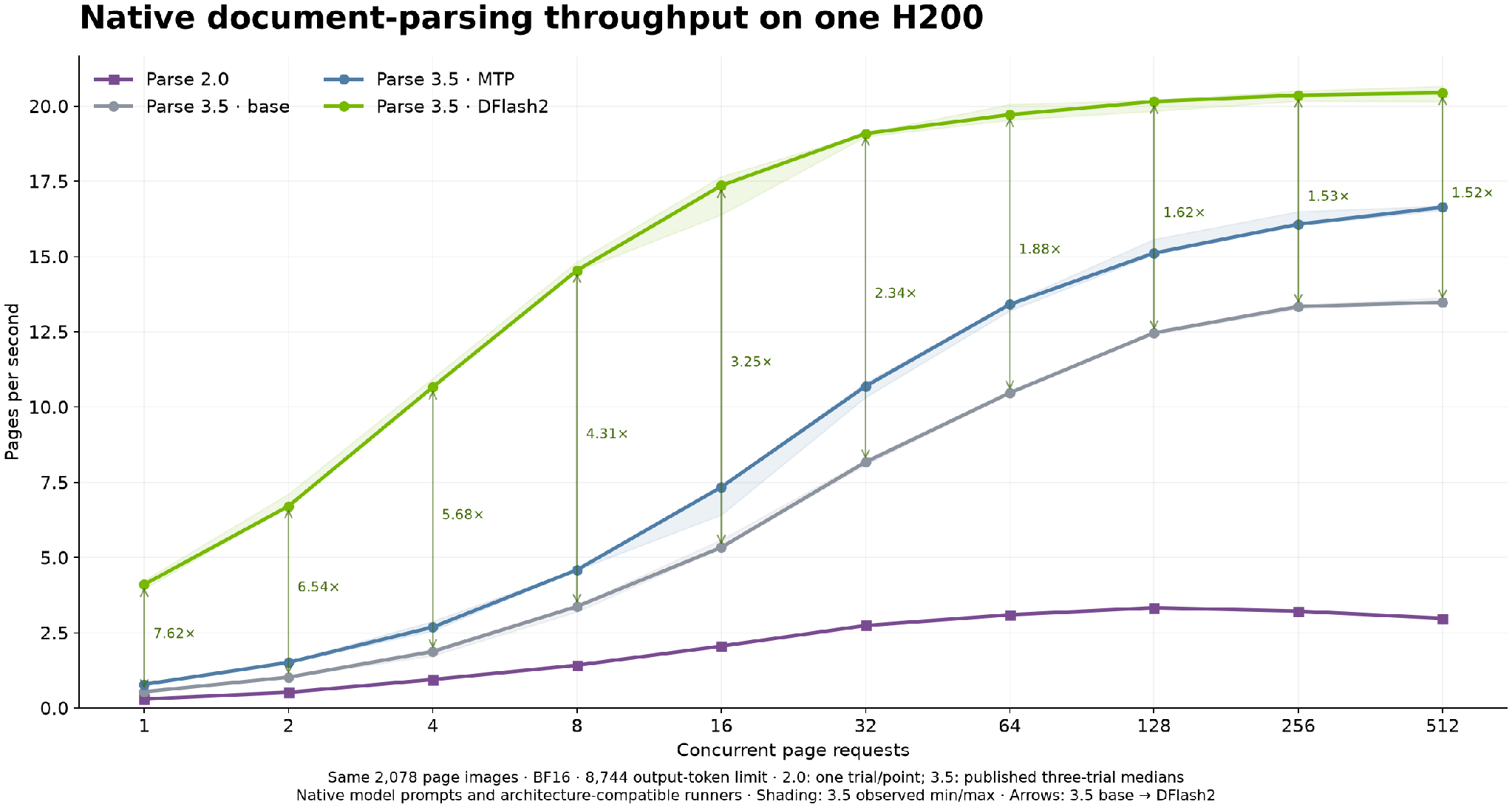
In NVIDIA’s native single-pass benchmark on one H200 in BF16, using the same 2,078 page images, DFlash2 delivered 7.62 times the throughput of speculation-disabled Parse 3.5 at one concurrent request. At 512 concurrent requests, the gain narrowed to 1.52 times. The chart makes the deployment choice clear: the low-load headline is not the gain to expect from an already busy server.
Parsing passes control different work. Double pass revisits table and chart crops; triple pass also adds separate region detection. Those stages add image analysis and can create multiple requests. Speculation accelerates token generation inside the requests. The model card’s HTTP multipass timings therefore describe a different pipeline from the native throughput chart.
A Thai fine-tune shows a narrower deployment case
Independently controlled iApp provides a useful implementation example with OpenThai2.1, its Thai-focused derivative. In a November 26 H100 test, sending one page at a time, it reported 0.44 seconds per page with DFlash2, versus 1.5 with built-in one-token MTP and 2.4 without speculation. These were medians over 12 Thai table pages and three to four server starts: a limited measurement of its fine-tune, rather than a reproduction of NVIDIA’s H200 benchmark or a universal PDF speed.
The runtime matters. iApp used development build vLLM 0.32.1rc1.dev505+g00b6c4c56 and says PyPI’s 0.31.0 cannot serve the model natively.
The public weights use OpenMDW 1.1, with separate tokenizer and component terms. PDF pages must first be rendered as images; the helper does not infer cross-page table continuations or document-wide reading order.