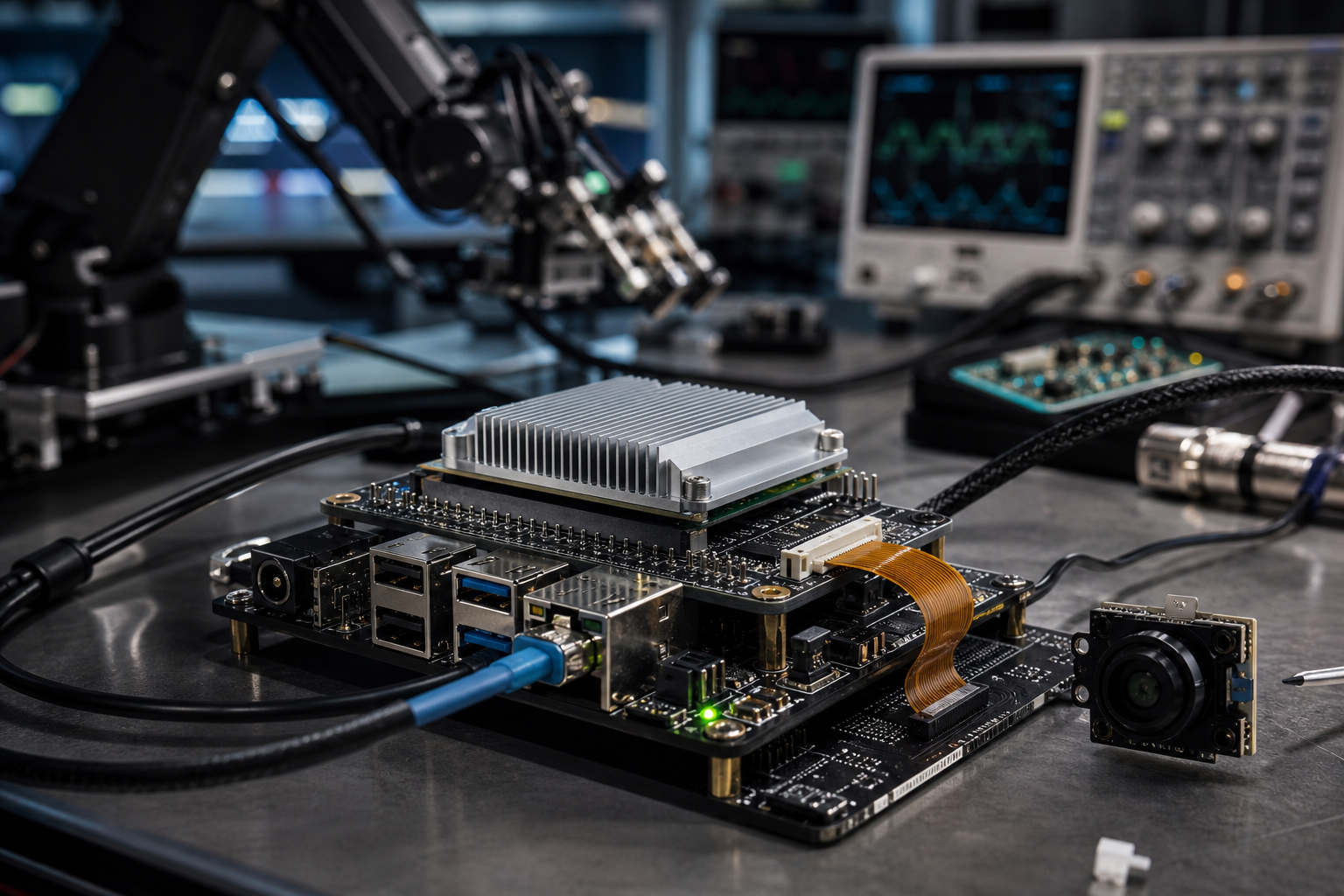
NVIDIA’s latest JetPack update is aimed at a very specific problem in physical AI: getting agent-style workloads to run reliably on edge hardware instead of leaving every reasoning loop in the cloud.
In a June 1 technical blog, NVIDIA said JetPack 7.2 for Jetson adds one-command deployment for NemoClaw, new Jetson agent skills, official Yocto Project support, and Super Mode support for Jetson AGX Orin 32 GB. The company framed the release around robotics, industrial automation, inspection, vision AI, and other edge-AI systems where software agents need to interact with sensors, local models, and real-time workflows.
Why it matters
The important shift is not just another SDK version number. Robotics and automation teams are trying to move from demos to systems that can observe, plan, call tools, and make local decisions without turning every step into a round trip to a remote model service. That makes memory pressure, update discipline, operating-system integration, and reproducible builds as important as raw TOPS.
For builders, JetPack 7.2 reads like an attempt to make the Jetson stack more production-shaped: easier model deployment, more automated developer workflows, and cleaner paths for teams that need customized Linux images rather than a one-off lab SD card.
Technical breakdown
NVIDIA highlights NemoClaw deployment as a key part of the release. In practical terms, that points to an edge system where a local agent can coordinate perception, tool use, and application logic closer to the sensors and actuators. That is especially relevant for inspection rigs, mobile robots, and factory cells where latency and connectivity can decide whether an AI feature is usable.
The Jetson agent skills are also worth watching. If they reduce repetitive tasks such as Linux customization, memory optimization, and model benchmarking, they could help small robotics teams spend less time on board bring-up and more time validating behavior in the real world. Official Yocto support matters for a different reason: it gives embedded teams a more familiar route to controlled, repeatable system images.
Builder, STEM, and industry impact
For maker and university labs, the release reinforces a useful learning path: edge AI is no longer only about running a classifier on a camera feed. The emerging workflow includes local agents, tool calls, model packaging, fleet updates, and real-time constraints. Those are the same concerns students and early-stage robotics teams will meet when prototypes leave the bench.
For industry, the practical test will be whether JetPack 7.2 shortens deployment time without hiding too much of the system. Factory and inspection teams need predictable behavior, observable failure modes, and a clean way to reproduce the software image that passed validation.
Risks and unknowns
Agentic edge AI is still a young pattern. Local autonomy can reduce latency and protect privacy, but it also raises harder questions around safety boundaries, recoverability, and debugging. A robot or inspection station that can call tools and change behavior needs guardrails that are as concrete as its hardware interface.
The other unknown is device fit. Jetson modules cover a wide range of power and memory envelopes, and not every agent workflow will be practical on every board. Teams should benchmark their actual models, sensor rates, and worst-case memory use before treating “agentic-ready” as a deployment guarantee.
TVG Take
JetPack 7.2 is most interesting because it treats physical AI as an embedded systems problem, not just an AI model problem. The winning edge deployments will be the ones that combine local reasoning with disciplined Linux builds, measurable latency, recovery paths, and sensor-to-actuator validation. For TVG’s robotics and maker audience, this is a signal to start learning the full stack: model runtime, OS image, hardware I/O, and field testing.