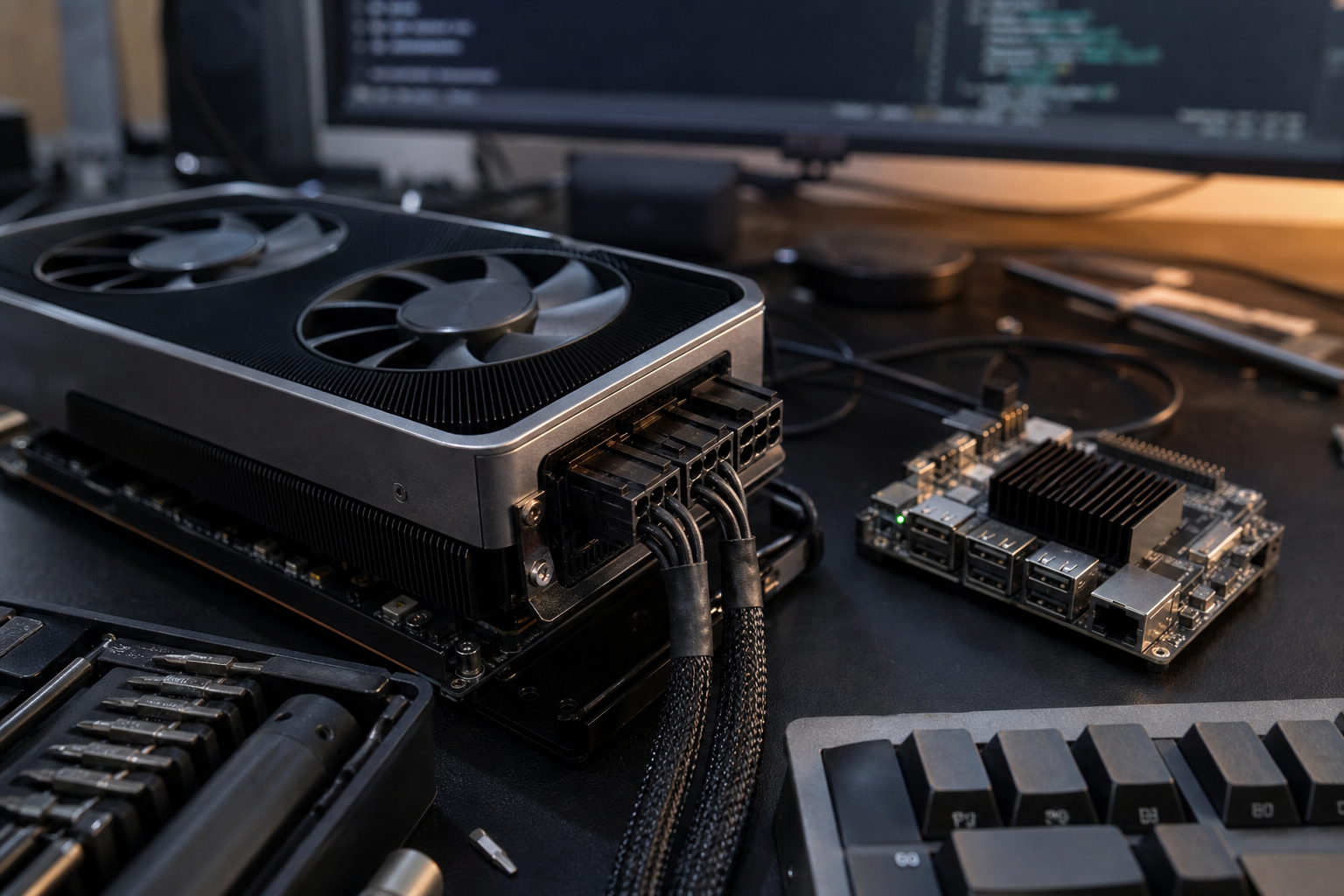
NVIDIA’s RTX Spark messaging is a useful signpost for where the AI PC category is heading. The interesting part is not another round of “AI inside” branding. It is the possibility that desktop and laptop systems will become practical local workstations for model testing, retrieval tools, agent workflows, and private inference.
The original version of this TVG article overstated the OpenAI angle in the headline. The cleaner reading is that RTX Spark is an NVIDIA-centered AI PC push, with the broader ecosystem moving toward local developer workflows that may connect to OpenAI-style applications and agent tooling.
Why it matters
For the last two years, many AI workflows have depended on cloud APIs or oversized workstation setups. That works for production services, but it is awkward for makers, researchers, and small teams that want to test models locally, keep data private, or build prototypes without burning API budget on every experiment.
An AI PC only matters if it can reduce that friction. The useful system is not a badge on a laptop lid. It is a machine that can run local models, accelerate retrieval and embedding workloads, support common frameworks, and still behave like a daily computer.
Technical breakdown
RTX Spark sits in the same conversation as NVIDIA’s broader push around local AI acceleration, GPU-backed inference, and Windows developer workflows. The hardware story is about putting enough compute and memory bandwidth close to the user so that local agents and creative tools do not need to round-trip everything through the cloud.
The software story is just as important. Developers need drivers, model runtimes, containers or packaged environments, quantized model support, and sane update behavior. A powerful chip with a fragile software stack will not help small teams ship reliable tools.
Builder impact
For makers, the near-term use cases are practical: local coding assistants, document search, vision experiments, robotics planning prototypes, and offline demos. For robotics teams, local AI PCs can also act as development stations before models are moved to edge hardware such as Jetson-class systems or industrial PCs.
For small companies, the appeal is privacy and iteration speed. Running a local model against internal manuals, CAD notes, service logs, or lab data may be easier to justify than uploading everything to a cloud workflow.
Risks and unknowns
The category still has real risks. Vendors may overmarket “agentic PCs” before the software is mature. Memory limits, thermals, battery life, driver compatibility, and model size will define what users can actually run. Buyers should look for workload demonstrations, not generic AI claims.
TVG Take
RTX Spark matters if it makes local AI boring enough to use every day. The engineering win would be a repeatable desktop stack where makers can test models, connect tools, inspect outputs, and then deploy smaller versions to edge hardware. That is more valuable than another vague AI PC slogan.
What to watch next
The practical benchmark will be developer friction. Can a buyer install a current model runtime, run a capable local model, connect it to files or tools, and keep the system stable through driver updates? If the answer is yes, AI PCs become useful lab infrastructure. If not, the category remains mostly marketing.
TVG would also watch the bridge from desktop to edge. Robotics and maker teams often prototype on a bigger machine before deploying to Jetson, ARM SBCs, or industrial edge boxes. RTX Spark-style systems become more valuable if they make that path predictable instead of creating another isolated platform.