What happened
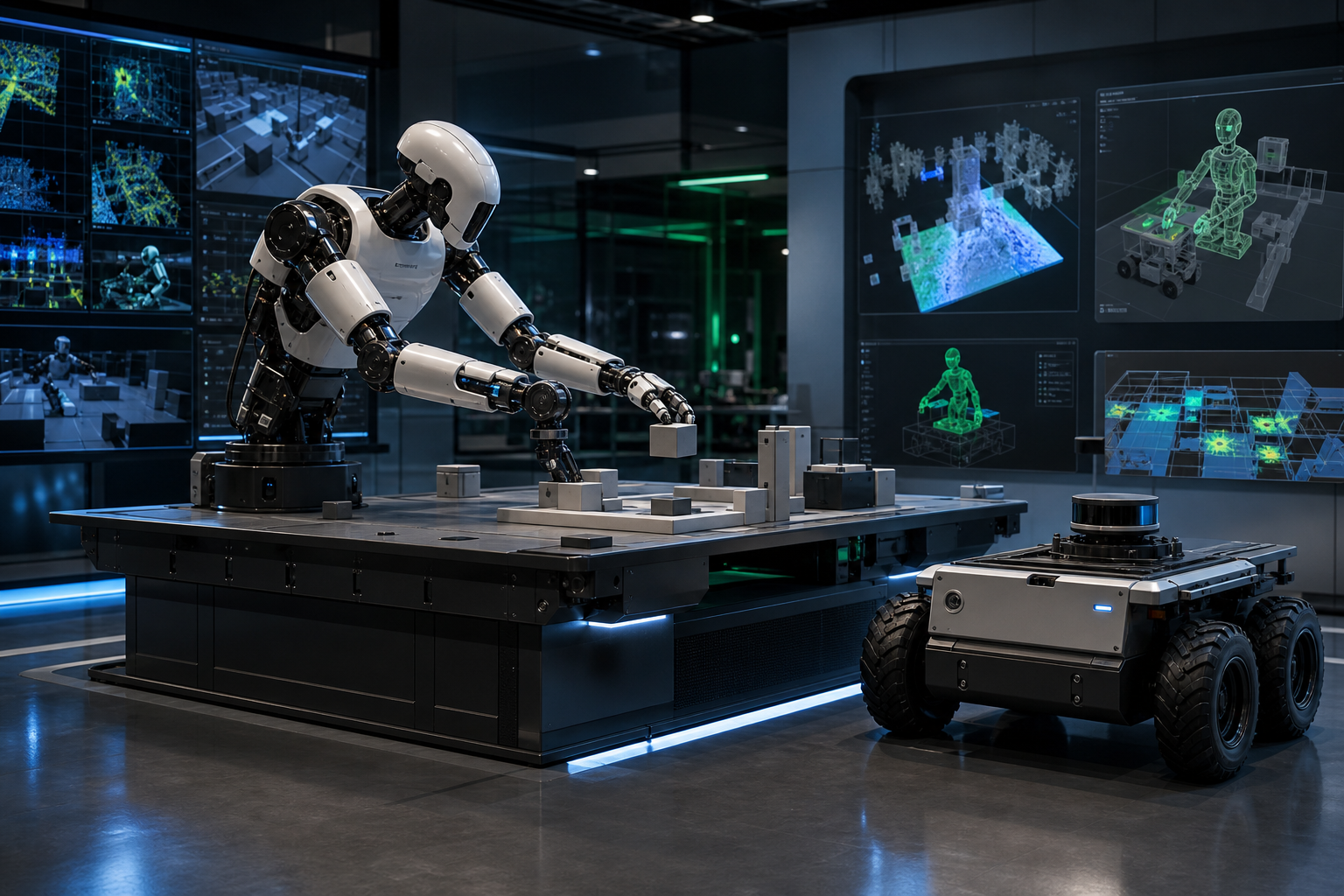
NVIDIA used CVPR week to introduce a set of physical-AI agent skills aimed at speeding up the development loop for autonomous vehicles, robots, and vision-AI systems. The company says the new skills are powered by NVIDIA Cosmos 3 and are designed to help researchers move through data generation, simulation, policy training, and evaluation with fewer one-off toolchain gaps.
Why it matters
For robotics teams, better models are only part of the deployment problem. The expensive work is usually the loop around the model: reconstructing realistic scenes, generating edge cases, training a policy, testing behavior, finding failure modes, and repeating the cycle without burning every iteration on real hardware. NVIDIA’s announcement is important because it frames physical AI as a workflow problem, not just a model-release problem.
Technical breakdown
NVIDIA describes the core bottleneck as fragmentation across separate tools for scene reconstruction, synthetic data, training, and evaluation. Its pitch is that agent skills can help automate parts of that build-and-evaluate loop, including converting real-world observations into simulation-ready assets and producing controlled scenarios for autonomous systems.
The same announcement points to continued momentum around open physical-AI assets. NVIDIA says its Physical AI Dataset has passed 15 million downloads on Hugging Face and highlights Isaac GR00T X Embodiment Sim as a heavily downloaded robotics dataset. The company also references new dataset releases such as GRAIL, which it describes as roughly 50 hours of humanoid-object interaction data.
For teams already using simulation, the key technical question is not whether synthetic data is useful. It is whether the synthetic loop is traceable, repeatable, and close enough to the target deployment environment to expose real failure modes instead of creating polished demos that only work in the lab.
Builder, STEM, and industry impact
University labs, robotics startups, and advanced student teams should read this as another sign that simulation literacy is becoming a core robotics skill. A team that can build a robot but cannot define evaluation scenarios, collect failure data, and compare policy behavior across controlled environments will struggle to keep pace with teams that treat simulation as part of the product pipeline.
For STEM programs, the practical takeaway is to teach students how to structure experiments: what environment changed, what policy was tested, what metric improved, and what failed. That mindset translates from small mobile robots to industrial autonomy.
Risks and unknowns
The risk is over-trusting synthetic performance. Robot behavior can still break on lighting, friction, calibration, sensor placement, occlusion, or mechanical tolerances that were not modeled accurately. Teams should also watch the cost and complexity of the stack: a powerful simulation workflow can become a bottleneck if only a few specialists know how to operate it.
TVG Take
NVIDIA’s physical-AI agent-skills push is most interesting because it moves the conversation from “bigger model” to “better robotics development loop.” For builders, the winning workflow is not synthetic data by itself. It is a disciplined loop that connects real observations, simulated variants, policy training, evaluation, and hardware validation. If that loop gets easier to run, smaller robotics teams get a better shot at shipping systems that survive contact with the real world.