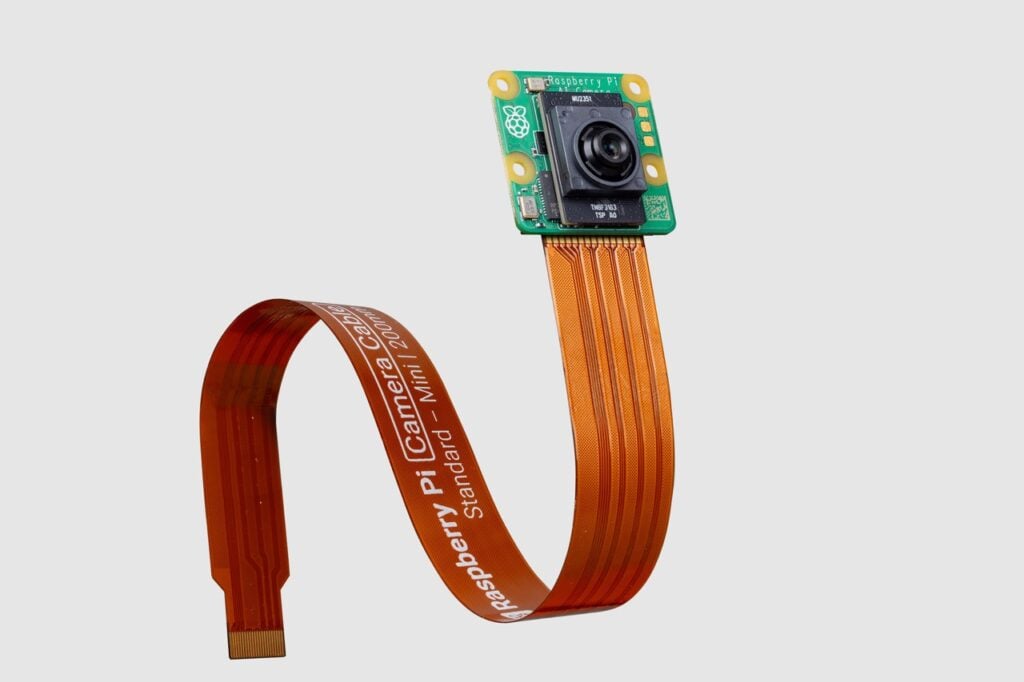
Raspberry Pi’s AI Camera is the kind of product that makes edge vision less theoretical and more buildable. Instead of asking a single-board computer to capture frames, run inference, and still manage the rest of a robot or lab project, the AI Camera moves part of that work onto the image sensor module itself.
The product is built around Sony’s IMX500 intelligent vision sensor, which combines a 12-megapixel image sensor with an integrated AI accelerator. Raspberry Pi’s launch notes list two sensor modes — 4056×3040 at 10fps and 2028×1520 at 30fps — plus a 78-degree field of view, manually adjustable focus, and an onboard RP2040 used for neural-network and firmware management.
Why this product matters
Most maker and classroom AI camera projects still have a familiar bottleneck: the camera captures the data, then the host board has to run the model. That works for demos, but it can become fragile when the same board is also handling motor control, networking, storage, UI, or robotics middleware.
The Raspberry Pi AI Camera changes that division of labor. Raspberry Pi says the module can run popular neural-network models with low power consumption and low latency while leaving the host Raspberry Pi processor free for other tasks. For robotics and STEM builders, that matters because the camera becomes less of a passive sensor and more of a front-end perception module.
Technical breakdown
The headline specification is the Sony IMX500 sensor. Unlike a conventional image sensor that only sends image data upstream, the IMX500 can run neural-network inference close to the pixel pipeline. Raspberry Pi’s documentation describes the inference output being sent back to the host alongside the image frame over the CSI-2 camera bus.
That integration is important. Raspberry Pi says the AI Camera works with its camera software stack, including libcamera, Picamera2, and rpicam-apps. In practical terms, builders do not have to treat the product like a completely separate accelerator board with a one-off capture path. The AI result and camera frame can be synchronized through the normal Raspberry Pi imaging flow.
- Sensor: Sony IMX500 Intelligent Vision Sensor
- Resolution: 12MP
- Modes: 4056×3040 at 10fps, 2028×1520 at 30fps
- Field of view: 78 degrees, manually adjustable focus
- On-module controller: RP2040 for neural-network and firmware management
- Host connection: Standard Raspberry Pi camera ribbon cable / CSI path
Where it fits in real projects
This is not a replacement for a high-end GPU workstation or a full robotics perception computer. It is better understood as a compact edge-perception module for constrained systems. Good candidate projects include:
- classroom object detection labs, where students need repeatable hardware instead of cloud inference;
- mobile robots that need basic visual classification without saturating the host CPU;
- inspection rigs that need simple pass/fail or object-presence inference near the camera;
- maker projects where a Raspberry Pi Zero or Raspberry Pi 5 needs camera AI without adding a larger accelerator stack.
The most useful angle is not raw TOPS bragging rights. It is system architecture: the camera can reduce host-side load and simplify the mechanical package compared with a separate camera plus accelerator board.
What builders should verify before buying
The product looks strong on paper, but teams should still validate the fit before designing around it. Model support is the first question. Raspberry Pi says models from frameworks such as TensorFlow or PyTorch can be converted using Sony’s AI tools, but conversion workflows are often where real projects slow down.
The second question is latency under the exact application. A demo object detector and a robotics control loop are not the same workload. Builders should test camera exposure, frame rate, model inference time, result synchronization, and how the host application handles missed or delayed frames.
The third question is optics and mounting. The 78-degree field of view is useful for many mobile and classroom projects, but inspection and tracking rigs may need a different working distance, lighting setup, or enclosure strategy.
TVG Take
The Raspberry Pi AI Camera is interesting because it is a real product with a clear engineering role: move useful perception closer to the sensor and keep the host board available for the rest of the system. For classrooms, robotics clubs, and builders who already know the Raspberry Pi camera ecosystem, that is more useful than another abstract AI demo.
TVG would treat this as a strong candidate for a hands-on review. The tests should focus on model-conversion friction, end-to-end latency, thermal behavior, classroom setup time, and whether synchronized image-plus-inference results are reliable enough for student robots and small automation rigs.