Bambu Lab’s A2L launch is not just another desktop 3D printer release. The engineering story is that larger build volumes, auto-calibration and workflow sensors are moving from enthusiast wish lists into the default checklist for practical maker machines.
What happened
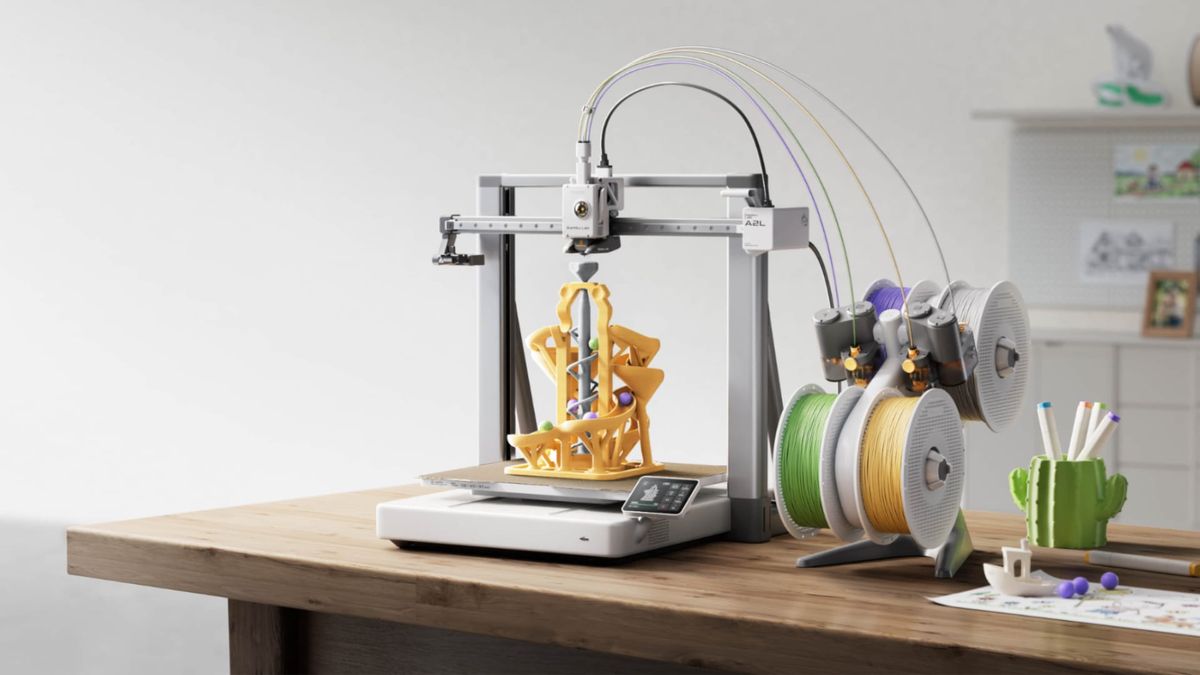
Bambu Lab announced the A2L on June 1, 2026, calling it a large-format A-Series printer for bigger creative projects. The company says the A2L has a 330 × 320 × 325 mm build volume, which it describes as 105% more print volume than standard 256 mm-class machines. Independent coverage from 3D Printing Industry lists the same build volume and reports additional workflow features including hands-free leveling and offset adjustment, multi-color printing support, blade cutting and pen plotting.
Why it matters
Build volume changes what a desktop printer is used for. Small machines are excellent for brackets, fixtures and miniatures, but larger printers reduce the need to split cosplay parts, home décor items and functional prototypes into multiple glued sections. That can save post-processing time and improve mechanical continuity, especially when a part’s strength depends on geometry rather than just material choice.
Technical breakdown
The A2L’s 330 × 320 × 325 mm envelope is the headline, but the workflow details may matter more over time. Auto-leveling and offset adjustment reduce setup friction, while runout, clog, spool-tangle, blob and extrusion-force detection, as reported in launch coverage, point toward a printer that tries to detect failure modes before they waste large prints. Multi-color and multi-material support also moves the machine closer to small-batch production workflows, where repeatability and operator time are as important as top speed.
Builder, STEM and industry impact
For makers, a larger affordable platform means fewer compromises when printing helmets, organizers, fixtures and classroom robot parts. For STEM labs, the relevant lesson is design-for-printing discipline: students can work on bigger assemblies, but they still need to understand orientation, supports, thermal warping and tolerance stackups. For print farms, the A2L signals that consumer desktop machines are continuing to absorb features once associated with more expensive prosumer systems.
Risks and unknowns
Large beds introduce their own problems. Bigger prints take longer, consume more filament and punish calibration errors more severely. Open-frame machines can also be less ideal for temperature-sensitive materials than enclosed systems. Buyers should wait for independent testing on noise, dimensional accuracy, first-layer consistency, failure detection and long-duration reliability before treating any launch spec as proof of production readiness.
TVG Take
The A2L is interesting because it competes on workflow, not just novelty. If the automation features hold up under real print-farm and classroom use, large-format desktop printing becomes less of a weekend gamble and more of a practical fabrication tool.