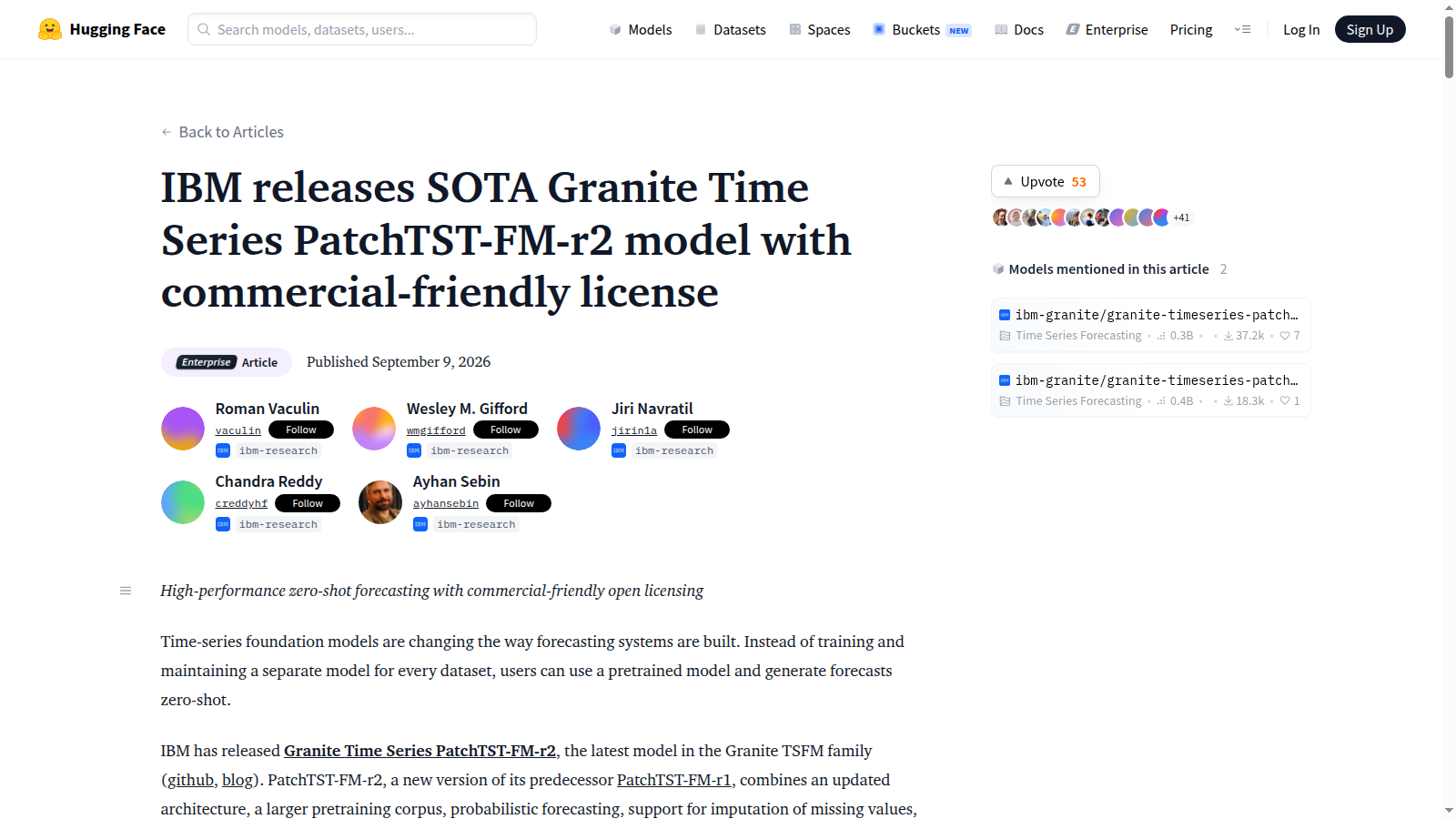
IBM released Granite Time Series PatchTST-FM-r2 on September 9 with a redesigned Conformer backbone, roughly 385 million parameters and dual Apache 2.0/OpenMDW 1.0 licensing. The practical change is not simply a higher benchmark position: engineers can evaluate one downloadable model on an unseen time series, request point and quantile forecasts, and inspect the training-data description before deciding whether task-specific training is necessary.
Featured image: official IBM Research announcement for Granite Time Series PatchTST-FM-r2. Image: IBM Research/Hugging Face.
R2 divides local and long-range temporal work
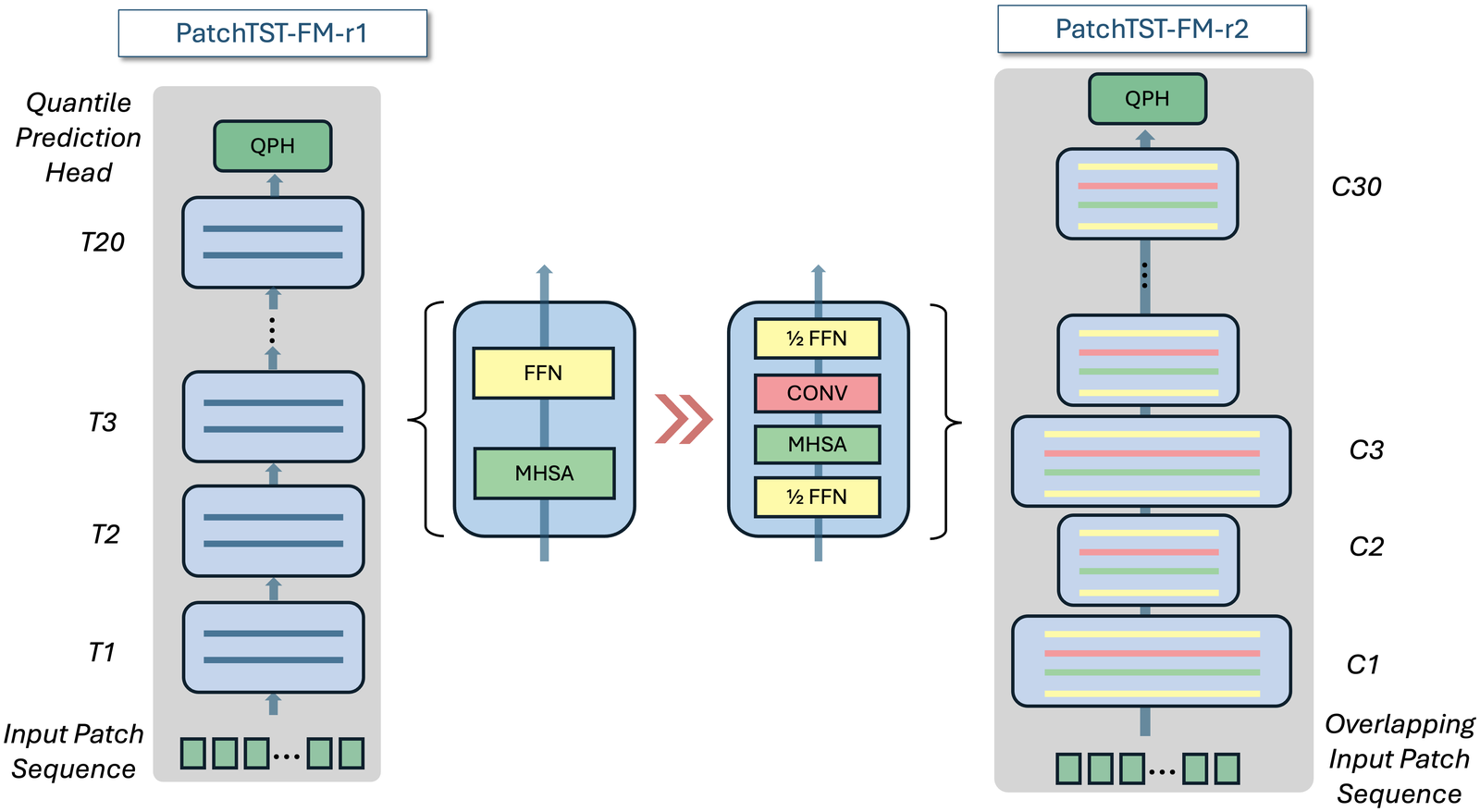
The PatchTST-FM-r2 model card replaces the earlier plain transformer blocks with Conformer blocks. Each block places multi-head self-attention and a temporal convolution between two half-step feed-forward layers. IBM says the convolution handles near-term relationships between patches, leaving attention more capacity for longer-range dependencies.
The backbone alternates convolution kernels in a repeating {5, 5, 3, 3} pattern and grows from 20 to 30 blocks. Input patches contain 16 time steps with a stride of eight, creating 50% overlap; Hamming-window weighting and overlap-and-add inference smooth the boundaries between predicted patches. Those details matter because r2 is not merely an r1 checkpoint with more data—the computation path and forecast stitching changed.
The model exposes 99 quantiles over an 8,192-step context
IBM specifies a hidden dimension of 1,024, a training context of 8,192 steps and a prediction head spanning 99 quantiles. Quantile output lets an application preserve forecast uncertainty instead of receiving only one point estimate. The published Python example installs granite-tsfm>=0.3.9, loads ibm-granite/granite-timeseries-patchtst-fm-r2, uses 512 historical hourly samples and asks for a 64-step forecast at quantiles 0.1, 0.5 and 0.9.
pip install "granite-tsfm>=0.3.9"

model = PatchTSTFMForPrediction.from_pretrained(
    "ibm-granite/granite-timeseries-patchtst-fm-r2"
)
That example is a starting point, not evidence that every industrial series will forecast well. Sampling interval, missing-data pattern, seasonality, horizon and the cost of asymmetric errors still have to match the deployment. A sensor-maintenance team may care more about the upper-risk quantile than median error; an inventory system may need calibration across multiple horizons.
The leaderboard claim has a reproducibility condition
IBM reports a geometric-mean CRPS of 0.467 and MASE of 0.6846 on GIFT-Eval when filtering for replicable, zero-shot models without test leakage. Lower is better for both measures, and r2 ranks second in that filtered set while IBM identifies it as the highest-ranked option there with a permissive commercial-friendly license.
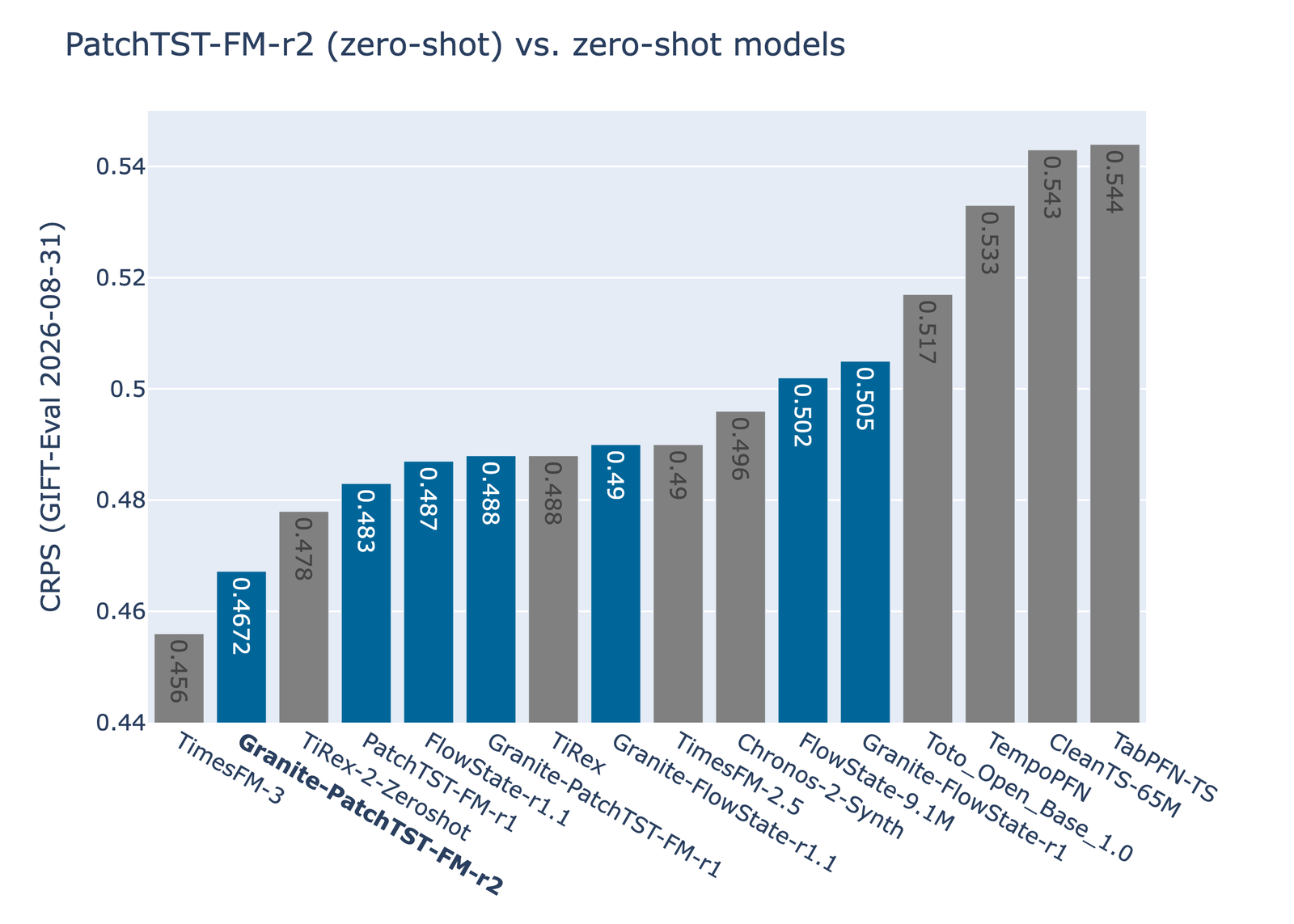
The model card also says the r2 result is in a pending pull request to the independently maintained GIFT-Eval repository. That qualification belongs beside the ranking: IBM publishes the filters and numbers needed to inspect the claim, but the benchmark project has not yet presented the submission as a settled mainline result.
Training disclosure narrows the evaluation question
The documented corpus combines selected GIFT-Eval pretraining datasets, KernelSynth-derived synthetic data, a TSMixup corpus restricted to datasets outside the GIFT-Eval evaluation set, and about 500,000 synthetic CauKer sequences of length 4,096. IBM’s September 9 technical release article also states that the implementation remains backward-compatible with r1 checkpoints.
For an engineering team, the next decision is therefore bounded: reproduce the public pipeline on held-out local history, compare quantile calibration and operational error costs against the current baseline, and verify memory and latency on the intended hardware. The release establishes a permissively licensed, inspectable candidate. It does not establish that the candidate will beat a specialized model on a particular plant, robot or energy dataset.