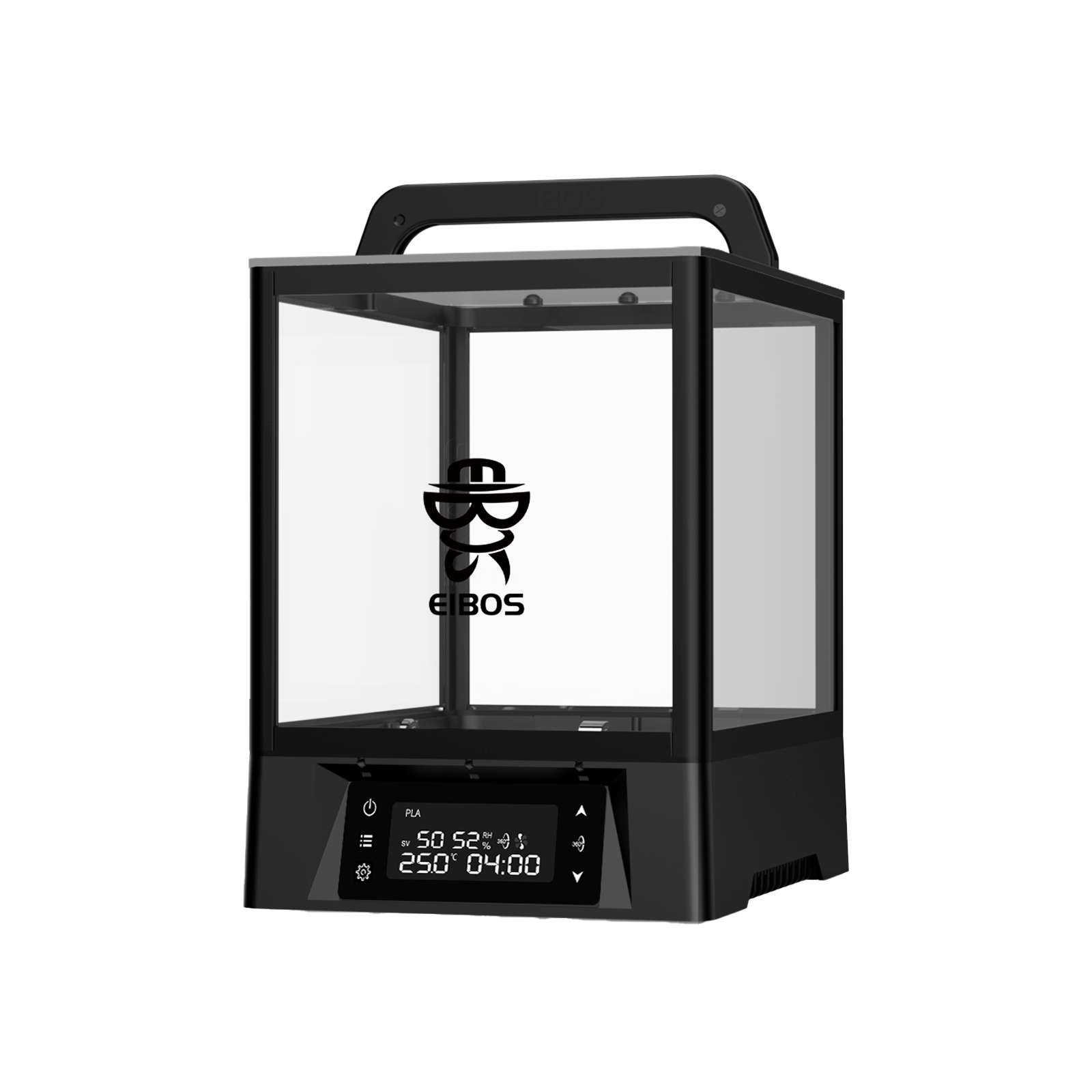
The EIBOS Polyphemus adds powered spool rotation to a 130W filament dryer that can hold two standard spools. EIBOS says the moving rollers and distributed hot-air outlets reduce the vertical temperature differences common in bottom-heated chambers. That is a credible engineering approach, but the official specifications alone do not establish how much moisture it removes or whether it produces better prints than a well-designed stationary dryer.
Evidence note: TVG has not tested the Polyphemus or received a review unit. This source-based analysis separates EIBOS’s documented specifications from manufacturer performance claims.
The 70°C and 80°C versions need careful identification
EIBOS’s current US storefront offers both 70°C and 80°C maximum-temperature variants. On September 9, 2026, the selected US 110V, 80°C configuration was listed in stock at $99.99, reduced from $149.99. Price, stock, plug type and warehouse availability can change, so buyers should confirm the exact selection shown in the cart.
The linked EIBOS manual documents a 30–70°C range, while the current retail specification for the 80°C model states 30–80°C at a 25°C ambient temperature. EIBOS does not clearly identify which manual revision applies to the 80°C hardware, so buyers should not merge the two ranges into one specification.
The decision-critical physical limits are clearer:
- Product size: 275 × 205 × 317mm; net weight: 2.2kg.
- Capacity: two spools up to 210 × 80mm each, or one spool up to 210 × 170mm.
- Optional expansion: one spool up to 250 × 170mm. The 3kg extension is not part of the standard factory configuration.
- Filament diameter: 1.75mm.
Rotation changes heat exposure, not filament moisture by itself
The Polyphemus turns its spools on powered rollers, exposing different parts of a large coil to the lower hot-air outlets instead of leaving one section continuously nearest the heat source. Rotation can be switched on or off independently.
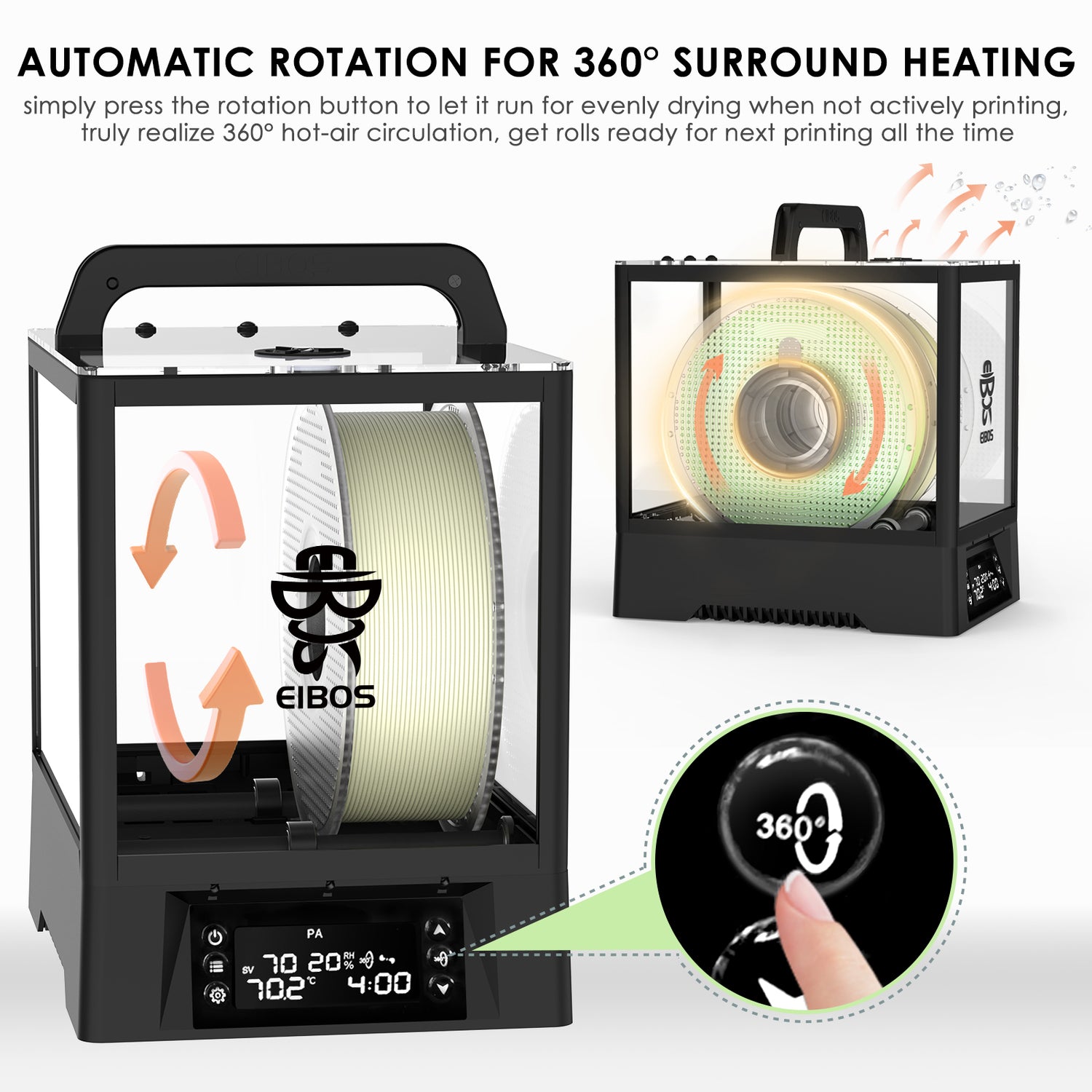
EIBOS claims rotating heat produces a 1°C directional temperature difference, compared with 36°C for “regular heating.” The checked product material does not provide the sensor positions, load, ambient conditions or complete test method behind that comparison. It is evidence of the design target, not independent proof of chamber uniformity.
The manual says temperature and humidity are measured at the sensor location. Warmer air can show lower relative humidity before the filament has released much water, so the display does not measure moisture inside the polymer. EIBOS’s roughly 200°C figure describes the PTC heater component under a stated condition—not the chamber temperature.
Airflow and venting support drying and storage modes
Multiple hot-air outlets distribute heat beneath the spools. EIBOS instructs users to open or adjust the top vent during drying so moist air can escape, then close it and use the silicone plugs and desiccant compartments during storage.
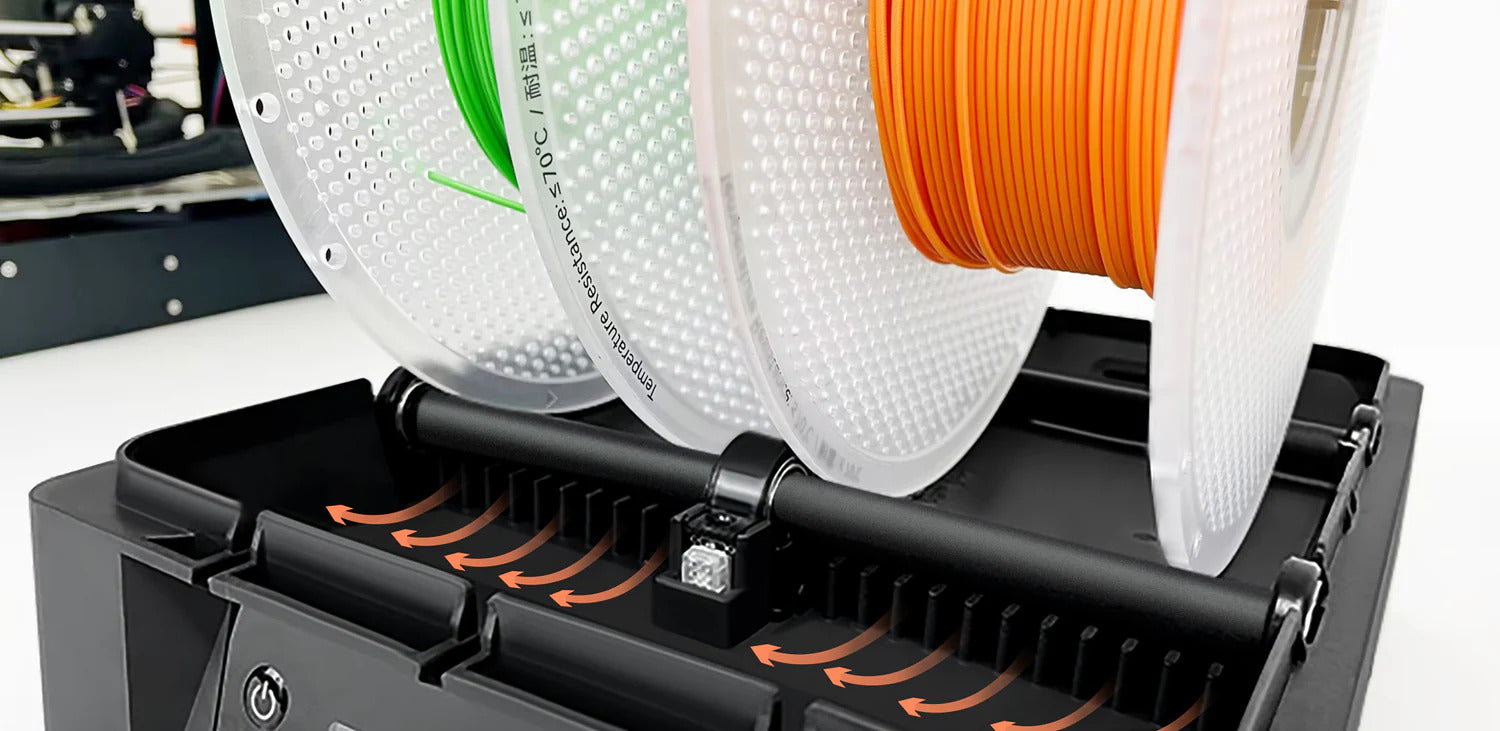
The controls provide nine material presets and three programmable memories. The timer runs from 30 minutes to 24 hours, with an always-on option. EIBOS calls the presets reference values, so the filament maker’s guidance and the spool’s heat tolerance take priority.
Filament can feed from the enclosure through directional outlets and an included PTFE tube. The storefront lists eight outer holes, while the manual specifically describes three directional printing outlets. Those phrases may count different openings, but the checked documentation does not reconcile them.
Who gains from the added mechanism
The strongest fit is a user who routinely conditions two 1.75mm spools, works with moisture-sensitive materials, or feeds a printer directly from a heated enclosure. A lab alternating among PETG, TPU, nylon and support material is more likely to use the capacity and programmable settings than an occasional PLA user.
The trade-off is another motorized subsystem. EIBOS calls the motor replaceable and claims a 1,500-hour lifespan, but its documentation does not establish noise, long-term roller behavior or feed resistance. One-spool users may be better served by a smaller, simpler dryer.
What the specifications support
The architecture is meaningfully different, but the documentation does not prove temperature accuracy throughout a loaded chamber, actual moisture removal or better print results. Choose it for its capacity and rotating mechanism, verify the exact 70°C or 80°C version, and do not treat the humidity display or EIBOS’s uniformity comparison as a measured drying verdict.
Sources
- EIBOS Polyphemus official store listing — current variants, price, dimensions, capacity and manufacturer claims.
- EIBOS Polyphemus product page — rotation, airflow, venting and control descriptions.
- EIBOS Polyphemus instruction manual — operation, presets, package contents and 70°C-version limits.
- EIBOS downloads — official 3kg extension files and instructions.