
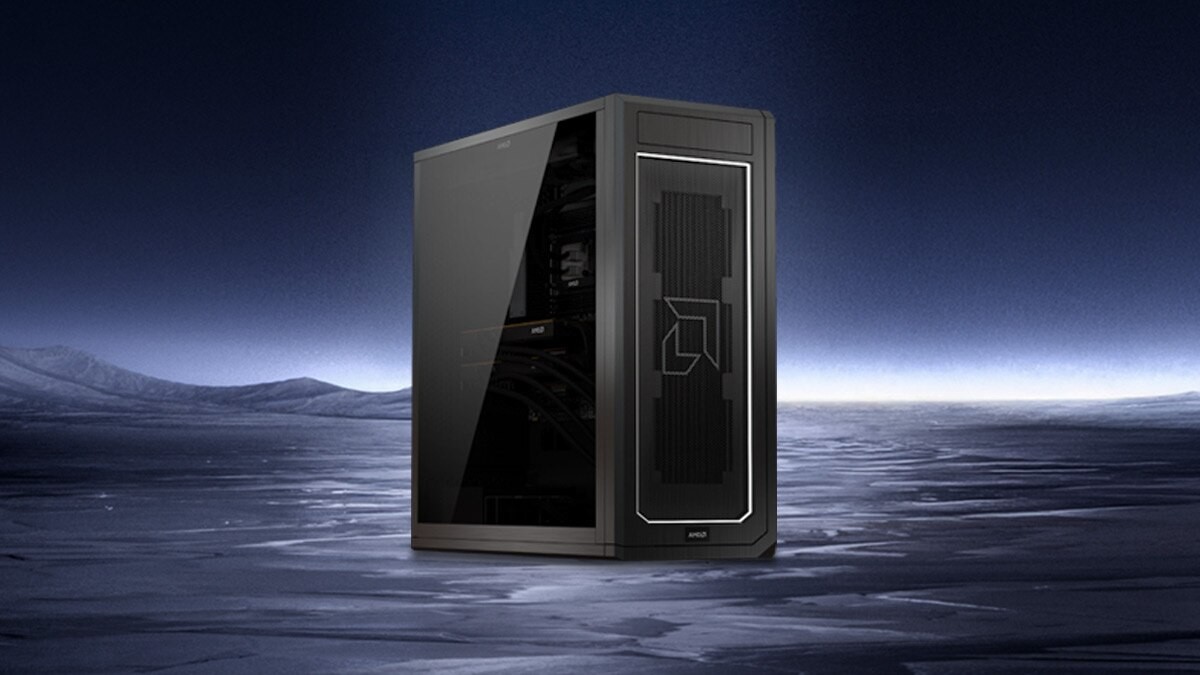
AMD has unveiled the Threadripper Halo Station, a prototype deskside AI workstation built around a 96-core Ryzen Threadripper PRO 9995WX and up to four Instinct MI350P accelerators. AMD says the top configuration combines 2 TB of DDR5 system memory with 576 GB of HBM3E. Pricing, launch timing and complete system specifications are not yet public.
The prototype starts with a 96-core workstation CPU
AMD showed the system at IFA 2026 and describes it as a liquid-cooled machine for training, fine-tuning and running large models locally. Its CPU is the Ryzen Threadripper PRO 9995WX: 96 Zen 5 cores, 192 threads, an eight-channel DDR5 RDIMM controller and a listed boost clock of up to 5.4 GHz.
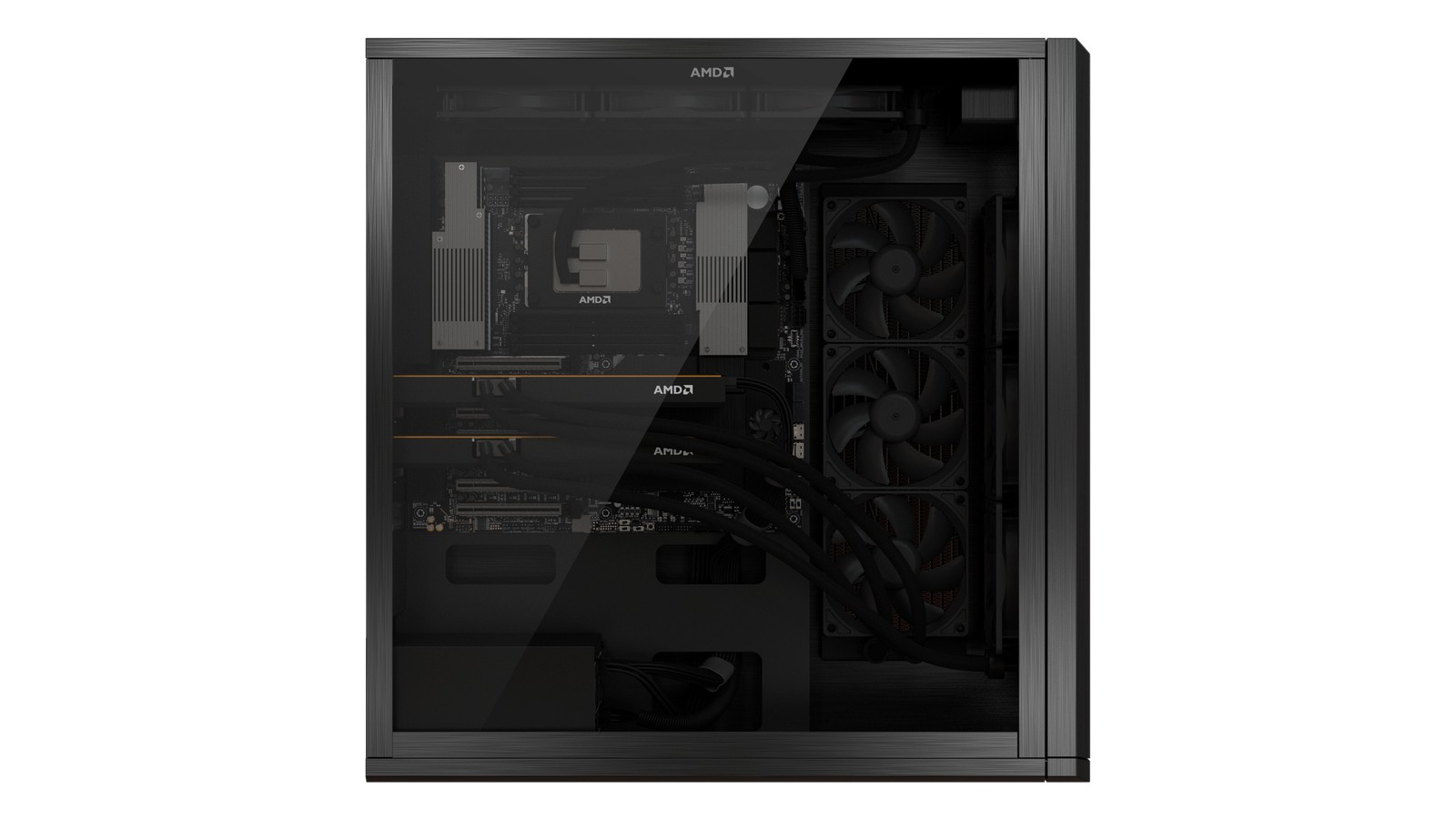
The accelerator side is modular. AMD’s own comparison notes specify four PCIe Instinct MI350P cards in the maximum configuration. Each card carries 144 GB of HBM3E and offers 4 TB/s of peak memory bandwidth, yielding 576 GB and 16 TB/s across four devices. TechPowerUp reports that the IFA display used two cards, or 288 GB of HBM3E.
“2.6 TB” combines two different memory pools
AMD promotes up to 2.6 TB of combined memory by adding 2 TB of RDIMM system memory to 576 GB of accelerator HBM3E. That is a useful capacity headline, but it should not be read as one uniform pool with one latency or bandwidth figure. The CPU memory and four discrete accelerator memories remain physically different resources, and software still has to place model weights, activations and data appropriately.
The distinction matters most for AMD’s claim that the station can handle models with more than one trillion parameters locally. Capacity may make a model loadable, but usable training or inference also depends on precision, interconnect traffic, framework support and the way a workload partitions across the four cards. AMD lists ROCm as the software platform but has not published workload-level results for this prototype.
Power and delivery remain the practical unknowns
Each MI350P has a maximum board power of 600 W, while the 9995WX has a 350 W default TDP. Four accelerators plus the CPU therefore total 2,750 W before memory, storage, pumps, fans and conversion losses. That arithmetic is not a wall-power measurement, but it explains why electrical service, heat rejection and acoustic design will be central deployment questions.
AMD calls Halo Station a prototype and has not announced pricing, final configurations or availability. The IFA machine confirms that AMD is packaging datacenter-class accelerators in a deskside form, not that a standard office outlet or ordinary workstation environment will suit the maximum configuration.
TVG Analysis
The most important part of Halo Station is not the “trillion-parameter” label. It is the decision to pair familiar x86 workstation memory with multiple high-bandwidth accelerator cards. That could suit teams whose datasets and preprocessing already live in a CPU-heavy workstation workflow. Until AMD publishes inter-GPU topology, measured wall power, acoustics, validated software stacks and shipment details, the system is best read as an architecture preview rather than a purchasable benchmark winner.
For a smaller local-AI option, see TVG’s Ryzen AI Halo agent-computer analysis.


My previous machine struggled with memory limitations and that specific configuration might not scale as well as the marketing suggests.