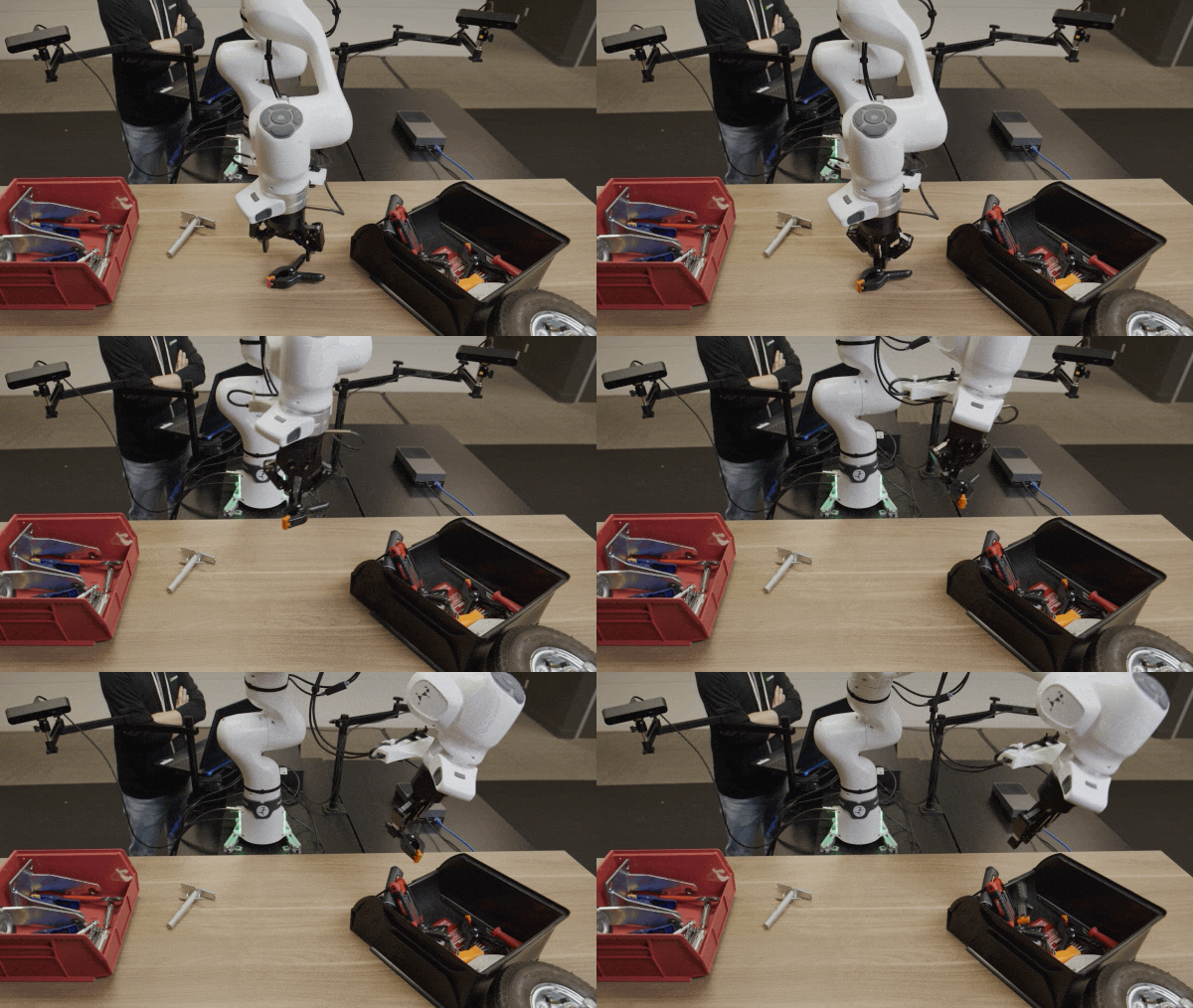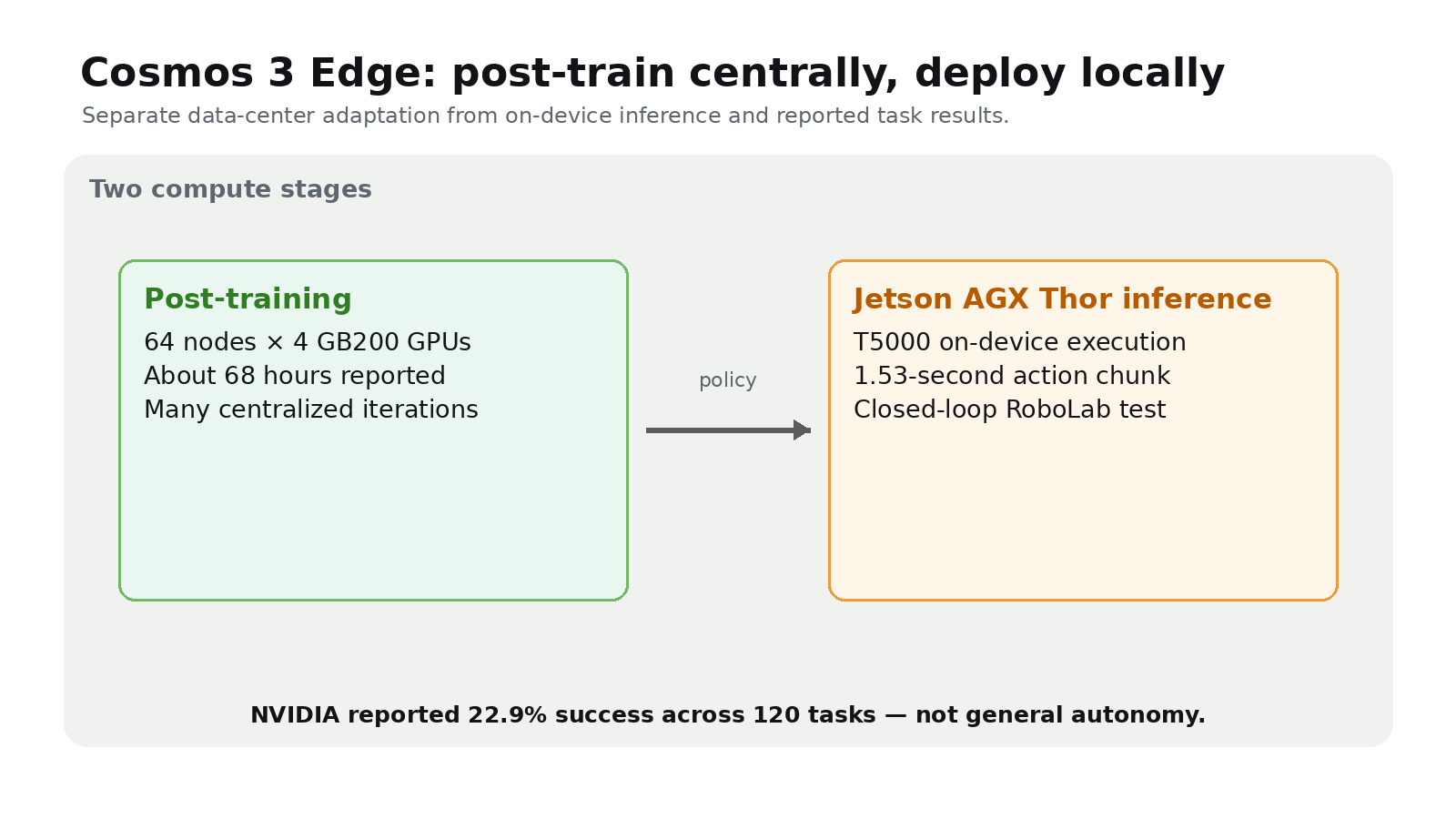
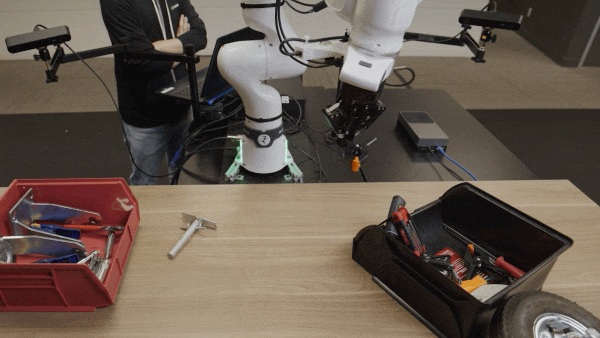
NVIDIA has published a developer guide on post-training Cosmos 3 Edge for on-device robot control, according to the company’s robotics technical blog. The post frames Cosmos 3 Edge as a way to adapt a world model into a robot policy that can run closer to the machine instead of depending only on remote inference or offline simulation.
For TVG readers, the news is less about one model name and more about the workflow NVIDIA is promoting: collect or synthesize robot-task data, adapt the model, validate behavior, and move more control logic onto the device where latency and network reliability matter.
Why it matters
Robot control is where AI hype meets motors, contact, safety limits, and recovery behavior. A policy that looks promising in a video still has to survive sensor noise, object variation, gripper slip, lighting changes, and the small delays that appear when compute is separated from the robot.

What NVIDIA is emphasizing
The NVIDIA post describes post-training Cosmos 3 Edge for robot manipulation and points developers toward adapting a pretrained model to a more specific task. That is a practical direction for teams that do not have the budget or data volume to train a robot-control stack from scratch.
- Start with a repeatable task, not a vague “general robot” goal.
- Track what data came from simulation, teleoperation, video, or real robot trials.
- Measure latency on the target edge device, not only in a workstation demo.
- Keep a fallback control mode for failed grasps, stalls, or unexpected contact.
TVG Analysis
The useful signal is that robot AI is moving from “can a model understand the scene?” toward “can the system close the loop near the machine?” That raises the bar for validation. Teams should expect model quality, edge compute, mechanical design, and safety recovery to be evaluated together rather than as separate demos.

What remains unknown
NVIDIA’s guide does not make every robot deployment simple. TVG will watch how developers report task success rates, hardware requirements, recovery behavior, and sim-to-real gaps as more teams try on-device policies outside controlled demos.
What teams should test first
The first useful test is not a full production task. It is a narrow manipulation scenario with clear success and failure states: pick an object, place it in a marked area, recover from a miss, and stop safely when the object is not where the model expects it to be. That gives developers a way to compare model changes without changing the entire robot cell.
Data provenance also matters. A dataset built from polished videos, synthetic scenes, and a small number of robot trials may teach useful priors, but it can hide contact failures that appear only on the real machine. Teams should record which examples came from simulation, which came from teleoperation, and which came from autonomous attempts.
Edge deployment is a systems problem
Running a policy on the device can reduce network dependence, but it also introduces thermal, power, memory, and update-management questions. A robot controller that throttles after 20 minutes, loses logs during a restart, or cannot roll back a policy update is not deployment-ready simply because inference happens locally.
- Latency: measure the full camera-to-action loop, not just model inference time.
- Thermals: run long enough to find throttling and fan-noise side effects.
- Recovery: define how the robot pauses, retries, or hands control back to a safe mode.
- Version control: preserve the policy, dataset, runtime, and robot firmware as one release record.
That kind of discipline is what separates a credible physical-AI pilot from a demo that cannot be repeated by a second operator.
Related TVG reading
- https://tvgreport.com/nvidia-physical-ai-models-robot-evaluation-training-loop/
- https://tvgreport.com/edge-ai-camera-latency-budget-robotics-builders/
For TVG, the publishing test is practical usefulness: can a builder, teacher, or small technical team use this information to make a safer, more reliable decision without pretending that the article is a hands-on review? That standard is why each checklist above focuses on observable behavior, source-backed constraints, and repeatable validation rather than brand excitement.