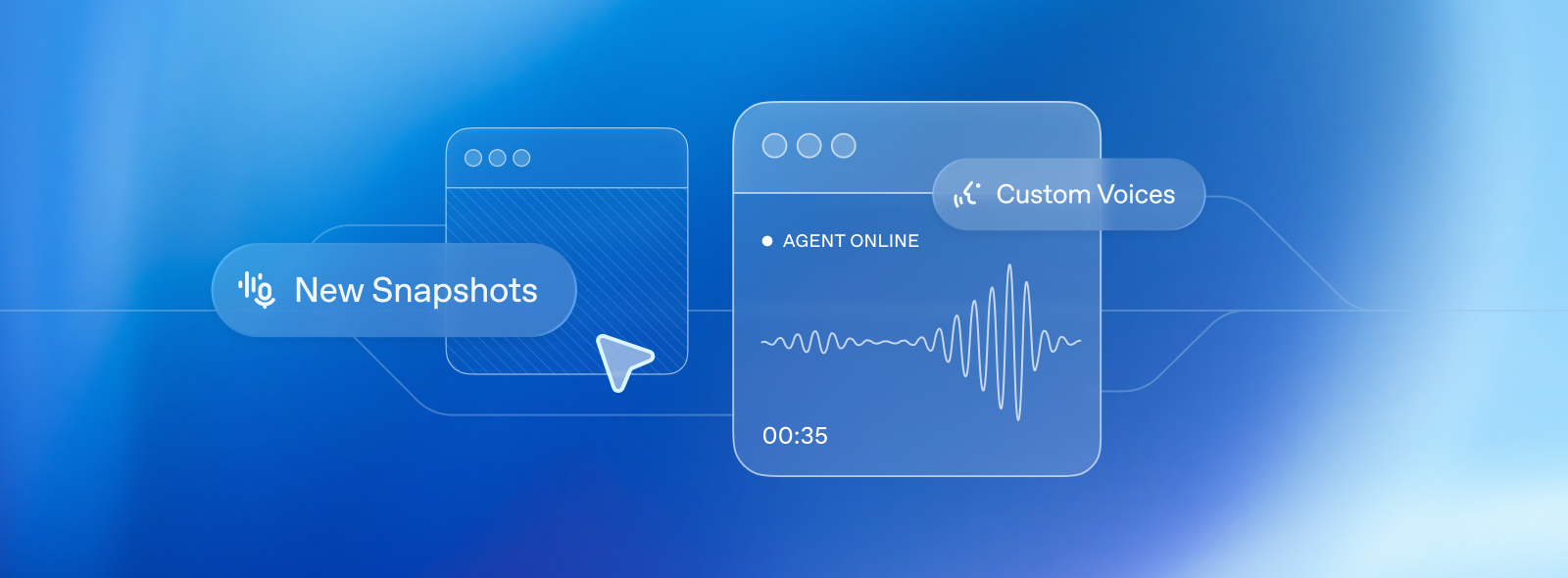
OpenAI is widening its voice-app toolkit with new audio model snapshots and broader access to Custom Voices, a move aimed less at novelty demos and more at production voice systems that have to behave predictably for real users.
The company described the update in its developer blog post, “Updates for developers building with voice”, where it says the changes are meant for voice agents, support systems, and branded voice experiences. OpenAI’s separate Realtime and audio guide frames the broader developer path for low-latency speech applications.
For TVG readers, the important part is not that another AI feature can speak. It is that voice is moving into workflows where latency, turn-taking, interruptions, consent, accessibility, and fallback behavior matter as much as raw model quality.
What OpenAI announced
OpenAI says the update includes new audio model snapshots and broader access to Custom Voices for production voice apps. In practical terms, that gives developers more options for tuning voice experiences around brand identity, speech quality, and application type without treating every voice interaction as a one-off experiment.
The company’s Realtime API documentation also points developers toward streaming interactions where speech input and speech output can happen with lower delay than a batch-style “record, upload, wait, play back” flow. That matters for agents that need to interrupt, clarify, or recover when a user changes direction mid-sentence.
OpenAI has been steadily packaging developer features around production use rather than single prompt calls. TVG covered that same theme in OpenAI’s GPT-5.1 developer update, where coding, reasoning, and debugging tools were the story. This voice update pushes a similar pattern into audio.
Why it matters
Voice apps fail differently from chat apps. A slow text response is annoying; a slow spoken response can break the conversation. A hallucinated sentence in a chat can be reread and corrected; a spoken mistake may pass before the user has time to inspect it.
That makes production readiness a wider checklist. Developers need to test latency under network variation, audio quality in noisy rooms, barge-in behavior, logging policy, voice disclosure, and escalation to text or human support. If a branded voice is used, teams also need rules for where that voice may appear and how it should behave when confidence is low.
The update also intersects with creator and audio workflows. TVG recently covered AI music labeling and royalty rules at TIDAL; voice apps raise a neighboring question: when synthetic audio becomes part of a product, how clearly should users be told what is generated, recorded, transformed, or branded?
What builders should watch
OpenAI’s announcement gives developers more building blocks, but it does not remove the need for system-level testing. Teams should treat voice as a real-time interface layer, not just another model endpoint with a microphone attached.
Useful tests include noisy-room transcription, overlapping speech, long calls, dropped connections, repeated wake-word or push-to-talk flows, and recovery after the model misunderstands a name, serial number, address, or technical term. For robotics labs, field-support teams, and education tools, those are not edge cases; they are normal operating conditions.
TVG Analysis
The practical signal is that voice AI is becoming a product-engineering problem again. The visible demo is the voice. The harder work is routing, safety limits, user consent, logs, latency budgets, and support playbooks.
OpenAI has not answered every operational question in one update, and developers still need to verify cost, uptime, privacy, and brand-safety behavior in their own applications. TVG will watch whether voice-agent teams begin publishing clearer benchmarks around latency, interruption handling, and failure recovery rather than only sample conversations.