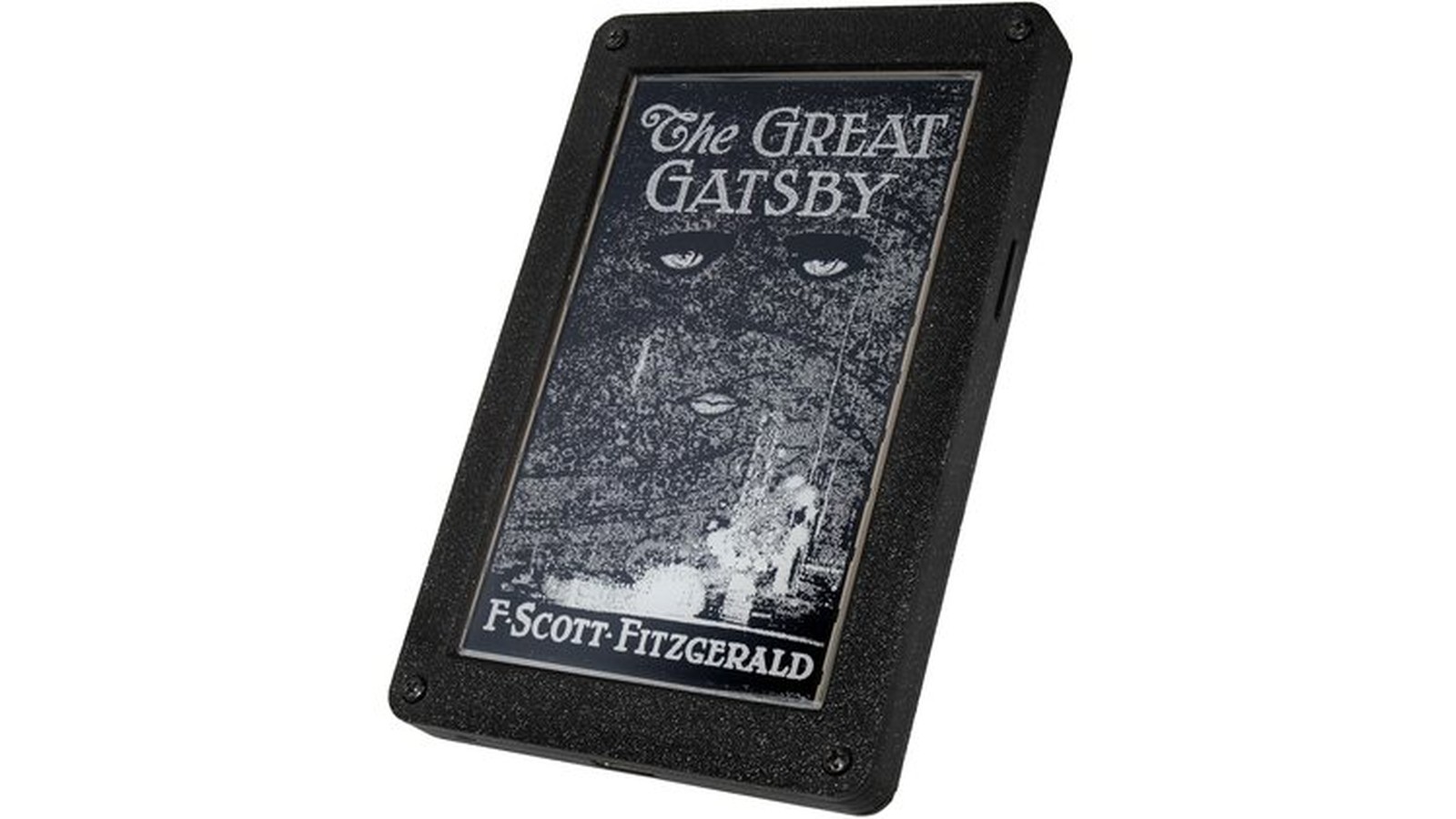
Open Book Touch is now live on Crowd Supply, bringing an open-source e-reader project back into the maker conversation with a small front-lit e-paper touchscreen, EPUB support, Wi-Fi for file transfer, and a design centered on hackability rather than app-store lock-in.
This is a project watch, not a review. TVG has not tested Open Book Touch, has not received a unit, and is not recommending that readers back it. Crowdfunding specs, pricing, delivery dates, software behavior, and final build quality can change before hardware ships.
Still, the project is worth tracking because it sits at a useful intersection for maker labs: e-paper displays, low-power embedded hardware, open-source firmware, classroom reading tools, and field manuals that do not depend on a bright tablet screen or a closed e-book ecosystem.
What the campaign says
The Crowd Supply campaign page describes Open Book Touch as a pocketable, front-lit, open-source e-reader. The page lists a 4.26-inch front-lit e-paper touchscreen, support for EPUB and TXT files, Wi-Fi mainly for getting books onto the device, and a one-centimeter-thin enclosure. At the time TVG checked the page, the campaign showed a $45,000 funding goal, a funding deadline in August 2026, and reward pricing in the $149 to $249 range.
The project update titled “Six Years in the Making, Open Book Touch Is Here” frames the device as the result of a long-running open-reader effort. Coverage from Hackaday and Liliputing points to the same maker-friendly appeal: a small e-reader that exposes hardware and software rather than hiding the whole device behind a sealed consumer appliance.
Why maker labs may care
Most labs already have tablets, laptops, and phones. The case for an e-paper device is different. E-paper works well for reading documentation, checklists, lab notes, wiring references, and field manuals without the glare, battery drain, and distraction of a full tablet. A small e-reader can sit next to a soldering station, 3D printer, robotics field, or camera bag as a quiet reference device.
An open-source e-reader adds another layer. Students and hobbyists can study the firmware, inspect the bill of materials, modify the reading experience, or use the device as an embedded-systems learning platform. That is more useful for a maker lab than a locked-down consumer e-reader that only teaches purchasing and account management.
Spec-readiness checklist
Before backing or standardizing on any crowdfunded e-reader, maker labs should verify:
- Display behavior: refresh rate, ghosting, front-light uniformity, and readability under classroom and outdoor lighting.
- File workflow: how EPUB, TXT, and future formats are loaded, organized, and updated.
- Open-source depth: whether hardware files, firmware, build instructions, and toolchains are complete enough for real modification.
- Battery and charging: charge connector, standby drain, runtime under front-light use, and replacement path.
- Repairability: enclosure access, screen replacement risk, battery availability, and common part sourcing.
- International text: font support, writing systems, and right-to-left or non-Latin rendering if the lab serves multilingual students.
- Long-term maintenance: who maintains firmware, how bugs are reported, and whether community forks are realistic.
Where it differs from a normal e-reader
The strongest reason to follow Open Book Touch is not that it competes with a mass-market Kindle or Kobo on store integration. It likely does not. The stronger reason is that it treats the e-reader as a small embedded device that can be understood, repaired, and modified.
That difference changes the evaluation standard. A normal e-reader is judged by bookstore access, battery life, polish, and customer support. A lab-oriented open reader is judged by whether students can learn from it: can they flash firmware, read schematics, replace parts, understand the display pipeline, and document changes without depending on a vendor-only repair path?
It also raises accessibility questions. A small e-paper screen can be excellent for distraction-free reading, but labs should verify font scaling, contrast, language support, and navigation before assigning it to students with different vision or reading needs.
That makes it more similar to other maker-lab tools than to a normal consumer gadget. The right comparison may be a Raspberry Pi accessory, a microcontroller board, or a classroom electronics kit: useful if the documentation, community, and repair path are strong; frustrating if software polish or supply-chain support lags behind the idea.
TVG recently looked at PocketMage as an e-paper PDA project watch. Open Book Touch sits nearby but with a more focused reading role. It also connects to TVG’s broader interest in practical field documentation, including portable monitor versus tablet workflows for robot dashboards.
Backer-risk notes
Crowdfunding hardware can miss deadlines, change components, alter enclosures, revise firmware scope, or ship with rough edges. A campaign page is not the same as a finished retail product. Labs should not plan curriculum, accessibility support, or event deployments around a crowdfunded device until units are in hand and tested.
For individual makers, the better question is whether the learning value justifies the risk. If the goal is a polished bookstore appliance, a mainstream e-reader is safer. If the goal is to study a low-power reading device, inspect open files, and possibly build classroom projects around e-paper, Open Book Touch is a project worth watching.
TVG Take
Open Book Touch is interesting because it makes the e-reader legible as engineering again. The TVG checklist is simple: verify the openness, verify the file workflow, verify repairability, and treat delivery dates as provisional. If those pieces hold, the device could become more than a reading gadget; it could be a compact e-paper platform for labs that care about documentation, low-power design, and student-visible hardware.

That’s a really clever design for a portable reader. I’m glad to see projects like this exploring open-source hardware options.