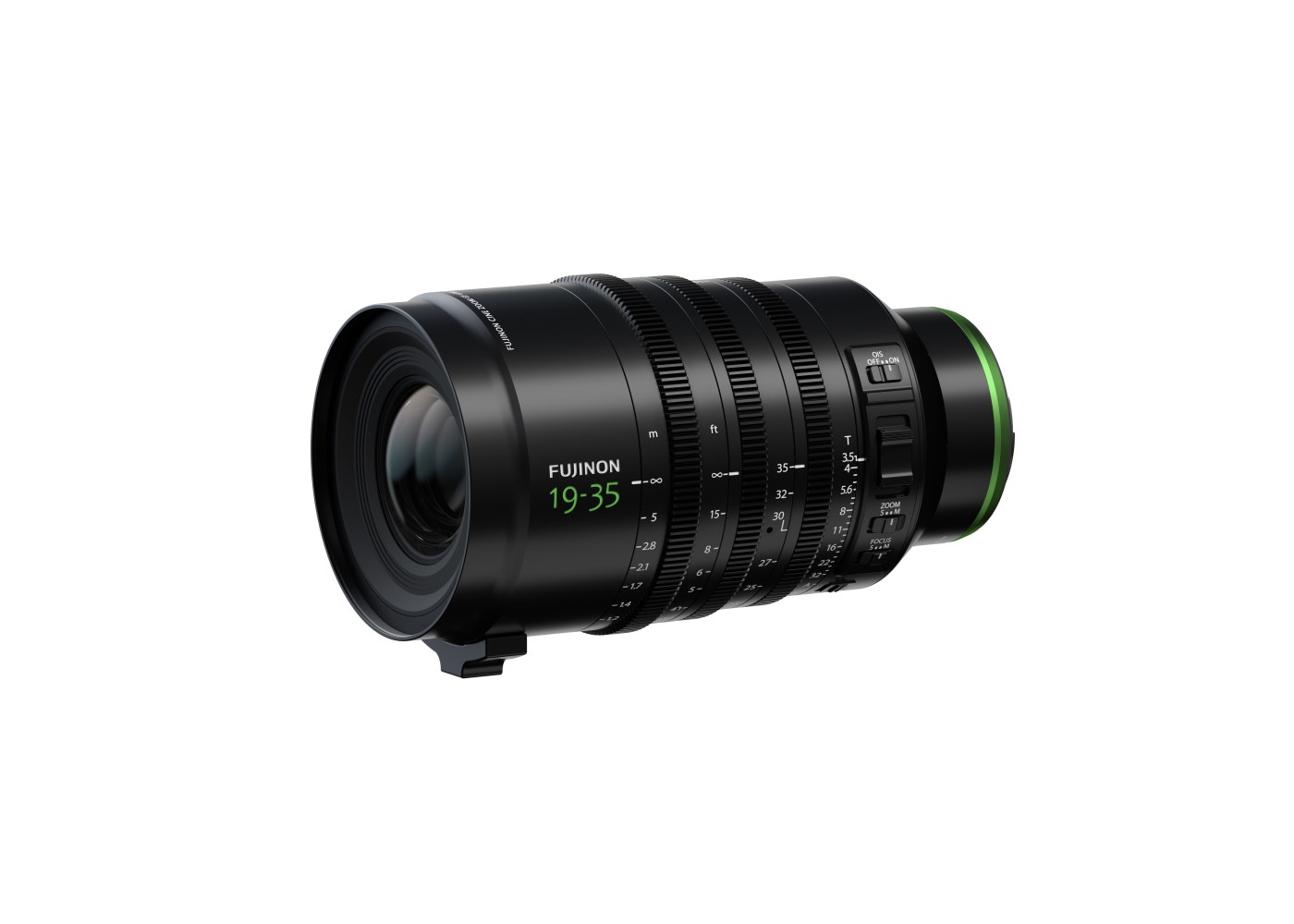
Fujifilm has announced the FUJINON GF19-35mmT3.5 PZ OIS WR, a wide cinema power zoom for its GFX system that is scheduled to be available July 23, 2026, at a manufacturer suggested retail price of $5,499.95 in the United States.
The lens is not a general consumer zoom. Fujifilm says it is the second FUJINON cinema power zoom lens for GFX, joining the GF32-90mmT3.5 PZ OIS WR. The company positions the new 19-35mm lens as the wide end of a two-lens large-format video kit, with a 35mm-equivalent range of 15-28mm.
For TVG’s creator and field-production lane, the useful part is the combination of wide coverage, constant T3.5 aperture, optical image stabilization, weather resistance, and power zoom control. Those features affect how a small crew plans motion shots, vehicle interiors, tight rooms, walkthroughs, robotics documentation, and lab demonstrations where backing up the camera is not always possible.
What Fujifilm announced
According to Fujifilm’s U.S. announcement, the GF19-35mmT3.5 PZ OIS WR uses 23 elements in 15 groups, including four ED elements and three aspherical elements. The company also lists a 13-blade iris, focus-breathing suppression, optical image stabilization, weather resistance, autofocus, auto iris, and servo/manual zoom operation.
The official Fujifilm Shop USA product page describes the lens as a 19-35mm zoom with a 15-28mm equivalent field of view and a constant T3.5 aperture through the zoom range. Fujifilm says the lens is designed to work naturally with the longer GF32-90mmT3.5 PZ OIS WR so crews can keep a more consistent rendering across ultra-wide and standard focal lengths.
Specialist camera sites have also treated the launch as a cinema-workflow story rather than a still-photo lens refresh. PetaPixel highlighted the wide large-format power-zoom angle, while DPReview noted that the lens gives the GF format its widest angle of view in this power-zoom class.
Why it matters for field production
A power zoom is not just a convenience feature. On a controlled set, it helps repeat a move. In a robotics lab, maker classroom, inspection bay, or crowded field demo, it can reduce the amount of physical rigging needed to change framing while a shot is underway.
The wide end matters for another reason: documentation often happens in cramped spaces. Robot-drive testing, fabrication benches, CNC enclosures, drone prep tables, and mobile lab carts leave limited camera room. A 15-28mm equivalent field of view can make the difference between capturing the whole workflow and stitching together a sequence of compromised close shots.
The tradeoff is system cost and workflow discipline. At $5,499.95, this is not a casual upgrade for a school media lab or a small creator team. It makes more sense where the GFX camera body is already part of the production stack and where repeatable zoom control, consistent color, and matched lenses are worth more than simply carrying a smaller hybrid-camera kit.
TVG Analysis
TVG would treat this as a field-production reliability story, not a spec trophy. The first tests should be zoom repeatability, breathing behavior during focus pulls, stabilization when mounted on shoulder rigs or vehicle mounts, and how the lens balances on the actual GFX body being used. The second set of tests should be less glamorous: filter workflow, rain/dust handling, power draw during servo zoom use, and whether the wide field creates edge distortion issues in technical documentation shots.
Recent TVG coverage of camera sensor sizes for creator and maker vision, field camera power workflows, and action camera storage specs all point to the same lesson: impressive capture hardware only helps if the surrounding workflow is planned. The GF19-35mm looks most valuable when wide framing, matched cinema controls, and large-format rendering solve a real production constraint.
What remains unknown is how the lens behaves in independent field use: stabilization quality while moving, focus consistency during long takes, serviceability after travel, and whether small crews find the size and price justified outside higher-end GFX productions. TVG will watch for real-world operator reports after the lens reaches production users.