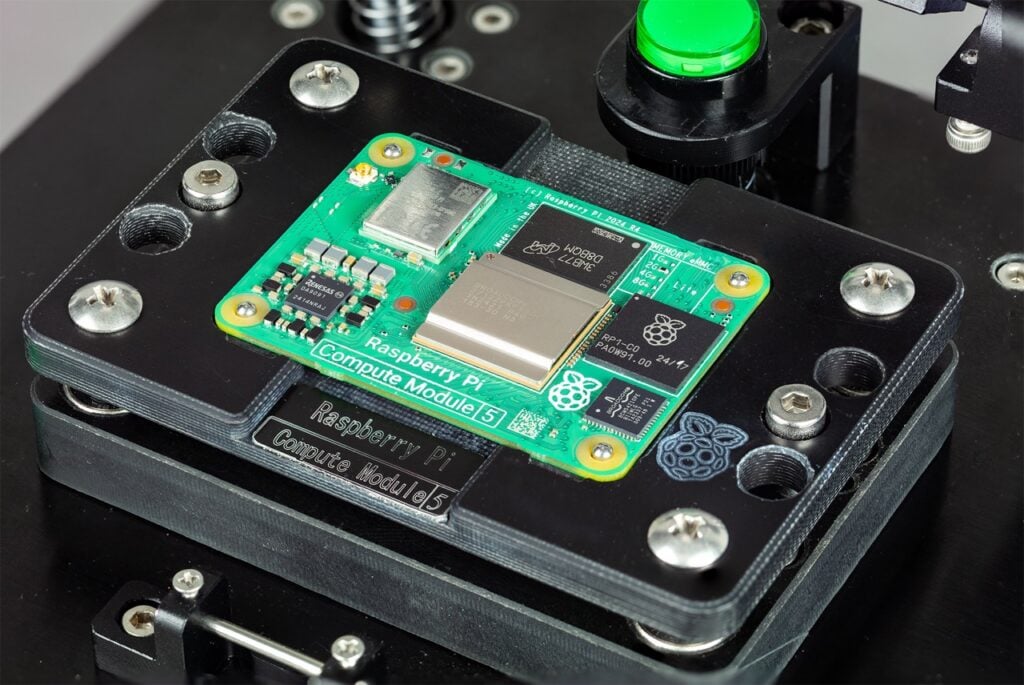
Raspberry Pi has released a major update to its secure-boot provisioning software that makes Raspberry Pi Connect easier to deploy across fleets of boards, a change aimed at organizations that need remote access without manually pairing every device one by one.
In a July Raspberry Pi blog post, engineer Gordon Hollingworth said version 2.3 of rpi-sb-provisioner now works with Raspberry Pi Connect for Organisations device identity support. The goal is to let provisioned devices receive an immutable identity and tie that identity to an organization account during the provisioning process.
The update matters because Raspberry Pi boards are no longer only hobby desktops. They show up in teaching labs, kiosks, camera boxes, lightweight industrial controllers, signage, research rigs, and remote maker-space equipment. In those settings, remote access is useful only if device identity, disk encryption, auditability, and lifecycle operations survive beyond the first image flash.
What Raspberry Pi changed
Raspberry Pi describes rpi-sb-provisioner as a system for provisioning operating-system images on devices with secure boot and full-disk encryption enabled. The company says the tool has grown from shell scripts into a system with a manufacturing database, audit log, and web UI.
The new version adds three practical pieces for fleet work. First, it integrates with Raspberry Pi Connect for Organisations so a device can be associated automatically rather than through a manual pairing step. Second, it brings image description provisioning from rpi-image-gen, which lets operators describe more complex partition layouts instead of relying only on a traditional Raspberry Pi OS image path. Third, it uses rpi-fw-crypto for asymmetric-cryptography operations tied to device-unique key material.
According to Raspberry Pi, that crypto work is used on the provisioning server to bind signing material to the server and on provisioned devices as part of full-disk-encryption key material. That is a narrower and more operationally specific claim than a generic “secure remote access” pitch.
Why it matters
For TVG readers, the important shift is from remote access as a convenience feature to remote access as a fleet-management workflow. A classroom with twenty Raspberry Pi 5 units, a city-sensor pilot with sealed boxes, or a robotics club with shared test rigs cannot depend on ad hoc passwords, undocumented images, or a single mentor’s browser session.
This also connects to the remote-lab patterns TVG has covered recently, including our ESP32-P4 IP-KVM remote lab story and our Wi-Fi 7 access point guide for maker spaces. Remote access fails in the real world when identity, network reliability, recovery, and ownership are treated as afterthoughts.
What remains unanswered
Raspberry Pi’s post points readers to bulk provisioning documentation and open-source software repositories, but it does not publish a complete independent security audit of every deployment pattern. Operators still need to test image rollback, account handoff, audit-log retention, device retirement, lost-device handling, and what happens when a board is moved between organizations.
For labs that already use Raspberry Pi Connect, the update is worth a close look. For teams starting fresh, the decision is less about whether remote access exists and more about whether the provisioning process can be repeated, documented, and recovered without heroics.
TVG Analysis
The useful part of this announcement is its boringness. Secure boot, full-disk encryption, device identity, audit logs, and repeatable imaging are not flashy features. They are the work that determines whether a Raspberry Pi fleet remains maintainable after the first demo day.
TVG will watch whether schools, small manufacturers, and maker labs publish field notes from real deployments. The next useful evidence will be less about launch wording and more about whether the provisioning flow reduces support tickets, avoids manual pairing mistakes, and makes shared-device ownership easier to prove.
What to watch next
For readers following this topic as an engineering problem, these related TVG Report pieces are the best next context:
- Secure AI Coding Agents Need a Deployment Risk Checklist
- Raspberry Pi 5 TOSLINK Project Turns USB Gadget Mode Into a Maker Audio Test
- FANUC’s Automate 2026 Physical AI Demos Put Robot Integration Under the Microscope