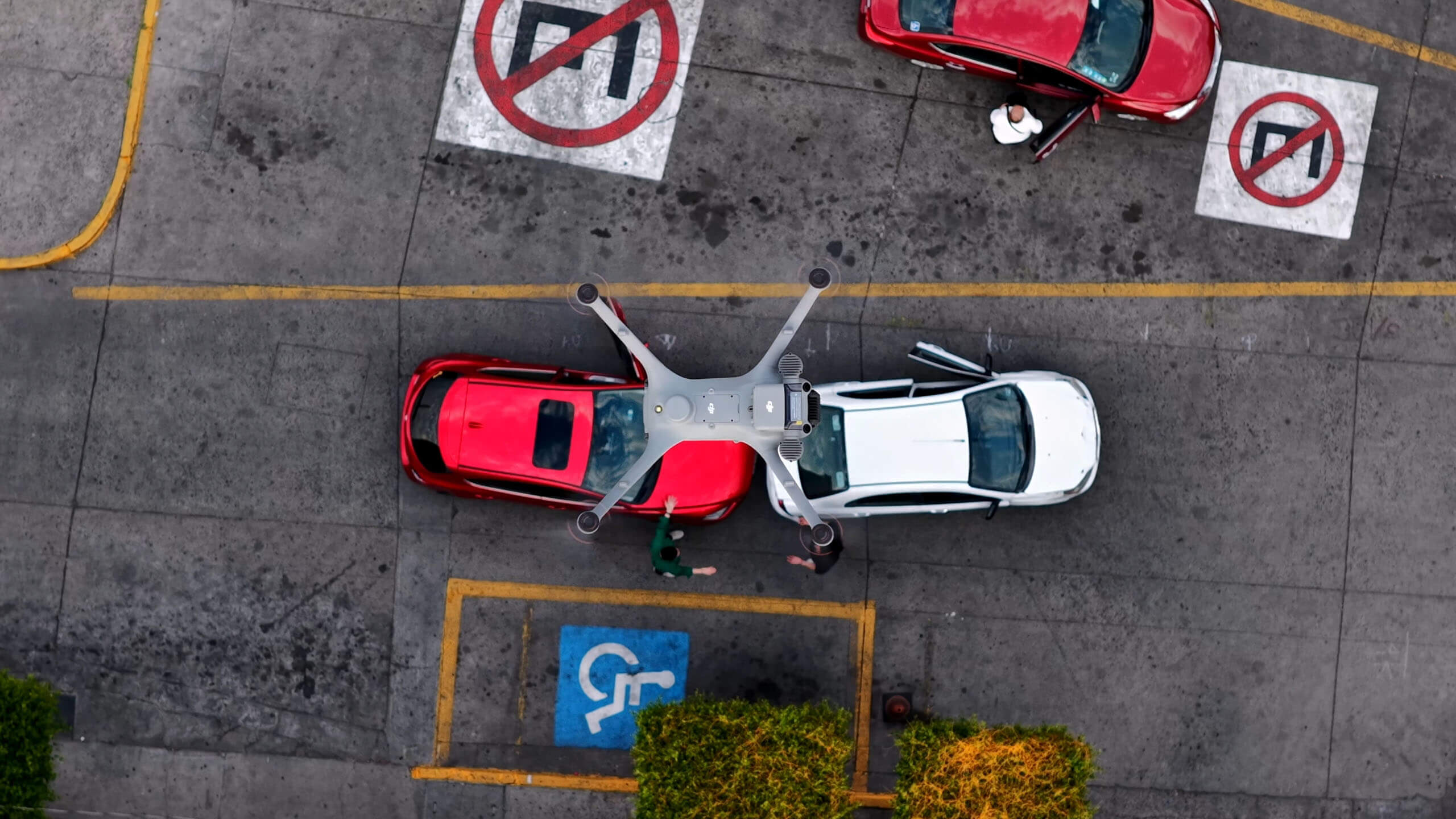
DJI has published a new Dock as First Responder white paper that explains how Dock 3 and FlightHub 2 fit into public-safety drone programs.
The document, titled “Dock as First Responder: Enterprise Deployment & Operations Guide”, focuses on more than the docked aircraft. DJI describes a DFR setup that includes dispatch tools, live video, event triggers, data handling, team structure, and compliance planning.
DJI’s public-safety page also presents Dock 3 and FlightHub 2 as part of a faster-response workflow for agencies that want aerial situational awareness before responders arrive on scene.
What DJI says
According to DJI, a pre-positioned Dock with FlightHub 2 Auto Dispatch can provide aerial situational awareness at a scene 1 km away in under 100 seconds.
The company notes that the figure was measured on a production model in a controlled environment, and that actual operation may vary.
DJI says the white paper covers DFR value analysis, system architecture, application scenarios and workflow, data security and compliance, internal data flow, and team structure. Those topics put the focus on the operating program around the drone, not only the aircraft or dock hardware.
FlightHub 2 is the control layer
DJI describes FlightHub 2 as the software layer for the workflow. The company lists Auto Dispatch, Event API, RTSP live streaming, and FlightHub Sync among the tools that can connect a docked drone to command-center operations.
That matters for public-safety and enterprise users because the video feed rarely lives in isolation.
A real-time crime center, emergency operations center, utility operations room, campus security desk, or private command trailer may all have different rules for who can view video, who can trigger a response, how long media is retained, and how the flight record is reviewed later.
Southern California is a difficult test case
Southern California is a useful example of why DFR deployments are not only about launch speed.
The region combines dense RF conditions, busy airspace, airports and heliports, coastal fog, inland heat, dust, hillsides, wildfire corridors, freeway networks, industrial sites, ports, campuses, and utility corridors. A docked aircraft that works cleanly in a controlled environment may face a very different set of constraints on a rooftop, public-safety facility, or canyon-adjacent site.
DJI’s materials do not claim one setup fits every location. Instead, the white paper points readers toward program design: where the dock sits, how video reaches decision-makers, what permissions are required, and how the system fits into existing operations.
Why it matters
Instead of treating drone first response as a faster-aircraft story, DJI’s latest DFR material shifts attention toward response automation and dispatch integration.
For agencies already evaluating remote drone operations, that could reduce the time between an incident report and aerial situational awareness. The open question is how often that workflow remains reliable outside controlled conditions.
Dock 3 still depends on the site
DJI lists Dock 3 as IP56 and rated for operation from -30° to 50° C. Those specifications are useful for outdoor deployments, but local conditions still decide how much work is required before a program can scale.
Coastal sites may bring marine layer and corrosion concerns. Inland and desert locations add heat, dust, and wind exposure. Hillside or wildfire-adjacent locations add line-of-sight, backup power, access, and coordination questions.
TVG previously covered DJI’s O4 Ground Station as a link-planning issue around fixed drone sites. The same broader point applies here: a docked drone program depends on aircraft, software, connectivity, location, and operating rules working together.
Deployment evidence matters more than launch speed
The strongest part of DJI’s white paper is that it treats DFR as an operations program rather than a single product category. That is the right direction for public safety, where launch speed is only useful if the right people receive the right information quickly enough to act.
The next proof point will come from deployments, not product pages. Mission completion rates, uptime, video-routing reliability, operator workload, weather interruptions, network performance, and data-retention practices will say more about DFR maturity than a controlled launch-time figure.
What remains unknown
DJI has not published a public benchmark that shows how Dock 3 and FlightHub 2 perform across every Southern California operating environment.
Additional deployment data will matter as agencies, utilities, campuses and private security teams evaluate dock-based DFR under evolving regulations and local operating rules. Mission completion, uptime, operator workload, weather interruption and data-governance records are the evidence needed to judge maturity.
Sources
- DJI: Dock as First Responder: Enterprise Deployment & Operations Guide
- DJI Enterprise: Dock as First Responder
- TVG Report: DJI O4 Ground Station Makes Drone Links a Field Reliability Question