Camera sensor size is one of the easiest specs to oversimplify. Bigger sensors can gather more light, offer more control over depth of field, and support cleaner images in difficult conditions. Smaller sensors can make lenses lighter, reduce cost, simplify mounting, and keep action cameras, drones, robot vision modules, and field kits compact. For robotics teams and creator crews, the right question is not “full frame or nothing?” It is “what failure are we trying to avoid in the field?”
This guide is for teams documenting robots, maker projects, school competitions, drone tests, field repairs, and product-review workflows. It connects camera sensor size to practical engineering decisions: lens availability, low-light behavior, rolling-shutter risk, storage rate, mounting, stabilization, and repeatable documentation.
The durable search question
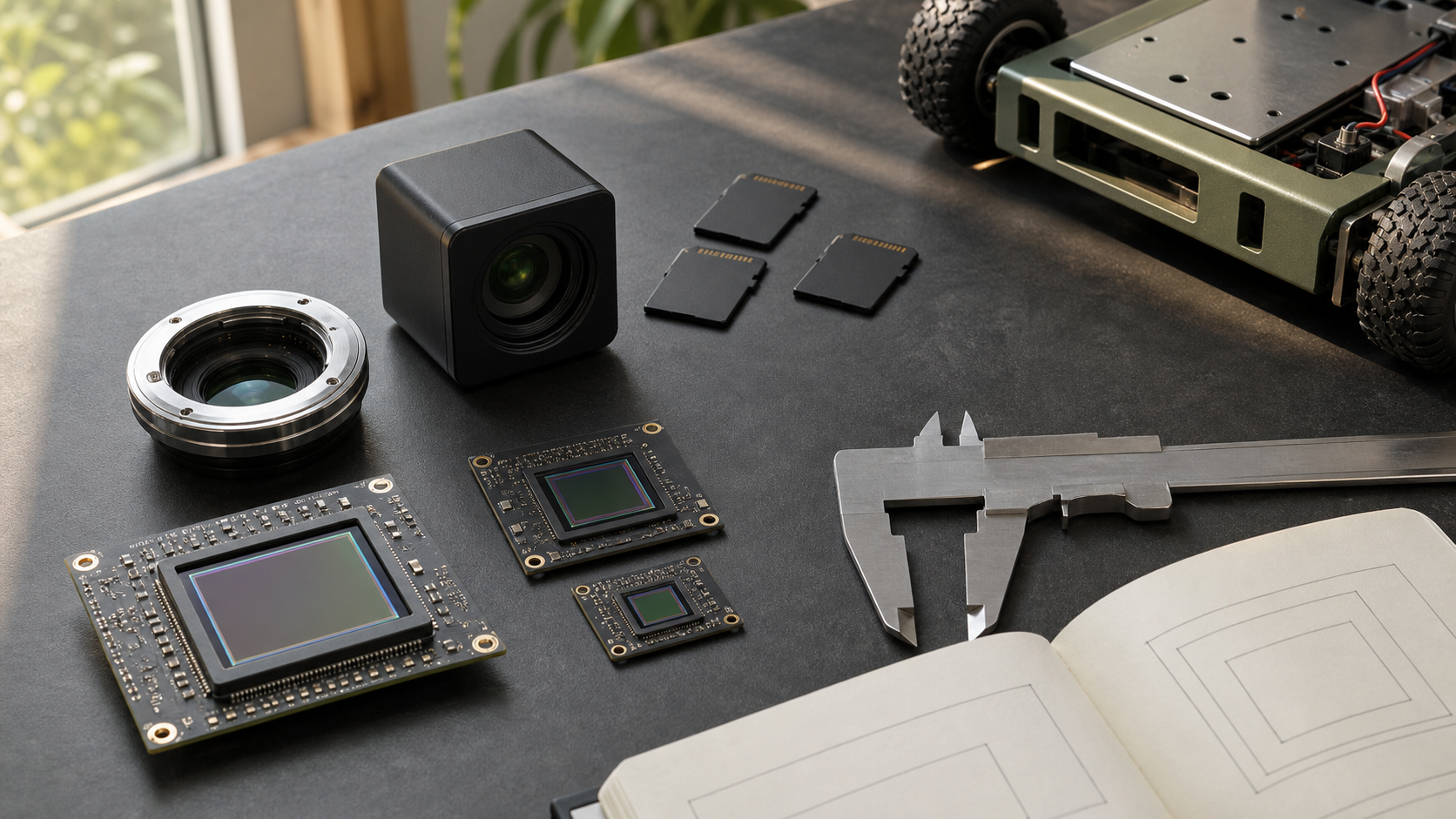
People often search for “camera sensor size explained” because sensor format names are confusing. Full frame is roughly based on a 36 mm by 24 mm still-photo frame. APS-C and Micro Four Thirds are smaller. Action cameras, phones, webcams, board cameras, and many robot-vision modules use still smaller sensors. Nikon’s explanation of DX and FX formats is useful because it ties smaller sensors to crop factor and lens field of view. Canon’s manuals similarly describe crop modes around an approximately 1.6x APS-C-style crop on full-frame bodies.
For TVG’s lane, crop factor matters because a robot or field team usually cares about coverage. A smaller sensor sees a narrower field of view with the same lens. That can be helpful for distant subjects but painful in a cramped pit, classroom, hallway, workshop, or inspection lane.
1. Field of view beats sensor prestige
A robotics team filming a test run needs to see the robot, the obstacle, and the human operating area. A drone team documenting a roof inspection needs enough context to prove where a close-up came from. A maker lab recording a 3D printer failure needs the nozzle, part, and motion path. In those cases, field of view and lens choice can matter more than sensor size alone.
Large sensors require lenses that cover a larger image circle. Those lenses can be larger and more expensive. Smaller sensors can use compact wide lenses, which is why action cameras remain useful even when their image quality is not cinema-grade. TVG recently covered action-camera stabilization specs for robotics teams; sensor format is part of the same decision. Stabilization, lens width, and mounting often decide whether footage is usable.
2. Low light is about the whole optical chain
Larger sensors tend to have an advantage when the lens, exposure, and resolution choices are comparable. They can collect more total light for the same framing and depth-of-field target. But teams should avoid treating sensor size as magic. A slow lens, poor exposure, aggressive compression, dirty protective cover, or dim workspace can erase the advantage.
For field documentation, the test is simple: record the actual environment. Try a workshop at night, a gym competition field, a shaded outdoor test, and a bright parking lot. Then check noise, motion blur, and whether the autofocus or fixed-focus setup misses the important subject. A smaller sensor with a fast, wide, well-mounted lens may beat a larger sensor that is hard to place.
3. Depth of field can help or hurt
Creator-camera discussions often praise shallow depth of field. For documentation, shallow focus can be a liability. If a robot arm, 3D printer nozzle, or drone payload moves through depth, a thin focus plane may hide the failure. Smaller sensors and wider lenses naturally offer more depth of field for the same framing, which can be good for unattended recording.
That is why board cameras, action cameras, and small-sensor inspection cameras remain practical. They may not produce the prettiest background blur, but they can keep the whole work area legible. When the goal is evidence, repeatability, or training footage, clarity beats cinematic separation.
4. Storage and heat scale with resolution choices
Sensor size does not automatically determine file size, but the cameras built around larger sensors often encourage higher bit rates, raw formats, and heavier codecs. That affects storage cards, offload time, batteries, and heat. TVG’s recent microSD vs portable SSD field-camera guide is the companion decision: capture quality is only useful if the team can move, back up, and review the files without losing data.
For school teams and small labs, the workflow should be boring: labeled cards, redundant copy, standard folder names, and enough compression to finish the event. A huge sensor and high-bit-rate codec can make beautiful files that no one has time to review.
5. Robot vision is not the same as documentation
Robot perception cameras have different requirements from documentation cameras. A robot may need global shutter behavior, synchronized capture, known lens distortion, low latency, fixed exposure, or infrared response. A documentation camera needs readable footage for people. Mixing the two roles is possible, but it creates compromises.
If a camera is part of the robot’s control loop, prioritize the perception requirements. If it is for documentation, prioritize mounting, power, storage, stabilization, and review speed. Do not pay for a large creative sensor when the robot actually needs deterministic timing or a rugged enclosure.
Practical buying checklist
- What must be visible? Whole field, mechanism detail, operator station, printed part surface, or inspection target?
- How close can the camera be mounted? Small rooms and robot pits often need wider lenses more than larger sensors.
- What light is normal? Test under real competition, workshop, or outdoor conditions before buying multiples.
- Will the camera run unattended? If yes, avoid fragile focus setups and overheating modes.
- How will files be backed up? Match sensor and codec ambition to the team’s storage workflow.
- Is the camera documenting or controlling? Documentation tolerates latency; control systems may not.
TVG Take
Sensor size matters, but it is not a trophy spec. For robotics and creator field work, the best camera is the one that captures the evidence the team needs, survives the mount, keeps enough of the scene in focus, and produces files the team can actually review. Bigger sensors are valuable when low light, lens control, or image quality is the bottleneck. Smaller sensors are valuable when mounting, depth of field, cost, and repeatability are the bottleneck. Treat sensor format as one line in the engineering trade study, not the whole decision.