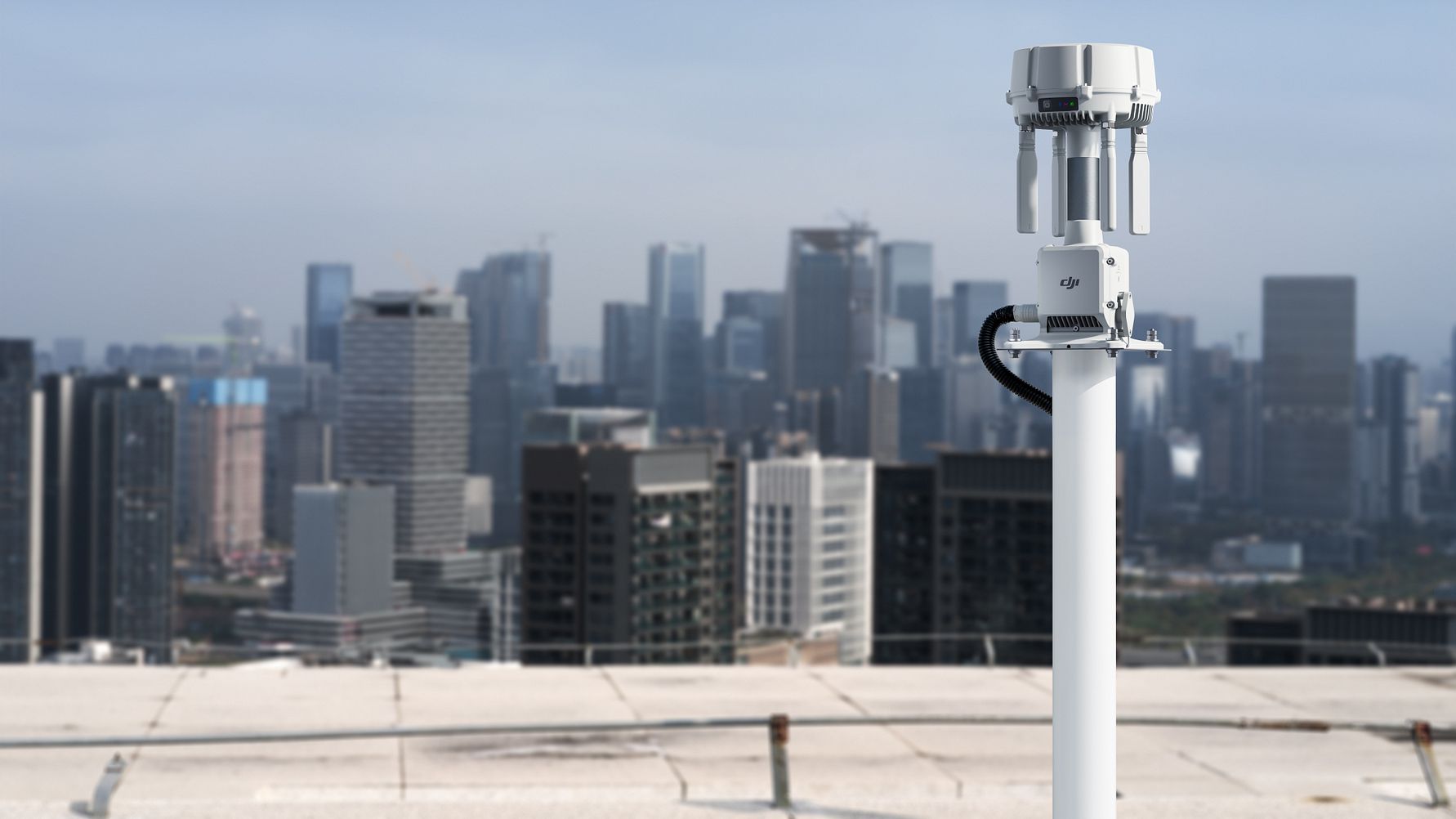
DJI has launched the O4 Ground Station, a wide-area transmission system for enterprise drones that is aimed less at casual piloting and more at the hard part of remote operations: keeping the control, video, and positioning links usable when buildings, trees, distance, or RF congestion get in the way. DJI’s newsroom says the system uses a 12-antenna array, automatic multi-band selection, and direct integration with FlightHub 2 for enterprise and dock-based deployments.
That matters because drone programs are increasingly judged by repeatability rather than by demo footage. A site inspection, public-safety search route, utility corridor survey, or delivery corridor only works if the communications plan survives real terrain. DJI describes the O4 Ground Station as compatible with recent DJI docks, enterprise drones, and delivery platforms, with Gateway Mode for FlightHub 2 and Relay Mode for offline or obstructed environments. DroneDJ’s coverage of the launch also points to the same practical pain point: operators want fewer dead zones and fewer surprises when a mission leaves a clean open field.
For TVG readers, the engineering issue is not simply “more range.” It is link budget, antenna placement, fallback behavior, and how much operational awareness the system gives a pilot or remote operations team before a mission fails. DJI says the RF unit is designed for higher output, better penetration through dense urban obstructions, and automatic shifting across sub-2 GHz, 2.4 GHz, 5.2 GHz, 5.8 GHz, and other bands when interference changes. That is the kind of feature list buyers should translate into test cases, not marketing copy.
What the O4 Ground Station changes for drone teams
DJI says the unit connects to FlightHub 2 for low-latency video feeds and, when paired with DJI Dock 3, can extend coverage up to 30 km in controlled conditions. It can also generate a Signal Map to help operators identify weak coverage zones and place ground stations more deliberately. That turns communications planning into something closer to a measured deployment task: place hardware, verify signal, log weak zones, adjust routes, and repeat.
That workflow is relevant beyond DJI’s own ecosystem. Robotics teams and field-documentation groups already think in terms of sensor coverage, battery planning, and line-of-sight constraints. The same thinking applies here. A drone link that works from a parking lot may not work behind a warehouse, under wet canopy, near metal structures, or in a congested event environment. TVG’s recent drone-versus-action-camera buyer evaluation made a similar point: the right capture tool is the one that survives the field conditions, not the one with the flashiest spec. The same field-readiness filter also applies to action camera specs for robotics and field teams, where stabilization, heat, mounting, and battery behavior matter more than headline resolution.
Technical tradeoffs to verify
The headline specs are useful, but buyers should still ask for deployment evidence. First, test how the ground station behaves when a link degrades gradually rather than fails cleanly. Second, verify whether the automatic band switching creates any latency spikes in the video feed. Third, document how Relay Mode affects mission planning when the station is placed on a high point and multiple remote controllers connect sequentially. Fourth, confirm regional availability and feature support, because DJI notes that some functions depend on drone model and country.
The outdoor hardware details are also worth reading carefully. DJI lists IP67 dust and water resistance, a -40°C to 55°C operating range, passive cooling, self-recovery behavior, and grounding design intended to reduce lightning-damage risk. Those are relevant to unattended dock operations, but they do not replace site engineering. Cabling, mounting height, grounding, power backup, and maintenance access still decide whether a system is reliable at 2 p.m. in a heat wave or 3 a.m. after rain.
Risks and unknowns
The biggest unknown is independent field validation. DJI’s figures are measured with production hardware in controlled environments, according to the company’s own notes. That is normal for a launch, but enterprise buyers should treat it as a starting point. Coverage maps, interference logs, and pilot reports across urban, industrial, and wooded sites will matter more than a single range number.
There is also a platform-lock question. Tight FlightHub 2 and Dock integration may be a strength for organizations already standardized on DJI Enterprise gear, but it is less attractive for mixed fleets unless integration boundaries are clear. Teams should ask what telemetry, Remote ID, ADS-B receiver data, and signal-map outputs can be exported or audited. DJI says the station can connect to third-party Remote ID or ADS-B receivers through MQTT, which is a useful opening for broader airspace awareness if documented well.
Engineering Takeaway
O4 Ground Station is best understood as communications stack, not an accessory. If the product performs as described, it could make docked and enterprise drone programs more predictable in difficult RF environments. The smart buyer move is to test it like a network deployment: map coverage, induce interference, measure latency, verify failover behavior, and document whether the claimed ruggedness survives the actual installation site.