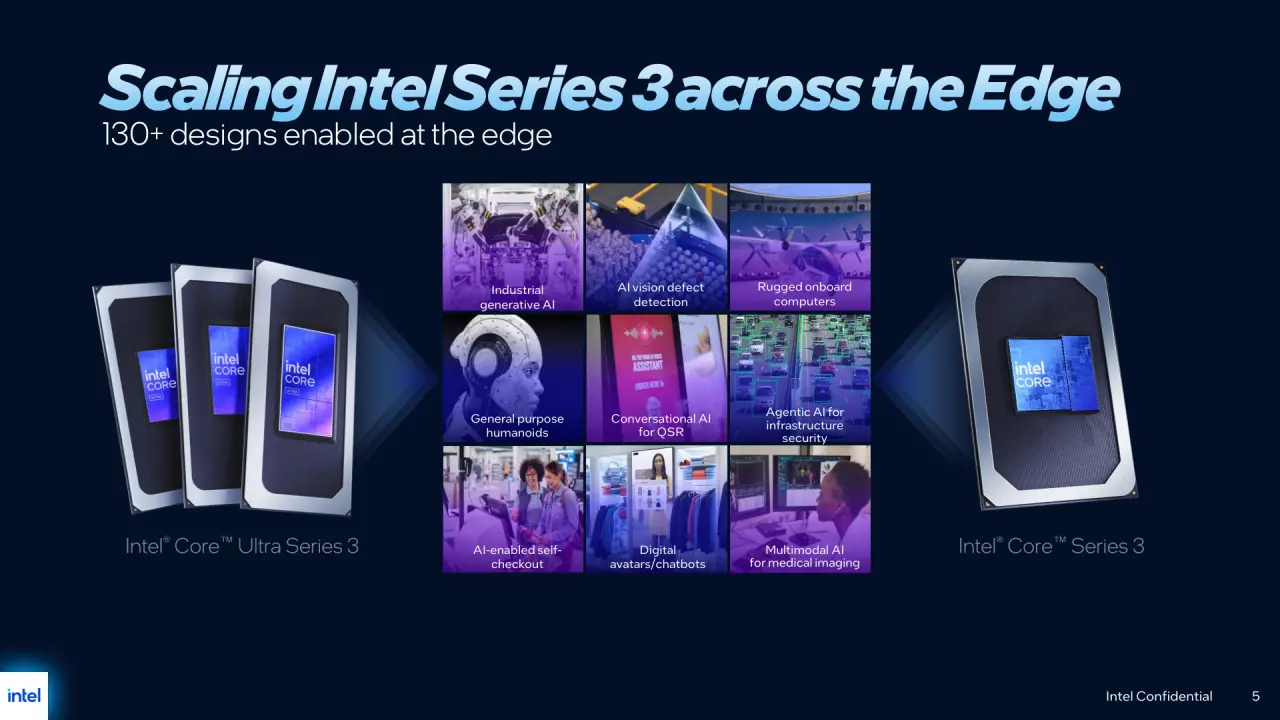
Intel’s Computex 2026 messaging put a useful spotlight on a robotics problem that is easy to underestimate: getting an AI demo to move once is not the same as deploying physical AI across real machines. Intel is pointing its edge roadmap at that gap with Core Ultra Series 3 design activity, Xeon 6+ data-center positioning, and an OpenVINO Physical AI framework preview for robotics and edge systems.
What happened
At Computex 2026, Intel described an expanded platform strategy spanning edge AI, robotics and data centers. Reporting from the show says the company is highlighting more than 130 edge design engagements around Intel Core Ultra Series 3 processors and a new OpenVINO Physical AI framework intended to simplify robot deployment. Intel’s own Computex page also positions Robotics and OpenVINO as part of its edge showcase.
Why it matters
For builders, “physical AI” is less about a single model checkpoint and more about the messy integration layer around it. Cameras, microphones, actuators, codecs, safety loops, model runtimes, fleet updates and telemetry all need to behave predictably on constrained edge hardware. If that stack is redesigned for every robot, engineering effort goes into glue code instead of better behavior.
Technical breakdown
The practical claim behind OpenVINO Physical AI is that a more unified software layer can reduce the custom pipeline work needed for multimodal robotics. That includes routing sensor data into inference, scheduling model workloads against CPU/GPU/NPU resources, and keeping the control path deterministic enough for physical systems. The hardware side matters too: robotics developers increasingly need edge devices that can run perception locally while still fitting power, thermals and bill-of-material constraints.
Builder, STEM and industry impact
For robotics teams, the short-term value is not that one vendor suddenly solves autonomy. It is that standard deployment tooling can make it easier to move from proof-of-concept to repeatable lab rigs, field pilots and classroom platforms. STEM labs and youth robotics programs may not use enterprise OpenVINO workflows directly, but the direction is relevant: the winning robot stack is becoming a combination of sensors, local inference, maintainable software and clear debugging tools.
Risks and unknowns
The open questions are execution and portability. Framework previews can look clean in demos while real robots expose timing issues, driver gaps and awkward hardware dependencies. Developers should also watch how much of the workflow stays open and reproducible across non-Intel accelerators, because robotics teams rarely want to rebuild their platform around one silicon roadmap unless the integration savings are substantial.
TVG Take
Intel’s Computex pitch is a useful reminder that the next robotics bottleneck is deployment discipline. The most interesting physical-AI tools will not be the flashiest demos; they will be the ones that make sensor pipelines, model runtimes and robot control loops boring enough to maintain.