Robot safety is not only an industrial-factory issue. Any machine that moves with enough force to pinch, crush, cut, burn, or surprise a person deserves a safety review before it is demonstrated in a school lab, maker space, garage, robotics club, or small business workshop.
Quick answer
Makers do not need to copy every industrial robot standard to build safely, but they do need the same safety logic: define the operating zone, control unexpected motion, add a reliable stop method, limit early-test energy, guard pinch points, and document what changed before public demos.
Key takeaways
- Robot safety starts with hazards, not paperwork.
- A reliable stop method and controlled startup behavior are baseline requirements for moving machines.
- STEM teams and maker labs should document each test configuration before inviting bystanders near a robot.
That may sound heavy for a weekend build, but it is the same engineering habit that separates a clever prototype from a machine people can safely stand near. Industrial robot standards such as ISO 10218 and ANSI/RIA R15.06 exist for professional systems, but the practical lessons apply far beyond a factory cell: identify hazards, control access, reduce unexpected motion, verify emergency stops, and document what the machine is allowed to do.
Why this matters now
Robotics hardware is getting cheaper, stronger, and easier to integrate. A student team can buy servo-driven arms, ROS-compatible mobile bases, linear actuators, depth cameras, AI accelerators, and grippers that used to require an industrial budget. That accessibility is good for education and innovation, but it also means more people are building machines with real kinetic energy before they have formal machine-safety training.
The risk is not only a high-speed industrial arm. A slow robot can still trap a finger. A small mobile robot can still roll off a table or collide with a child. A 3D-printer toolhead, laser module, CNC spindle, battery pack, or pneumatic actuator can create hazards that are easy to underestimate because the project looks “maker scale.”
The standards are written for industry, but the safety logic scales down
OSHA points to robot safety standards such as ANSI/RIA R15.06, which is tied to ISO 10218, for industrial robots and robot systems. Those documents are aimed at manufacturers, integrators, and industrial users, not a middle-school robotics team building a cart in a classroom. Still, the structure is useful: define the task, identify hazards, estimate risk, add safeguards, validate the result, and keep records.
For a maker or school project, that does not have to become a binder full of paperwork. It can start as a one-page checklist before anyone powers the robot near people.
A practical robot safety checklist for builders
1. Define the operating zone
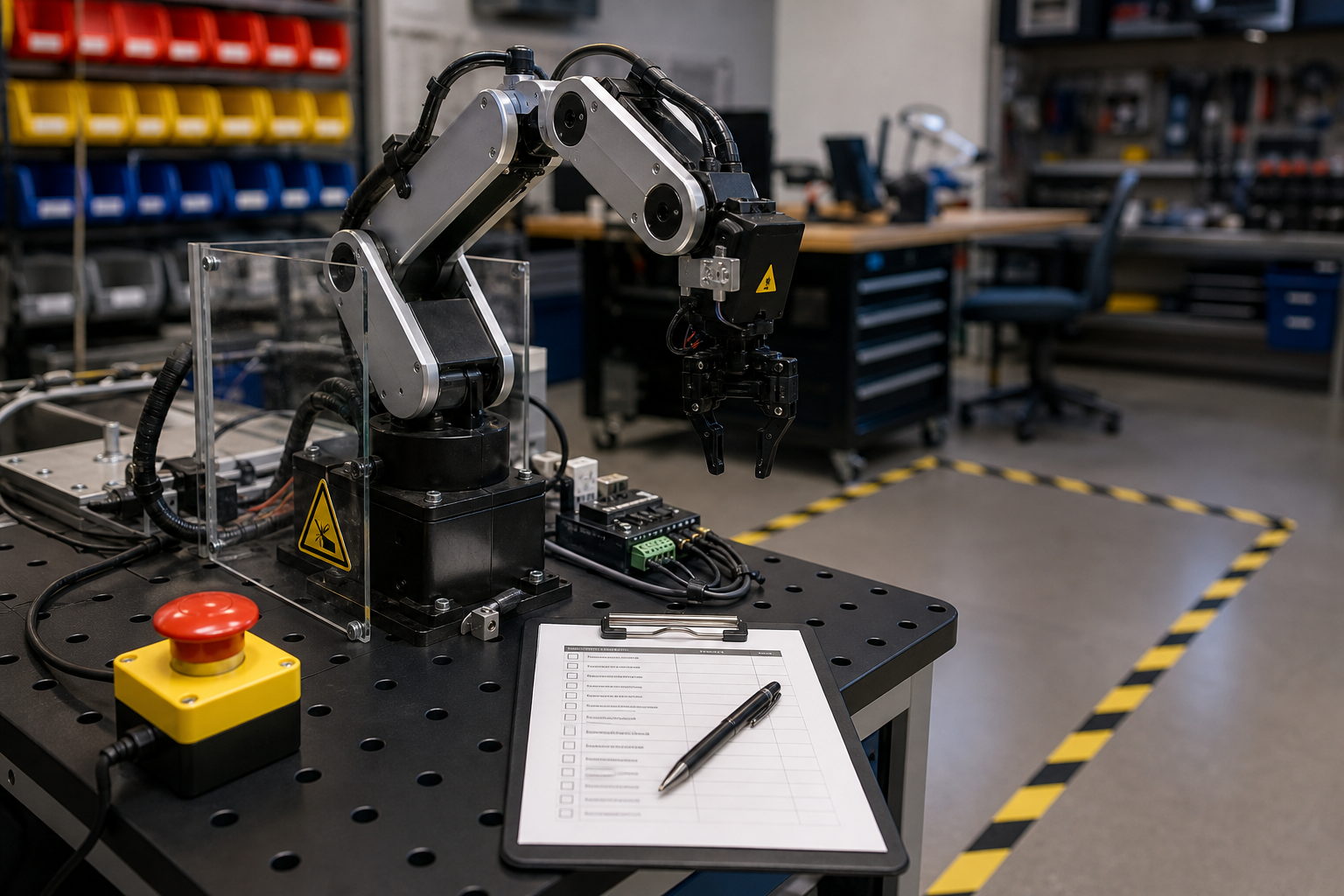
Before testing, decide where the robot is allowed to move and where people are allowed to stand. Mark the area physically if the robot can move with force. For mobile robots, include stopping distance, turning radius, sensor blind spots, and what happens if localization fails.
2. Add a real stop method
A keyboard interrupt is not an emergency stop. A software button inside a laptop app is not enough if the laptop freezes or the Wi-Fi drops. For anything with meaningful force, builders should have a clear, reachable way to cut motor power or trigger a safe stop. The stop method should be tested before every demonstration.
3. Control startup and restart behavior
Many robot incidents happen because a system starts moving at the wrong time. A safe project should not immediately drive motors just because a battery was connected, a script restarted, or a microcontroller rebooted. Require an intentional enable step, and make the robot default to a safe state after power loss, reset, or communication failure.
4. Limit force and speed during early testing
Do not tune a new robot at full power around people. Use current limits, speed limits, mechanical stops, lower supply voltage where appropriate, or test stands. The first goal is not maximum performance; it is predictable behavior.
5. Guard pinch points and sharp tools
Grippers, belts, lead screws, wheels, gears, linear rails, and linkages can create pinch points even when motors are small. If a finger can fit into a moving joint, that joint deserves attention. Covers, spacing, guards, labels, and operating rules all help.
6. Separate autonomous testing from public demos
Autonomous code should be treated as untrusted until it has been tested in a controlled area. A robot that behaves well for the developer may still fail when lighting changes, a camera is blocked, a floor surface changes, or a child steps into the path. Public demos should use conservative speeds and a human operator who can stop the system immediately.
7. Document what changed
When a team changes firmware, motor controllers, batteries, payloads, sensors, or code, the safety assumptions may change too. Keep a simple build log: date, change, person responsible, test result, and any new hazard found. That record is useful for schools, teams, mentors, parents, and future builders.
What this means for STEM teams
Safety work should not be framed as bureaucracy. It is engineering. Students who learn to ask “what happens if this fails?” become better designers. They also become more credible when talking to sponsors, schools, event organizers, and technical judges.
A robotics team that can explain its stop system, testing process, battery handling, and risk controls is doing more than protecting people. It is showing professional discipline.
TVG Take
The maker world should borrow the safety mindset from industrial robotics without pretending every classroom project is a factory cell. The right standard is proportional: a small robot does not need the same safety architecture as an automotive welding line, but it does need honest hazard review, predictable stopping behavior, and adult-level respect for stored energy and moving parts.
If a robot can move, pinch, cut, heat, lift, throw, roll, or surprise someone, safety is part of the build — not something to add after the demo video.
Sources and further reading
- OSHA: Robotics — Standards
- ANSI/RIA R15.06-2012: Industrial Robots and Robot Systems — Safety Requirements
- ANSI Blog: ANSI/A3 R15.06 robot safety updates
Robot safety FAQ for maker projects
Do small robots need a safety review?
Yes. Any robot with moving mass, pinch points, sharp tools, hot surfaces, autonomous motion, or public-demo interaction deserves at least a basic hazard review before people stand near it.
What is the first safety feature to add?
A reliable stop method is usually first: a visible emergency stop, dead-man switch, software stop that fails safe, or a power-isolation method appropriate to the machine.
How should student teams document robot safety?
Keep a short checklist covering operating zone, startup behavior, maximum test speed, guarding, emergency stop checks, and what changed since the previous test.