SunFounder’s PiDog V2 is the kind of educational robotics platform TVG wants to see more vendors make reviewable: a physical robot with enough sensors, software paths and calibration demands to reveal whether a kit is actually classroom-ready.
Disclosure / review-unit status
TVG has not received a review unit for this article. This review preview is based on SunFounder’s official product information, public PiDog documentation, official product imagery and TVG’s engineering review criteria. We are not claiming hands-on testing, runtime measurements, servo durability data or classroom deployment results.
Product summary
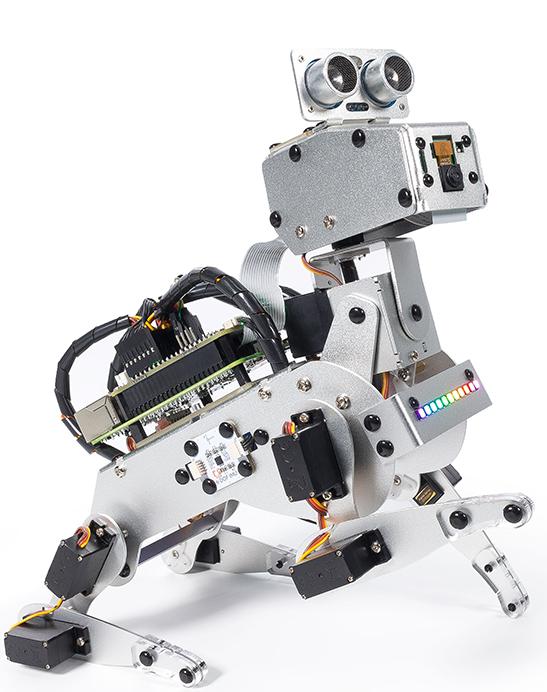
The SunFounder PiDog is a Raspberry Pi-based quadruped pet robot kit. SunFounder’s documentation describes an aluminum-alloy structure, a camera module for projects such as color recognition and face detection, 12 metal gear servos for walking and posing, an ultrasonic module, touch sensors, a light board, speaker output through the Robot HAT, a sound direction sensor and a 6-DOF IMU.
The current V2 positioning matters because SunFounder says the updated Robot HAT and servo configuration expand compatibility to Raspberry Pi 3, Raspberry Pi 4, Raspberry Pi 5 and Raspberry Pi Zero 2W. That makes PiDog a candidate for schools and maker labs already standardizing around Raspberry Pi hardware instead of single-purpose robotics controllers.
Who it is for
PiDog appears best suited for intermediate STEM labs, maker clubs and Raspberry Pi users who want a legged-robot platform rather than another wheeled rover. The difference is not cosmetic. Quadrupeds force students to think about gait timing, calibration, center of mass, sensor fusion, battery behavior and mechanical repeatability.
For review-unit outreach, PiDog is also a useful vendor target because a fair evaluation would produce actionable evidence: setup time, documentation friction, servo calibration repeatability, Python example quality, network setup, Raspberry Pi 5 behavior and how well the AI/LLM features hold up outside a demo script.
Technical specs and design signals
The most promising design signal is the breadth of onboard sensing. A camera, ultrasonic ranging, touch input, sound-direction sensing and a 6-DOF IMU give instructors several ways to turn the same robot into separate labs: perception, obstacle response, pose estimation, interaction design and control logic.
The second signal is documentation depth. SunFounder’s public docs include sections for Python projects, calibration, hardware components, OpenClaw control, online LLM connections and local chatbot work with Ollama. That does not prove classroom reliability, but it gives reviewers concrete workflows to test rather than only marketing claims.
The third signal is Raspberry Pi 5 support in the V2 kit. Pi 5 compatibility creates a stronger path for local AI experiments, but it also raises power, heat and setup questions. A credible review should not stop at “it runs on Raspberry Pi.” It should check whether the robot remains stable when the compute board, servos, camera and audio features are all part of a lesson.
What TVG would test
- Assembly time: how long a careful first-time builder needs, where the instructions slow down, and whether mistakes are easy to recover from.
- Servo calibration: whether calibration is clear, repeatable and durable after transport or student handling.
- Walking reliability: straight-line walking, turning, sit/stand transitions and stability on common classroom surfaces.
- Power behavior: brownouts, reboot risk, heat and runtime under mixed motion-camera workloads.
- Software path: setup friction for Raspberry Pi OS, Python dependencies, examples, camera access and network control.
- AI feature honesty: whether online-LLM and local-Ollama workflows are teachable engineering exercises or mainly novelty demos.
- Repairability: servo replacement, fastener access, cable strain relief and how well the kit survives repeated student sessions.
Failure points / risks / unknowns
The main risk is complexity. A quadruped robot with 12 servos, camera projects, audio interaction and Raspberry Pi setup can be exciting, but it can also become a troubleshooting stack where mechanical alignment, power stability and Python dependencies fail at the same time.
The second unknown is long-term servo and joint durability. Metal gear servos are a positive signal, but classroom robotics stresses are different from a demo bench. Students carry robots by the wrong part, run batteries low, collide with furniture and repeat motions far more often than a product video suggests.
The third unknown is the AI layer. Voice and LLM integrations can make a robot more approachable, but they should not hide the core robotics lesson. TVG would treat AI features as a secondary score unless the local examples are reliable, documented and safe to reproduce without confusing cloud-account setup.
Who should consider it
Consider PiDog if your lab already uses Raspberry Pi, wants a more challenging robotics platform than a two-wheel car, and has time to teach calibration and debugging as part of the curriculum. It looks especially relevant for clubs that want one platform to cover mechanical build quality, Python control, sensors, simple autonomy and human-robot interaction.
Be cautious if you need a lowest-friction beginner kit for a one-hour workshop. A legged robot is inherently less forgiving than a rover. For younger students or short events, SunFounder’s wheeled platforms may be easier to deploy; PiDog is more interesting when the goal is sustained engineering practice.
TVG Take
SunFounder PiDog V2 is review-worthy because it sits in the gap between toy-like STEM robots and expensive research quadrupeds. The hardware list is broad enough to support serious lessons, and the public documentation gives reviewers specific workflows to audit.
Our biggest question is not whether PiDog can perform scripted tricks. It is whether the kit can survive repeated setup, calibration and classroom use while keeping students focused on engineering instead of random troubleshooting. If SunFounder wants PiDog to be taken seriously by STEM programs, a transparent review unit test should measure exactly that.