Camera sensor size is one of the most abused shortcuts in creator gear. Bigger sensors can help with low light and shallow depth of field, but they do not automatically make a camera better for robotics documentation, 3D scanning, field inspections, or maker-lab video. The useful question is narrower: which sensor tradeoffs match the job you need to repeat reliably?
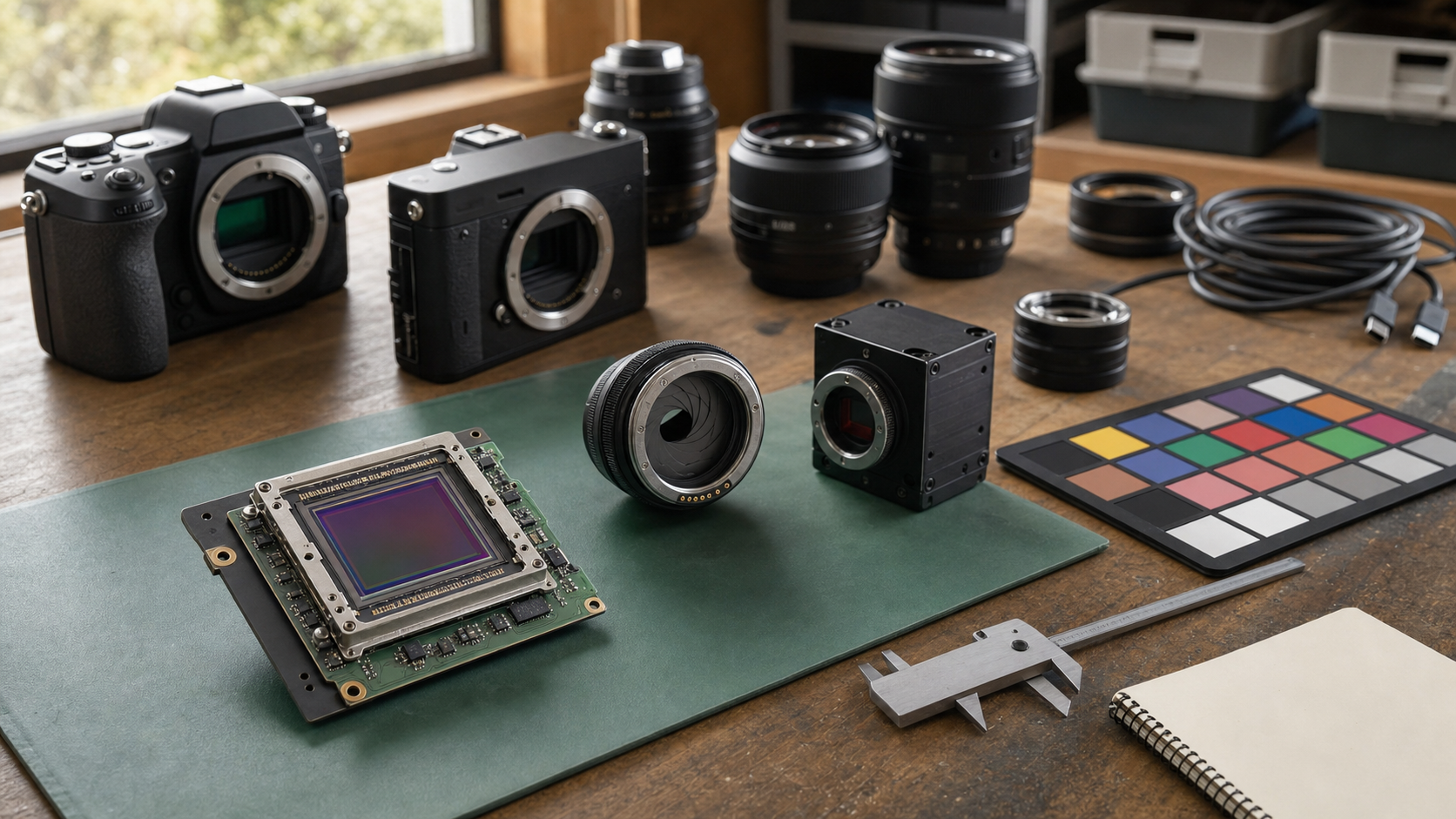
This guide is for builders, educators, and creator teams choosing between action cameras, mirrorless bodies, phone cameras, USB machine-vision modules, and compact 360 cameras. It focuses on the specifications that change the workflow: sensor area, pixel size, crop factor, readout speed, rolling versus global shutter, dynamic range, lens fit, heat, storage, and calibration.
Quick answer: what sensor size actually changes
Sensor size mainly changes three things. First, it changes how much light can be collected for a given field of view and lens design. Second, it changes lens behavior: the same focal length produces a narrower field of view on a smaller sensor, which is why crop factor matters. Third, it changes system size and heat, because larger sensors often require larger lenses, bigger image circles, and more demanding processing.
For maker work, those tradeoffs can point in different directions. A full-frame mirrorless camera may produce excellent lab video, but it is not the easiest camera to mount on a robot. A small action camera may survive vibration and weather, but its wide lens and heavy processing can make measurements harder. A machine-vision camera may have the right shutter and interface, but it may require more software work than a creator camera.
Sensor area is not the same as image quality
Sensor area matters because photons are physical. Larger sensors can use larger pixels or more total pixels, depending on the design. Larger pixels can improve signal-to-noise ratio in low light, but the final image also depends on lens speed, image stabilization, readout design, processing, compression, and exposure choices.
That is why two cameras with similar megapixel counts can behave very differently. A 24MP full-frame camera, a 24MP APS-C camera, and a 24MP phone sensor are not collecting light with the same pixel area or lens system. The phone may compensate with multi-frame processing. The full-frame camera may rely on optics and clean high-ISO performance. The machine-vision camera may skip consumer processing entirely so a robot pipeline gets predictable frames.
For a field team, the practical test is not a studio chart alone. Shoot the actual subject, from the actual distance, under the actual lighting, and with the same motion that the system will see in use.
Crop factor affects framing and mounting
Crop factor is a field-of-view translation. A smaller sensor captures a smaller part of the lens image circle, so a 25mm lens on a Micro Four Thirds camera behaves like a tighter field of view than a 25mm lens on full frame. That does not make the lens longer in a physical sense, but it changes composition, working distance, and depth-of-field choices.
For maker labs, crop factor affects camera placement. If a robot inspection camera needs to see a wide area from a short mounting distance, a smaller sensor may require a wider lens. Wider lenses can add distortion, especially near the edges. That matters for fiducial markers, AprilTags, 3D reconstruction, and any workflow where geometry matters.
TVG has covered related field documentation choices in our action camera, 360 camera, or drone buyer evaluation. Sensor size should be one part of that decision, not a replacement for mounting, stabilization, storage, and metadata checks.
Rolling shutter can be a bigger issue than sensor size
Many CMOS cameras read the image line by line. That rolling-shutter behavior can bend fast-moving objects, skew vertical lines during pans, and distort frames when a camera vibrates on a vehicle or robot. For ordinary talking-head video, it may be acceptable. For robotics, inspection, and motion analysis, it can break the measurement.
Sony Semiconductor describes global-shutter image sensors as a way to capture high-speed images with reduced distortion. In a global-shutter design, the frame is exposed at once rather than scanned line by line. The tradeoff is that global-shutter cameras can cost more, offer different sensitivity characteristics, or be aimed at industrial rather than creator workflows.
The simple rule: if the camera is mounted to a moving robot, pointed at spinning parts, used for fast inspection, or expected to feed measurement software, evaluate shutter behavior before arguing about full frame versus APS-C versus one-inch sensors.
Dynamic range is becoming a field-work spec
Dynamic range describes how much shadow and highlight detail a camera can capture in one scene. For creators, it affects sunset shots and high-contrast interiors. For technical teams, it affects inspection under mixed lighting, robotics footage moving between shade and sun, and documentation where blown highlights hide defects.
Recent sensor work shows why this spec is getting more attention. PetaPixel reported on Sony’s first LOFIC image sensor, describing claims of nearly 17 stops of dynamic range for a phone-class sensor. The point for TVG readers is not that one phone sensor solves every problem. It is that sensor architecture, readout, and HDR method increasingly matter as much as diagonal size.
When comparing cameras, ask whether HDR is single-exposure, multi-exposure, or mostly computational. Multi-exposure HDR can look excellent in still scenes but may introduce ghosting or artifacts with motion. For robotics footage and field inspections, motion behavior can matter more than a headline dynamic-range number.
Pixel size, resolution, and compression need to be read together
High resolution helps when you need to crop, read labels, or recover detail. It also increases processing load, heat, storage, and transfer time. A 4K or 8K headline does not tell you whether the camera records at a high enough bitrate, whether it overheats, or whether the lens can resolve the sensor’s detail across the frame.
For maker-lab video, compression can erase the advantage of the sensor. Fine textures, fast motion, LED flicker, and vibration can all stress codecs. If the camera is used for documentation rather than cinema, a stable 4K mode with reliable heat behavior may beat a fragile 8K mode that throttles or fills cards too quickly.
That connects directly to TVG’s action camera storage guide and field camera power workflow guide. A sensor choice is only as useful as the power, recording, and offload system around it.
Machine vision has different priorities
Creator cameras are optimized for pleasing images. Machine-vision cameras are optimized for predictable data. A USB or GigE machine-vision module may offer a global shutter, fixed exposure, external trigger support, C-mount lens options, and SDK access that a consumer camera does not expose.
That does not mean every robotics team should buy industrial cameras. Consumer cameras are easier for documentation, outreach, and general media. But if the camera is part of the control loop, the criteria change. Look for shutter type, trigger support, driver availability, frame timing, mounting, lens calibration, and whether the camera can deliver frames without unpredictable image processing.
Buying checklist for creator and maker teams
- Define the job first: documentation, inspection, robot perception, photogrammetry, streaming, or training media.
- Test lighting: indoor LED, mixed daylight, night, reflective surfaces, and fast transitions.
- Check motion: pans, vibration, moving subjects, spinning parts, and vehicle mounting.
- Verify lens geometry: distortion, focus distance, field of view, edge sharpness, and calibration support.
- Measure heat and runtime: especially in 4K, 8K, high-frame-rate, or sealed housings.
- Plan storage: bitrate, card rating, file splitting, backup workflow, and metadata.
- Match interface to workflow: HDMI, USB UVC, USB3 machine vision, SDI, Wi-Fi, or app-only transfer.
- Check repairability: battery replacement, lens protection, mount durability, firmware history, and spare parts.
TVG Take
Sensor size is a useful clue, but it is not a buying decision by itself. For technical creators and maker labs, the stronger method is to choose the smallest camera system that meets the motion, lighting, lens, runtime, and data requirements of the job. A bigger sensor is valuable when it solves a real exposure or lens problem. It is wasteful when the bottleneck is shutter distortion, overheating, weak mounts, or a storage workflow that fails in the field.