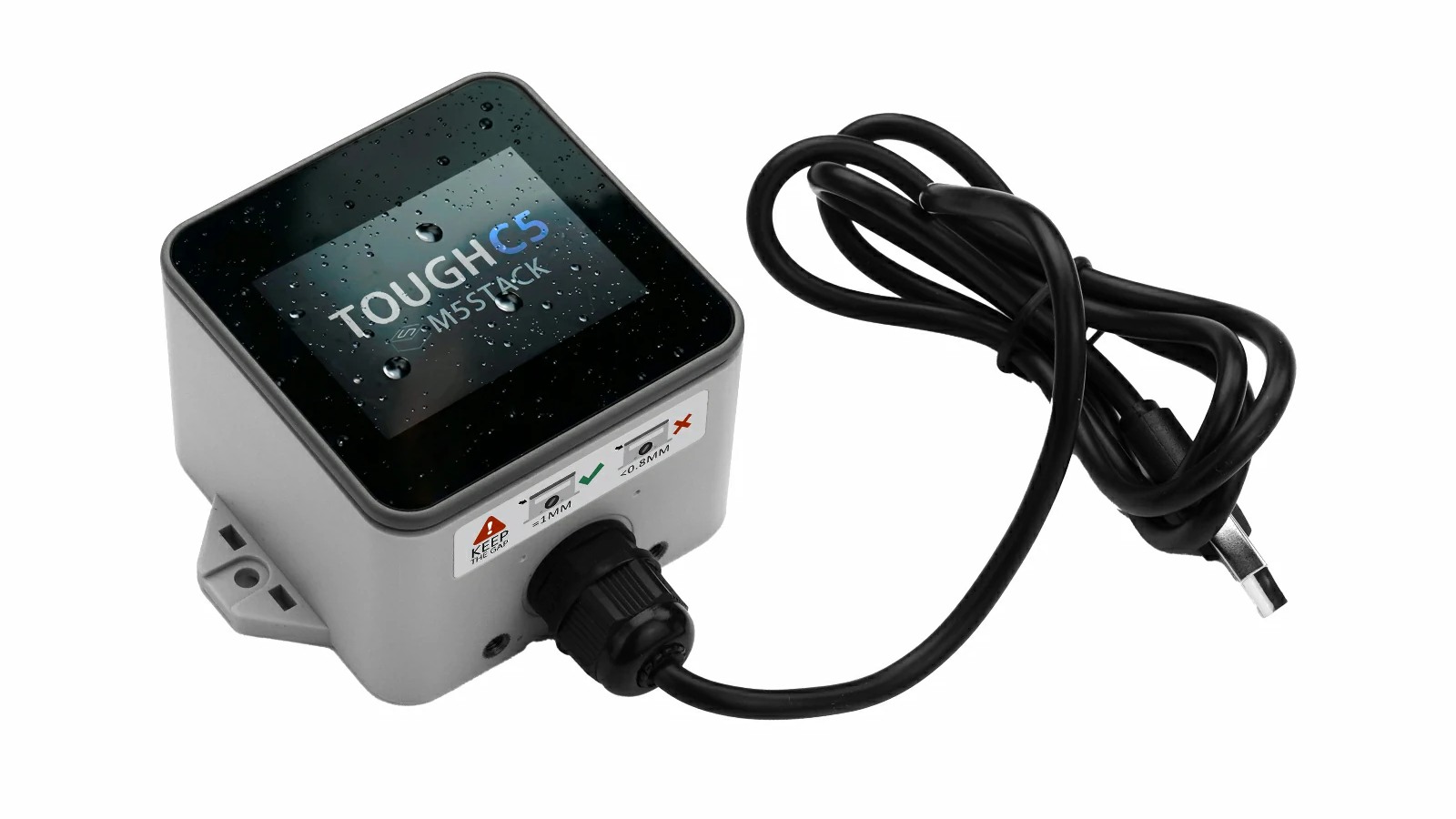
M5Stack has introduced ToughC5, a compact field-oriented controller built around Espressif’s ESP32-C5. CNX Software reported the launch on October 10. The unit combines dual-band 2.4/5 GHz Wi-Fi 6, Bluetooth 5 and IEEE 802.15.4 support with a 2-inch touch display, RS485 hardware, four internal HY2.0-4P expansion connectors and M12 cable-routing hardware.
The processor is only part of the design. ToughC5 targets small gateways and local control panels that need a wired field bus, a visible interface and more than one wireless path in one enclosure.
Power and I/O make it a controller, not just a dev board
The official documentation specifies three power paths: 5 V at 500 mA over USB, 6–24 V at 1 A through the RS485 interface, or a 3.7 V battery connection. An SP485EEN-L/TR transceiver handles RS485, while four internal HY2.0-4P connectors expose RS485, I2C, GPIO and UART options.
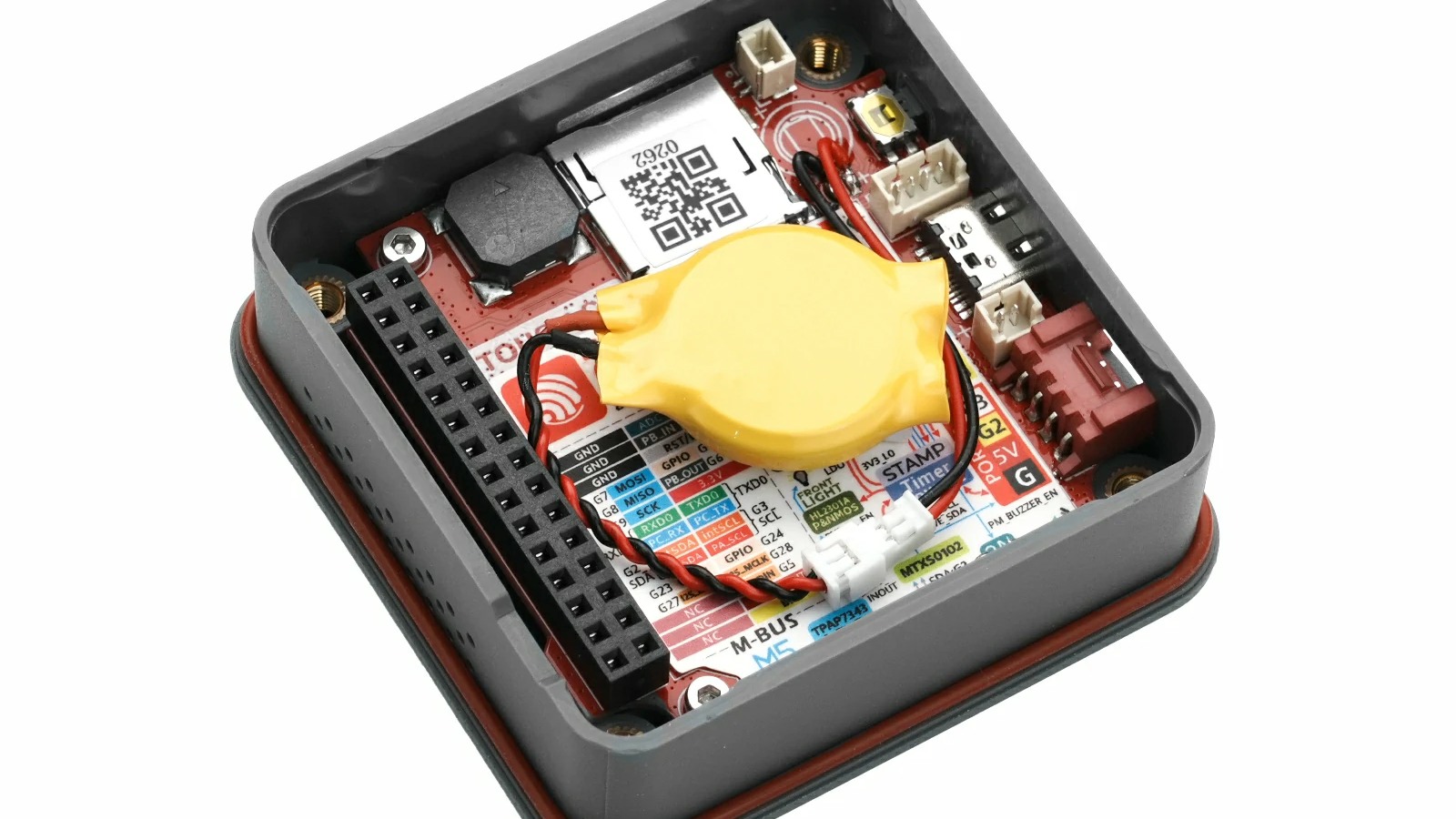
For a bench prototype, USB can power and program the controller. A field node can instead accept the wider RS485-side input range, reducing the need for a separate 5 V feed near the enclosure. That does not remove the normal RS485 design work: cable topology, termination, grounding and transient protection still depend on the installation.
The radio set supports several gateway roles
The ESP32-C5HR8 is a single-core 32-bit RISC-V device running up to 240 MHz. M5Stack pairs it with 16 MB of flash and 8 MB of PSRAM. Wireless support includes dual-band Wi-Fi 6, Bluetooth 5 and 802.15.4 for Zigbee or Thread, allowing a prototype to bridge a local low-power network to Wi-Fi without adding a second radio module.
Radio support is not the same as simultaneous production readiness for every protocol. Firmware stack maturity, antenna placement, regional settings and coexistence behavior still need to be checked for the chosen combination. The internal FPC antenna covers 2.4 and 5 GHz and uses an IPEX second-generation connector.
The display is small but unusually bright
The 2-inch 320×240 ILI9342C IPS panel is rated by M5Stack at a maximum brightness of 853 nits and uses a CHSC6540 capacitive-touch controller. That is enough resolution for status, alarm acknowledgement and a few local controls, but not for a dense dashboard. The unit also includes a microSD slot, RX8130CE real-time clock and passive buzzer.
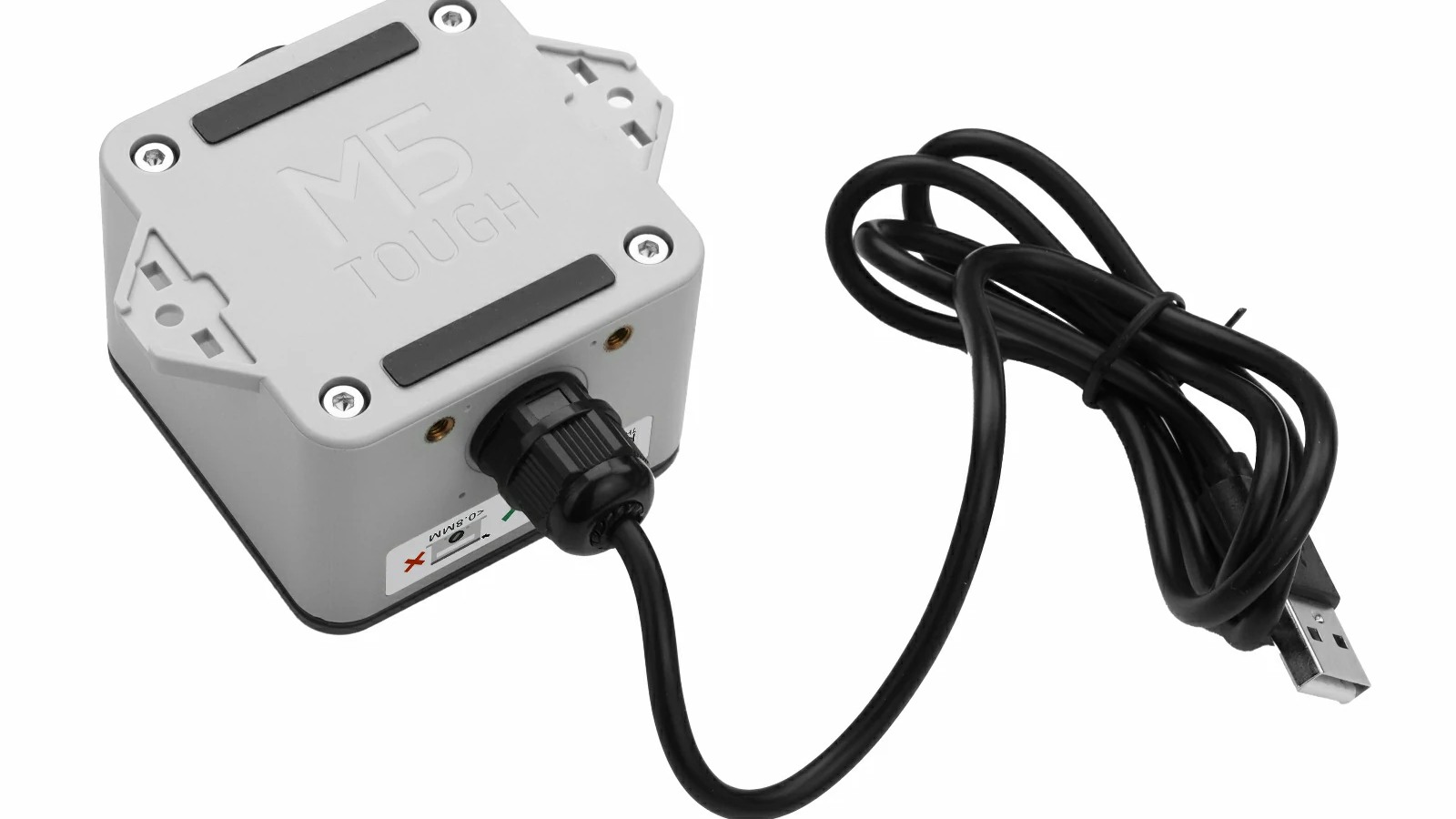
“Waterproof” needs a deployment boundary
M5Stack describes a waterproof structural design and a UV-resistant PC+ABS housing, but its own product image cautions that the unit is not protected against immersion. The documentation reviewed for this article does not state an IP code. Buyers should therefore avoid translating the product name or enclosure style into an assumed IP67/IP68 claim.
The enclosure measures 75.9×58.0×42.5 mm and weighs 119 g. M5Stack lists shutdown current at 10.41 µA and full-load current at 320 mA, both measured at 4.2 V. Those values are useful sizing anchors, not a battery-life promise: display brightness, radios, RS485 traffic and attached sensors will change the duty cycle.
Where it fits
ToughC5 is most coherent as a compact protocol bridge, environmental monitor or machine-side status terminal where RS485 and a local screen matter. It is less compelling when a bare ESP32-C5 board already has a protected cabinet and no need for touch input. The remaining questions are software support across Zigbee/Thread/Wi-Fi combinations and whether M5Stack will publish a formal ingress-protection rating for the assembled cable configuration.