Robotics Australia Group and HowToRobot launched AutomationFinder on September 1 as a national entry point for Australian businesses considering automation. The service is designed to move a project from a defined production problem through feasibility, business-case work and supplier discovery—before a buyer commits to equipment.
The platform starts with the task, not the robot
The partners describe AutomationFinder as a vendor-agnostic service powered by HowToRobot. Its stated sequence includes identifying worthwhile automation opportunities, testing feasibility, building a business case and finding suppliers. That order matters because a robot model is not a requirement: cycle time, payload, part variation, available floor space, safety boundaries and changeover demands are.
AutomationFinder’s About page says the initiative is operated by Robotics Australia Group and powered by HowToRobot. It also says participating suppliers do not pay to appear in search results or to receive opportunities. Those are useful independence claims, although buyers still need to inspect how requirements are written, how suppliers are screened and who owns acceptance testing.
Five decisions still belong to the manufacturer
A marketplace can organize discovery, but it cannot make a weak process measurable. The manufacturer must still name the operation, quantify the current constraint and decide what result counts as success. A realistic brief should separate a labor shortage from a quality problem, a throughput bottleneck or an ergonomics risk.
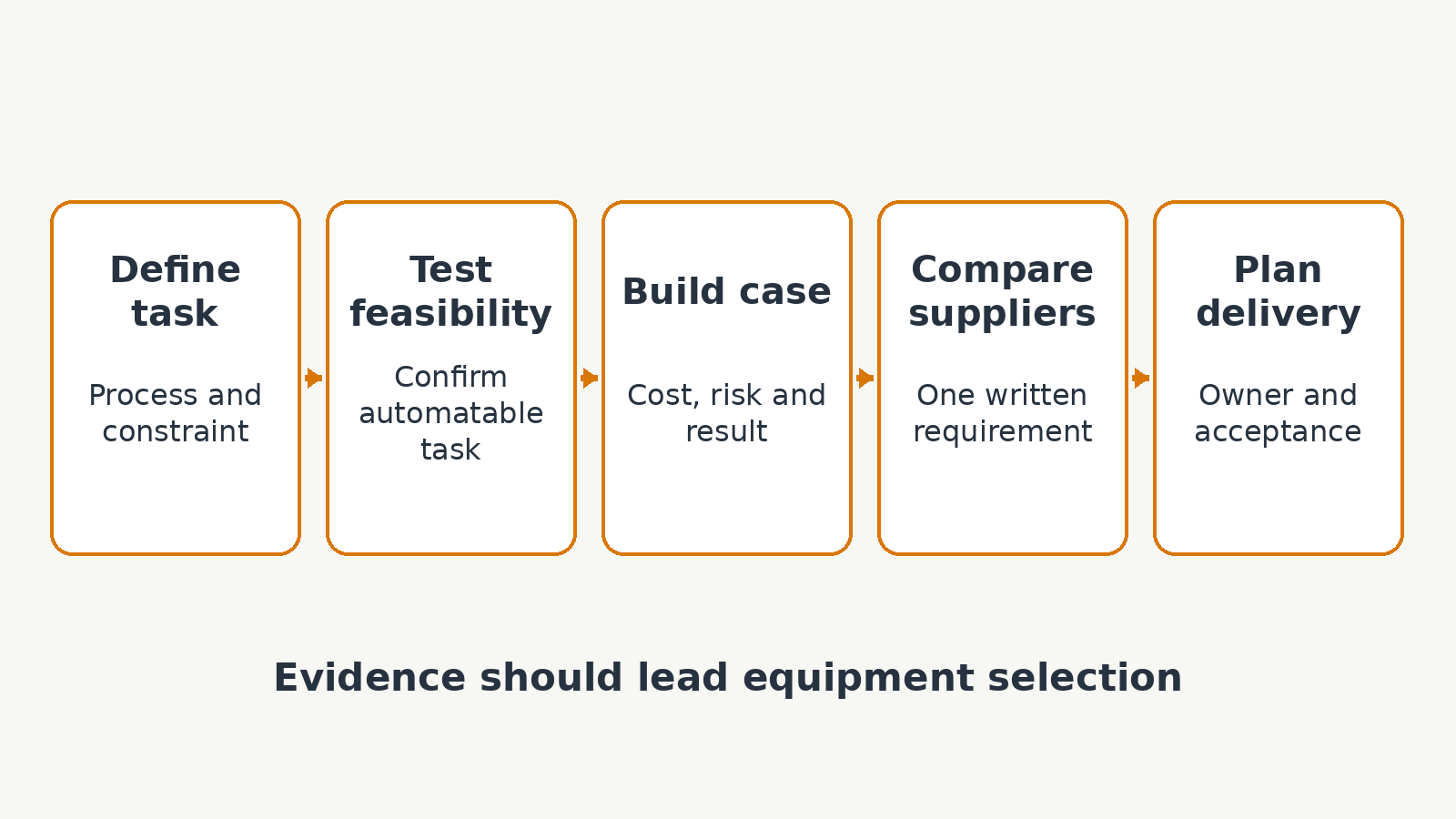
The second decision is feasibility. Parts may be reflective, flexible, randomly presented or difficult to grip. The workcell may lack safe access or a stable upstream flow. A useful feasibility study records these constraints instead of hiding them behind a polished demonstration.
The third decision is economic: capital cost is only one line. Integration, fixtures, guarding, training, maintenance, spares and changeover time can alter the result. Supplier comparison should then use the same written requirement for every bidder. Delivery planning needs named ownership, acceptance criteria and a recovery path if the cell misses them.
A useful request for quotation should also separate mandatory constraints from preferences. That lets integrators propose different technical approaches without quietly relaxing the requirement. Acceptance should be tied to representative parts, expected operators and a defined production window—not only a vendor demonstration.
What the launch changes—and what it does not
The Robot Report notes that Australia’s manufacturing robot density trails both the global average and several industrialized markets, citing International Federation of Robotics data. AutomationFinder addresses one plausible barrier: smaller and mid-sized businesses often do not have an internal automation engineering team that can translate a production problem into a supplier-ready brief.
It does not remove technical or commercial risk. The most important evidence will be completed projects: what types of factories use the service, whether requirements survive supplier handoff, and whether acceptance tests match the original business case. For TVG readers planning a first workcell, the practical lesson is to keep equipment selection downstream of task definition and measurable feasibility.
For more on evaluating robot software and integration boundaries, see TVG’s Isaac Sim 5.0 coverage.