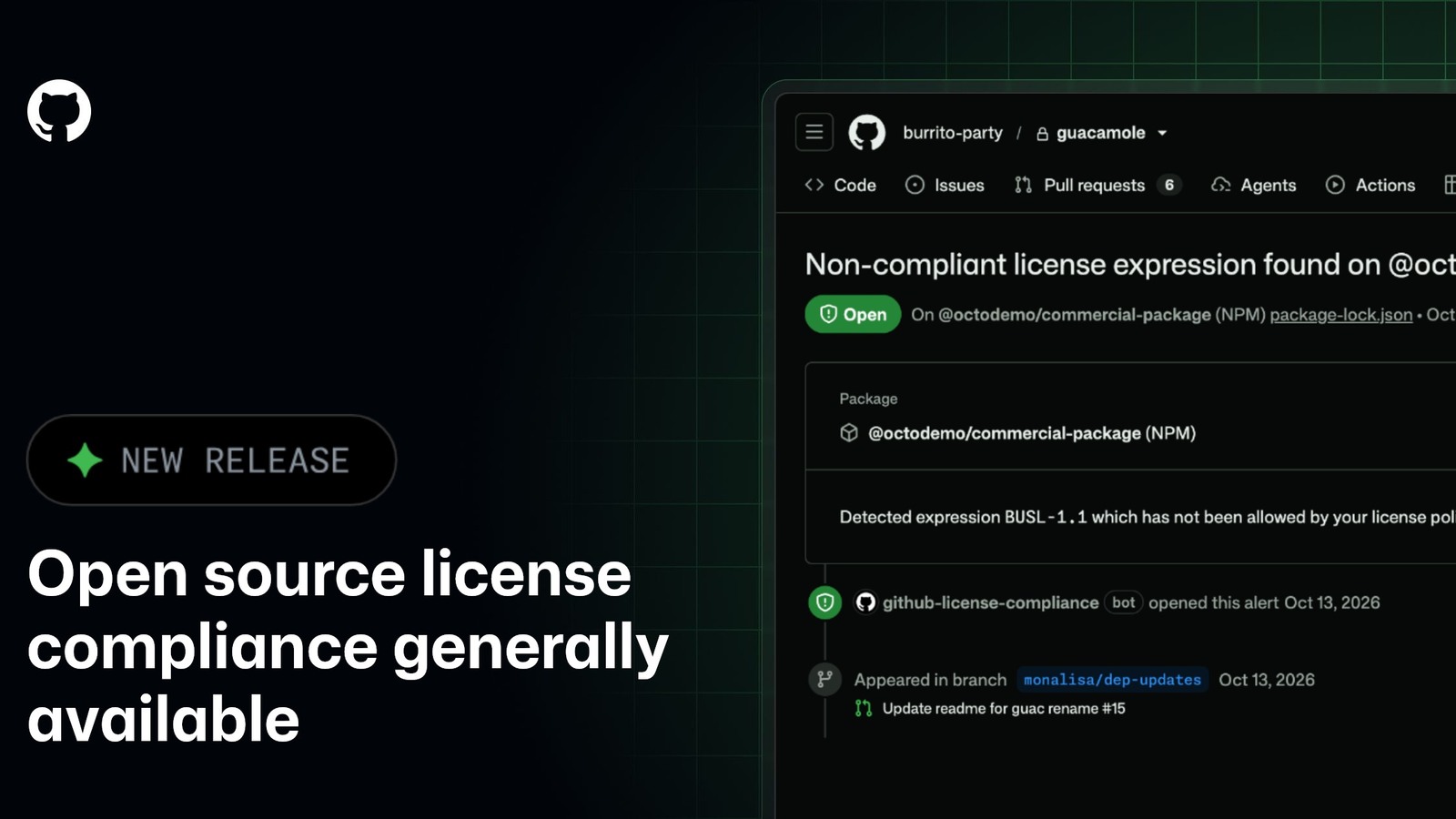
GitHub made open source license compliance generally available on October 16, turning dependency-license policy into a merge condition for eligible enterprise repositories. When a pull request changes package manifests, GitHub evaluates the licenses of direct and transitive dependency changes against an enterprise policy; an active ruleset can require a passing result before merge.
The release moves a task often handled by a separate scanner or legal review queue into the same branch-control system used for code scanning. It does not decide whether a license is acceptable for a particular product. The organization still defines that policy and owns its exceptions.
The enforcement point is the pull request
GitHub’s documentation describes a three-part control: an enterprise license policy lists allowed and denied licenses, a ruleset targets repositories, and the Require license compliance results before merging condition enforces the result. Evaluation runs when a pull request changes a package manifest and covers both direct and transitive dependency changes.
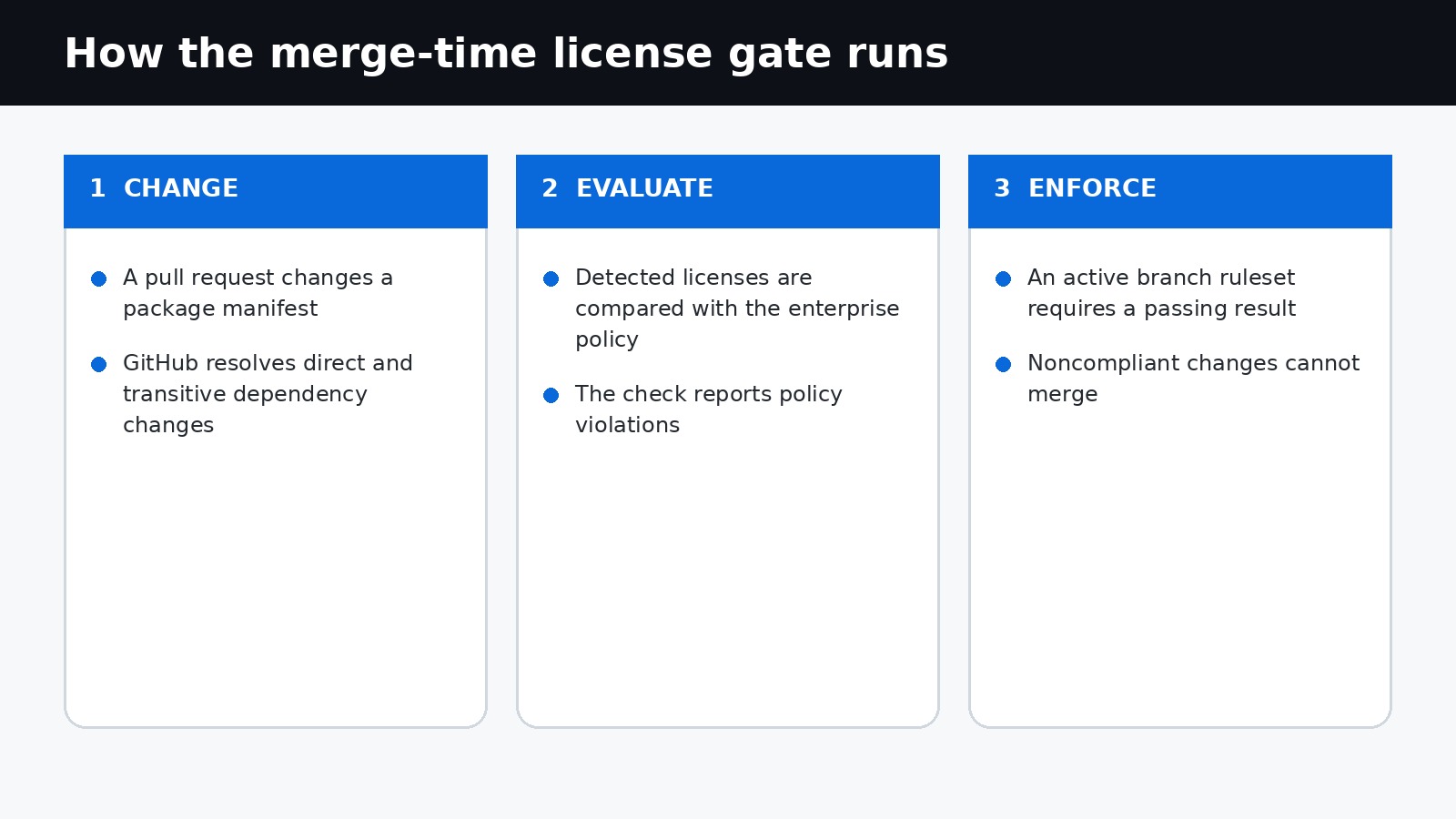
That placement matters because it blocks a newly introduced dependency before it reaches the default branch. It also makes the result visible beside other required checks rather than leaving it in a periodic report that a maintainer must reconcile later.
Rulesets define where the policy actually applies
A policy by itself is not enforcement. The relevant ruleset must be active, must target the repository and branch, and must include the license-compliance condition. A repository outside that target set can continue merging dependency changes without this gate even when an enterprise policy exists.
Rollout should therefore start with a report-mode or narrowly targeted ruleset, followed by a review of real pull requests. That exposes undeclared licenses, dual-license expressions and packages whose metadata does not match an organization’s policy vocabulary before a broad block is enabled.
SPDX identifiers help, but they are not legal conclusions
The SPDX License List supplies standardized short identifiers for commonly encountered licenses and exceptions. Those identifiers make a policy portable and machine-readable, but inclusion in the SPDX list does not mean a license is automatically open source or suitable for every distribution model. SPDX itself notes that the list covers software, data, hardware and documentation licenses, including entries with different approval status.
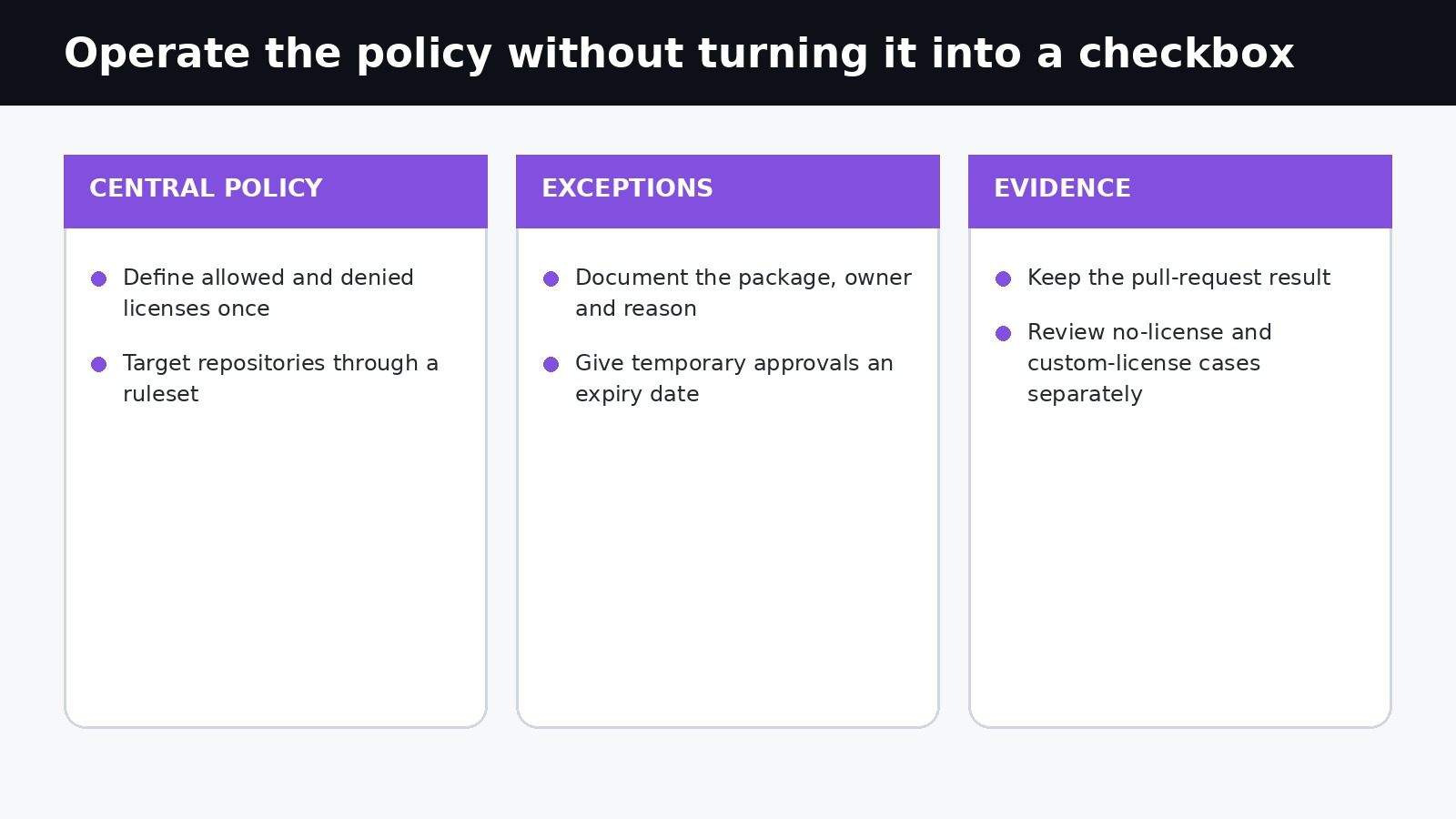
The engineering consequence is simple: normalize policy entries to exact SPDX expressions where possible, but route ambiguous, custom and missing-license cases to a named owner. A deny result can be automated; the business interpretation of an unusual license cannot.
Exceptions need an owner and an end condition
A useful exception record names the package and version, affected repositories, approving owner, reason and expiry or review date. Without those fields, a temporary decision becomes a permanent hole that is difficult to distinguish from policy drift.
Teams should also retain the pull-request result and the dependency manifest change that produced it. The gate answers whether GitHub’s detected license complies with the configured policy at that moment. It does not replace source-level notice checks, attribution-file generation or a release SBOM where those are required.
Availability and the remaining boundary
GitHub says open source license compliance is generally available for GitHub Enterprise Cloud and includes data-residency deployments. The control expands the dependency review workflow into an enterprise-wide policy lane, but it remains metadata-driven. Repositories with vendored source, downloaded binaries or build-time artifacts outside supported manifests still need complementary inventory and review.
The GA release is most valuable as an early merge control: it catches a policy mismatch close to the dependency change and leaves a reviewable result. Its quality still depends on repository coverage, dependency metadata and a policy that engineers and legal owners can explain.