Disclosure: TVG has not received a review unit for this article and has not performed image-quality, thermal, latency, inference-speed, networking, or long-duration reliability tests. This review preview is based on manufacturer specifications, official product information, public documentation, and TVG’s engineering review criteria.
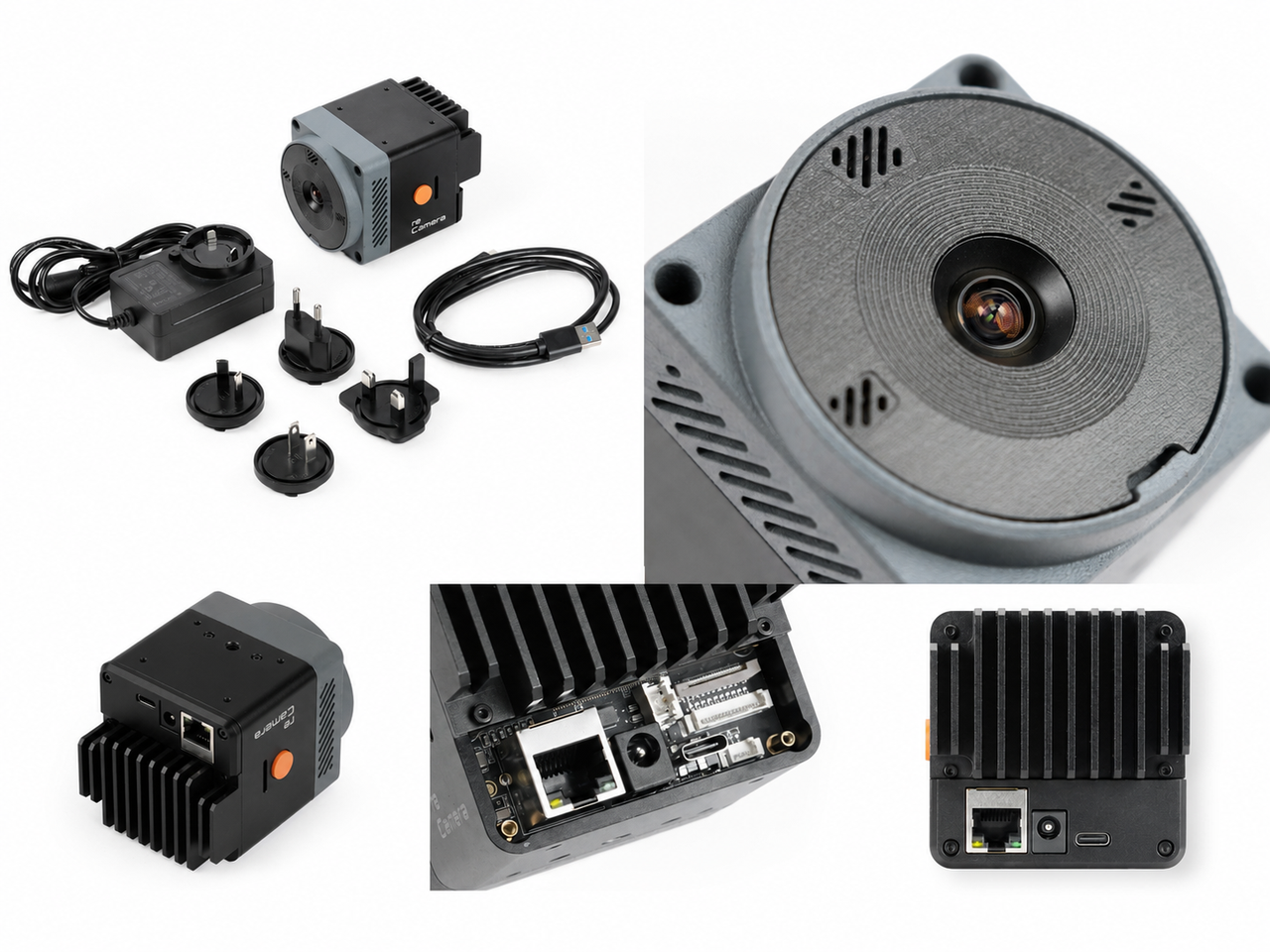
Seeed Studio’s reCamera Pro is an integrated edge-AI camera built around Rockchip’s RV1126B, an 8-megapixel starlight image sensor, local storage, audio, networking, and industrial-style expansion. The 2GB model was listed at $299.90 and in stock on Seeed’s official store when checked on October 14, 2026. That combination puts it well above an ESP32 camera board and below a full workstation-class vision computer—but the specification sheet alone cannot show whether the product is a dependable deployment tool.
Product summary
The reCamera Pro packages a quad-core Arm Cortex-A53 CPU, a manufacturer-rated 3-TOPS NPU, 2GB or 4GB of LPDDR4, 16GB of eMMC, and a microSD slot into one camera enclosure. Its SC850SL sensor is specified for up to 4K at 30 frames per second. The device also includes a six-axis IMU, two microphones, a 1W speaker, Gigabit Ethernet, wireless connectivity, USB-C OTG, two CAN interfaces, two GPIO connections, debug UART, and a 22-pin MIPI-DSI connector.
Seeed’s software pitch is equally important. Its official reCamera Pro documentation describes a built-in web interface for live video, AI detection, event recording, model configuration, and sound-model workflows. It also lists RTSP output, HTTP APIs, MQTT/HTTP/UART result delivery, native SDK access, and an experimental Debian 13 image. Those are useful integration signals, but they are not substitutes for measured throughput, stable firmware, or repeatable recovery behavior.
Who it is for
The most plausible users are robotics teams, automation developers, machine-vision prototypers, university labs, and advanced STEM programs that need more integration than a bare camera module provides. The enclosure, PoE option, CAN, GPIO, audio, local storage, and browser-based setup could shorten the path from a bench experiment to a pilot installation.
It is less obviously suited to buyers who only need a simple network camera, a low-cost classroom introduction to vision, or a fully certified industrial vision appliance. A $299.90 development platform must earn its place through software stability, low-light behavior, deterministic I/O, sustained inference, and field recovery—not by its TOPS number alone.
Technical specs and design signals
- Compute: Rockchip RV1126B with four Cortex-A53 cores at 1.2GHz and a manufacturer-rated 3-TOPS NPU supporting mixed INT8/INT16 computation.
- Memory and storage: 2GB or 4GB LPDDR4, 16GB eMMC, and microSD support listed up to 512GB.
- Imaging: 8MP SC850SL sensor, specified for up to 3840 × 2160 at 30fps.
- Sensing and audio: ICM-42670-P six-axis IMU, two electret microphones, and a 1W speaker.
- Connectivity: Gigabit Ethernet, Wi-Fi, Bluetooth, USB-C OTG, debug UART, two CAN channels, two GPIO connections, and MIPI-DSI.
- Power: 12–24V DC input, PoE support, and 7.4V lithium-battery charge/discharge management in Seeed’s specification table.
- Software paths: Web UI, RTSP, HTTP API, MQTT/HTTP/UART output, RKNN model workflow, native SDK, and documented firmware-recovery procedures.
The strongest design signal is integration. The official reCamera hardware repository distinguishes the Pro from the modular reCamera 2002 family: the Pro integrates sensing, audio, networking, power, and expansion in one platform. However, that repository also says editable PCB, BOM, and mechanical source files are not currently claimed for the Pro. “Open AI camera” therefore should not be read as a promise that every hardware design file is available.
The NPU and 4K figures also need careful interpretation. Three TOPS is a peak compute rating, not an application frame-rate guarantee. Similarly, a sensor capable of 4K30 does not prove that a chosen model, encoder, preview, event recorder, and API can all run simultaneously at that resolution and frame rate.
What TVG would test
- Setup repeatability: Time ten clean setups over USB, Ethernet, and Wi-Fi; record virtual-adapter failures, password-change behavior, browser compatibility, and steps needed to recover a misconfigured network.
- Imaging: Compare daylight and low-light detail, motion blur, dynamic range, white-balance recovery, lens distortion, focus consistency, exposure transitions, and real delivered frame rate at each advertised stream mode.
- Inference: Run identical RKNN models across several input sizes and track end-to-end latency, throughput, missed frames, CPU/NPU utilization, and temperature—not just the NPU’s peak rating.
- Concurrent workloads: Combine inference, RTSP, event recording, API queries, MQTT output, audio, and local storage to find which features compete for bandwidth or memory.
- I/O timing: Measure detection-to-GPIO, detection-to-CAN, and detection-to-MQTT latency and jitter. Robotics and automation projects need repeatability, not merely a working demo.
- Power and thermals: Log startup draw, steady-state power, surface and SoC temperature, throttling, and recovery across DC and PoE during multi-hour runs.
- Storage endurance: Fill and rotate event recordings on eMMC and microSD, interrupt power during writes, and verify dirty-filesystem handling, indexing, and export behavior.
- Maintenance: Test configuration backup, firmware update, failed-update recovery, log collection, API-version compatibility, and restoration after a factory reset.
Seeed’s official quick-start guide provides a sensible baseline: 12V power, USB-C data connection, browser access, a forced password change, live preview, and confirmation that inference reports a nonzero frame rate. A proper review would repeat those steps on multiple host systems before moving to custom models and long-duration tests.
Failure points, risks, and unknowns
Model compatibility is the first unknown. The hardware is tied to Rockchip’s RKNN deployment path, so conversion success, unsupported operators, quantization loss, and toolchain-version drift matter more than broad claims about running vision, VLM, LLM, or speech workloads.
Thermal behavior could define sustained performance. The enclosure has substantial fins, but the public specifications do not tell us how inference rate changes during a hot, enclosed deployment. TVG would not treat a short demo as evidence of all-day stability.
Imaging claims need workload context. “4K at 30fps” describes a sensor/video capability. It does not establish simultaneous full-rate AI inference, encoding, recording, and networking. Low-light marketing also needs measured scene illumination, shutter time, gain, motion, and noise reduction.
Field I/O needs electrical detail. CAN and GPIO are promising, but developers should confirm connector pinout, voltage levels, isolation, termination, cable retention, and failure behavior before connecting the camera to machinery or mobile robots.
Security and maintenance deserve scrutiny. The documented first-login flow requires replacing the default password, which is good. A review should still examine update cadence, credential recovery, service exposure, signed firmware, vulnerability response, configuration backup, and what remains accessible when cloud services are unavailable.
Who should consider it
Consider the reCamera Pro if your prototype needs a camera, local AI acceleration, networking, recording, and external I/O in one enclosure—and if your team is prepared to validate an RKNN-based software stack. It is especially interesting for proof-of-concept inspection stations, event-triggered monitoring, mobile robots, lab automation, and advanced edge-AI curricula.
Wait for hands-on evidence if your project requires guaranteed inference rates, calibrated image quality, deterministic control timing, hardened cybersecurity, formal environmental ratings, or a fully open hardware design. Buyers comparing it with a small SBC plus camera should price not only compute, but also enclosure, PoE, audio, storage, I/O integration, engineering time, and recovery tooling.
TVG Take
The reCamera Pro’s best argument is not “3 TOPS” or “4K.” It is the attempt to put vision, audio, storage, networking, power, and automation interfaces behind one documented deployment surface. That could make it a useful bridge between maker-grade AI cameras and more expensive industrial vision systems.
But integrated hardware raises the verification bar. TVG would judge this product on repeatable setup, sustained inference, low-light motion, model-conversion friction, I/O latency, storage recovery, and update reliability. Until those are measured on a review unit, the reCamera Pro looks like a capable engineering candidate—not a proven production camera.
Sources
- Seeed Studio: reCamera Pro 2GB official product page — product positioning, availability, price, and official gallery image; checked October 14, 2026.
- Seeed Studio Wiki: reCamera Pro overview — platform capabilities and software paths; updated September 21, 2026.
- Seeed Studio Wiki: hardware specifications — processor, memory, camera, storage, audio, networking, I/O, and power; updated September 21, 2026.
- Seeed Studio Wiki: quick-start guide — first connection, Web UI, live preview, and inference check; updated September 21, 2026.
- Seeed Studio: OSHW reCamera Series repository — architecture distinction, dated specification snapshot, and design-source status.