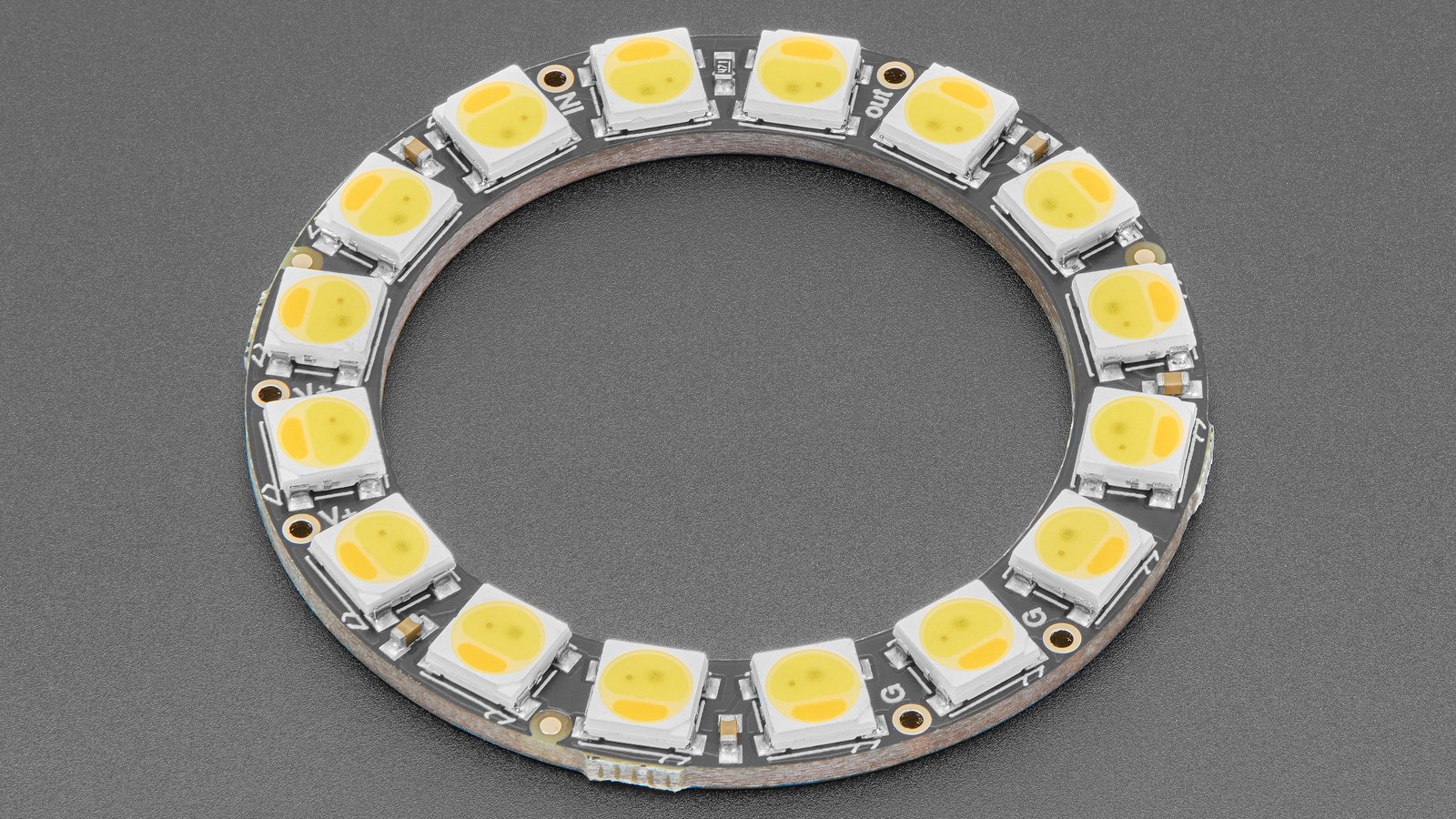
Adafruit has released 12- and 16-pixel NeoPixel rings built around WWA emitters rather than the familiar RGB mix. Each addressable package combines warm white, cool white and amber output, giving small lamps, indicators and props a way to shift white tint without mixing red, green and blue light. Adafruit announced both rings on October 10.
The two boards use the same control model but fit different mechanical envelopes. The 12-pixel ring measures 36.5 × 36.5 × 3.2 mm, while the 16-pixel version measures 44.3 × 44.3 × 3.1 mm. Both accept 5 V DC and expose a single timing-sensitive data line.
Three white emitters change the lighting job
WWA is not a substitute for full RGB animation. Its purpose is controlled white and amber output: cool white for a crisp task-light appearance, warm white for a softer look, and amber for a lower-color-temperature accent. Adafruit specifies 8-bit PWM per channel and a 32-bit value per pixel. That leaves firmware able to address every package independently while varying the white-channel blend.
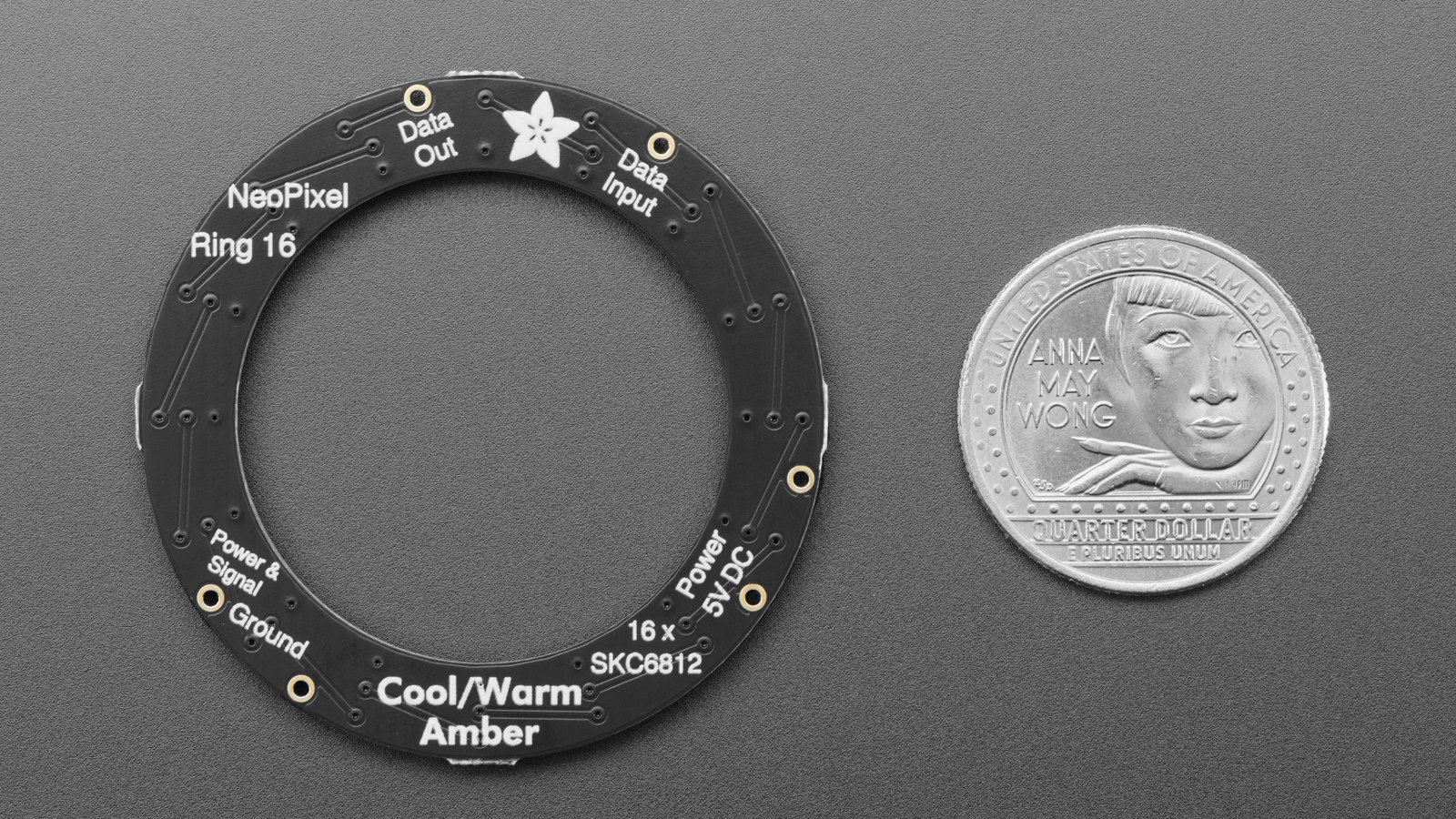
The design can simplify a project that needs white-tone variation more than saturated color. It does not, however, establish a calibrated color-temperature range or color-rendering index. Those values are not listed on the product pages, so photography, inspection and other color-critical uses still need measured spectral and thermal data.
Size and current determine the practical choice
Adafruit lists roughly 18 mA constant-current drive for each addressable LED package. A conservative supply design should still use the vendor’s broader NeoPixel power guidance and leave margin for wiring loss and startup behavior rather than multiplying one headline number and stopping there. The 16-pixel ring offers denser light around a 44.3 mm board; the 12-pixel version saves about 7.8 mm in board width.
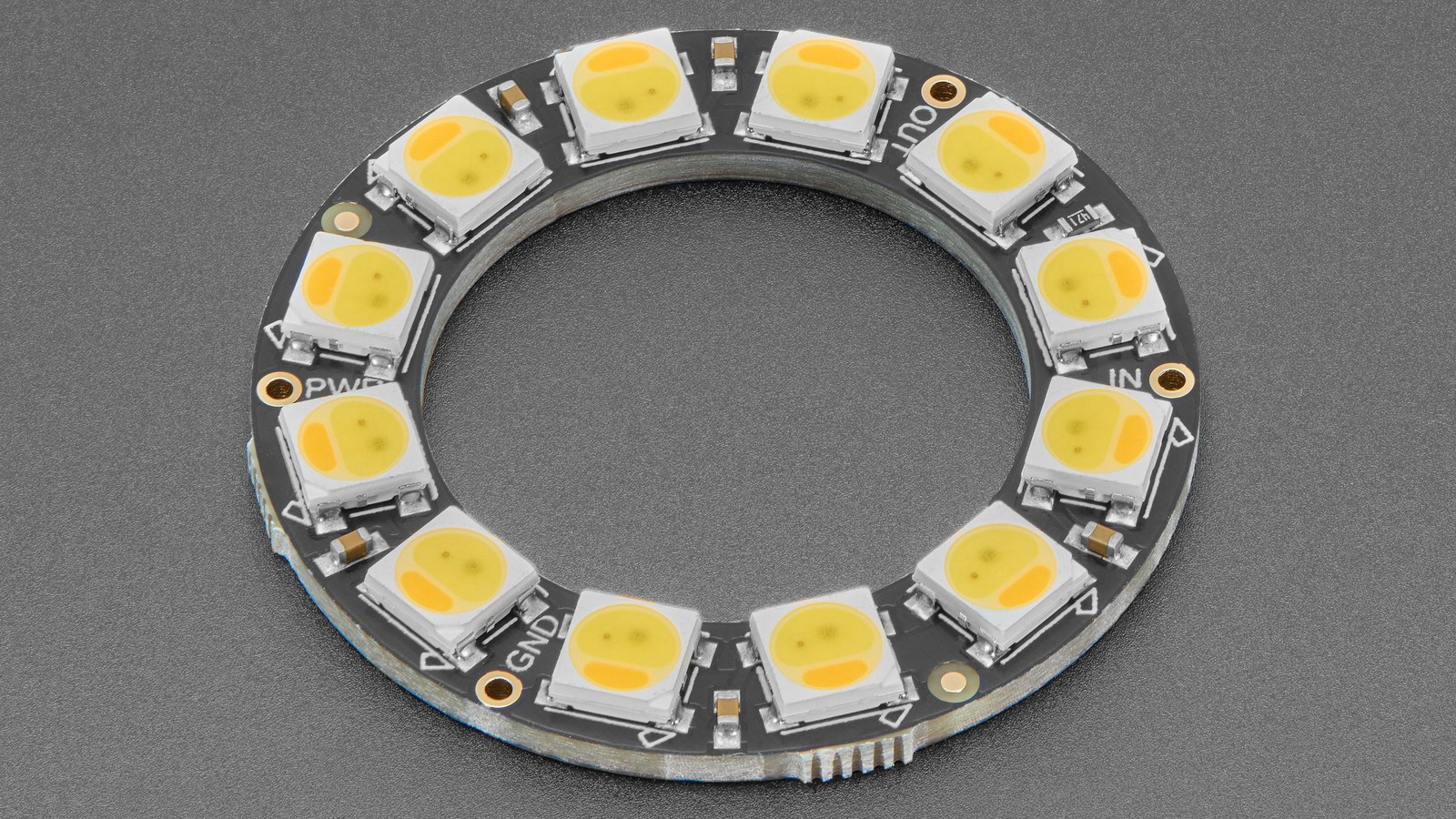
Both rings are chainable: data-out from one can feed data-in on the next, so one controller pin can drive a longer sequence. More pixels still increase update time, current demand and the consequences of voltage drop. Physical diffusion also matters because three white emitters inside each 5050 package can show unevenly through a shallow or clear lens.
The data stream still needs deterministic timing
The product pages call for an 8 MHz or faster real-time microcontroller and warn that the one-wire protocol is timing-sensitive. A Linux computer should therefore hand pixel output to a supported microcontroller or peripheral rather than bit-banging the line from a normal user-space process. The timing path also needs valid logic levels; the separate NeoPixel logic-level guide explains why a 3.3 V data source can lose noise margin against a 5 V pixel supply.
The WWA rings are useful additions where controllable white tone matters more than hue. The unanswered engineering questions are optical rather than digital: Adafruit has not published correlated color temperature, CRI, luminous flux or thermal-derating curves for these boards.