
BOSTON, MA — Astronomers have cataloged over 6,000 confirmed exoplanets, a milestone that reflects decades of evolving techniques and large-scale surveys. Kepler’s transit photometry jump-started the modern era by revealing thousands of candidates; subsequent radial-velocity follow-up and new methods have sharpened measurements of mass, orbit, and composition. Public archives now make those measurements available for analysis in classrooms and labs.
How it works
Most exoplanets are found through indirect signatures. Transit photometry detects the tiny dip in starlight as a planet crosses its star, producing a light curve that students can plot and fit to derive radius and orbital period. Radial-velocity (Doppler) measurements reveal the star’s wobble and yield planet mass. Direct imaging and astrometry capture planets in different regimes, while gravitational microlensing can reveal colder, more distant worlds. Each method has selection biases: current instruments favor larger planets close to their stars, which skews raw occurrence statistics.
Missions and archives matter. NASA’s Exoplanet Archive aggregates vetted detections and parameters, letting researchers and students search by size, equilibrium temperature, and orbital separation. The upcoming Nancy Grace Roman Space Telescope is expected to expand the sample toward colder, wider-orbit planets—changing both the discovery curve and the types of classroom problems one can pose.
What it teaches
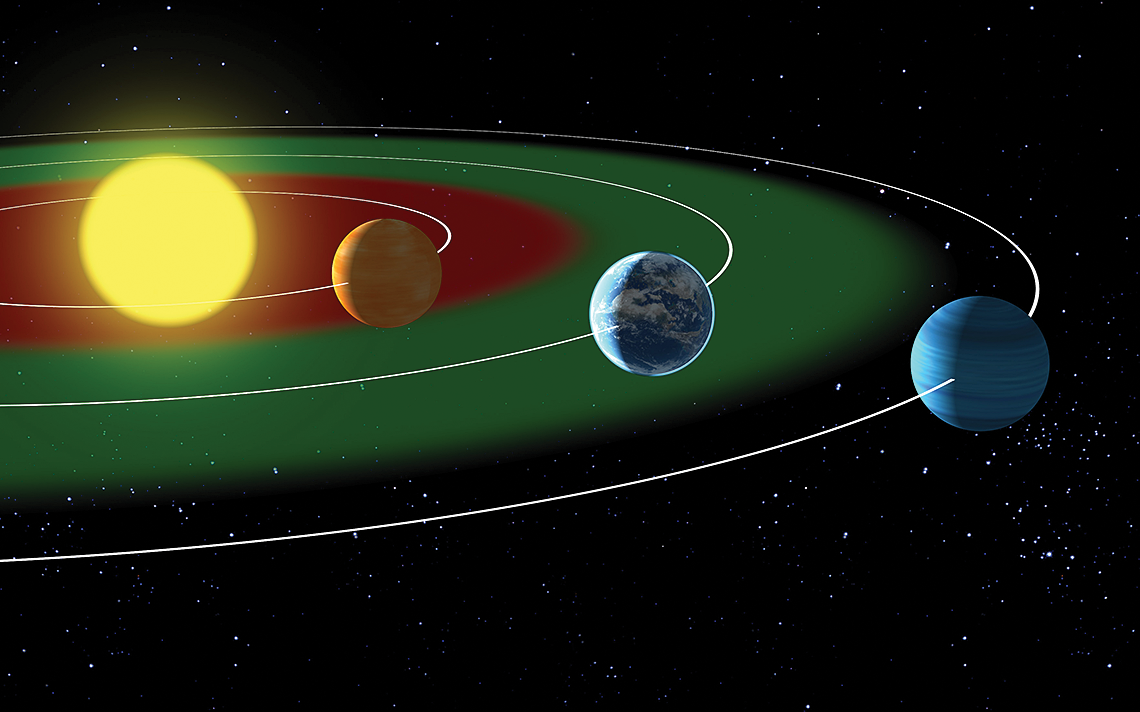
Exoplanet science is pedagogically valuable because it pairs clear physics with accessible, real data. Practical classroom modules can include extracting transit timings from light curves, performing least-squares fits to measure radii, using radial-velocity data to estimate mass, and propagating uncertainties. Higher-level work can incorporate population statistics—how common are super-Earths versus gas giants—and link to the Drake Equation when discussing habitability and the “Goldilocks” zone.
Beyond numerical skills, these datasets teach research practices: hypothesis framing, dealing with observational biases, reproducibility with public archives, and participation in distributed science through citizen-science projects that help vet candidates. For lab courses, curated subsets of exoplanet data let students run end-to-end projects from data cleaning to model selection.
The expanding catalog also highlights technological lessons—how improvements in photometric precision, spectrograph stability, and survey design change what can be discovered—making observational constraints a concrete topic in instrumentation or engineering modules.
The practical takeaway for instructors: integrate archived light curves and radial-velocity tables into assignments, scaffold statistical tools (error propagation, model comparison), and emphasize the interplay between instrument capability and scientific inference.
The Editor’s Take:
For educators, the exoplanet archive is a rare resource: authentic, current data that span physics, statistics, and engineering. Assignments built around real discovery methods give students hands-on experience with uncertainty, bias, and model testing—skills directly transferable to research labs and data-driven careers.
Credit and Source: IEEE Spectrum


