SAN JOSE, California — Nvidia and ABB Robotics are combining simulation and AI tooling to address one of industrial automation’s most stubborn engineering problems — the gap between how robots behave in virtual environments and how they perform on actual factory floors. The two companies announced a formal partnership this week, centering on the integration of Nvidia’s Omniverse simulation libraries into ABB’s RobotStudio engineering platform.
The resulting product, RobotStudio HyperReality, is scheduled for commercial release in the second half of 2026 as a subscription offering. More than 60,000 engineers currently use RobotStudio to design, program, and simulate robotic production systems. The Omniverse integration adds physically accurate rendering, synthetic data generation, and a tighter feedback loop between virtual testing and physical deployment.
How the Integration Works
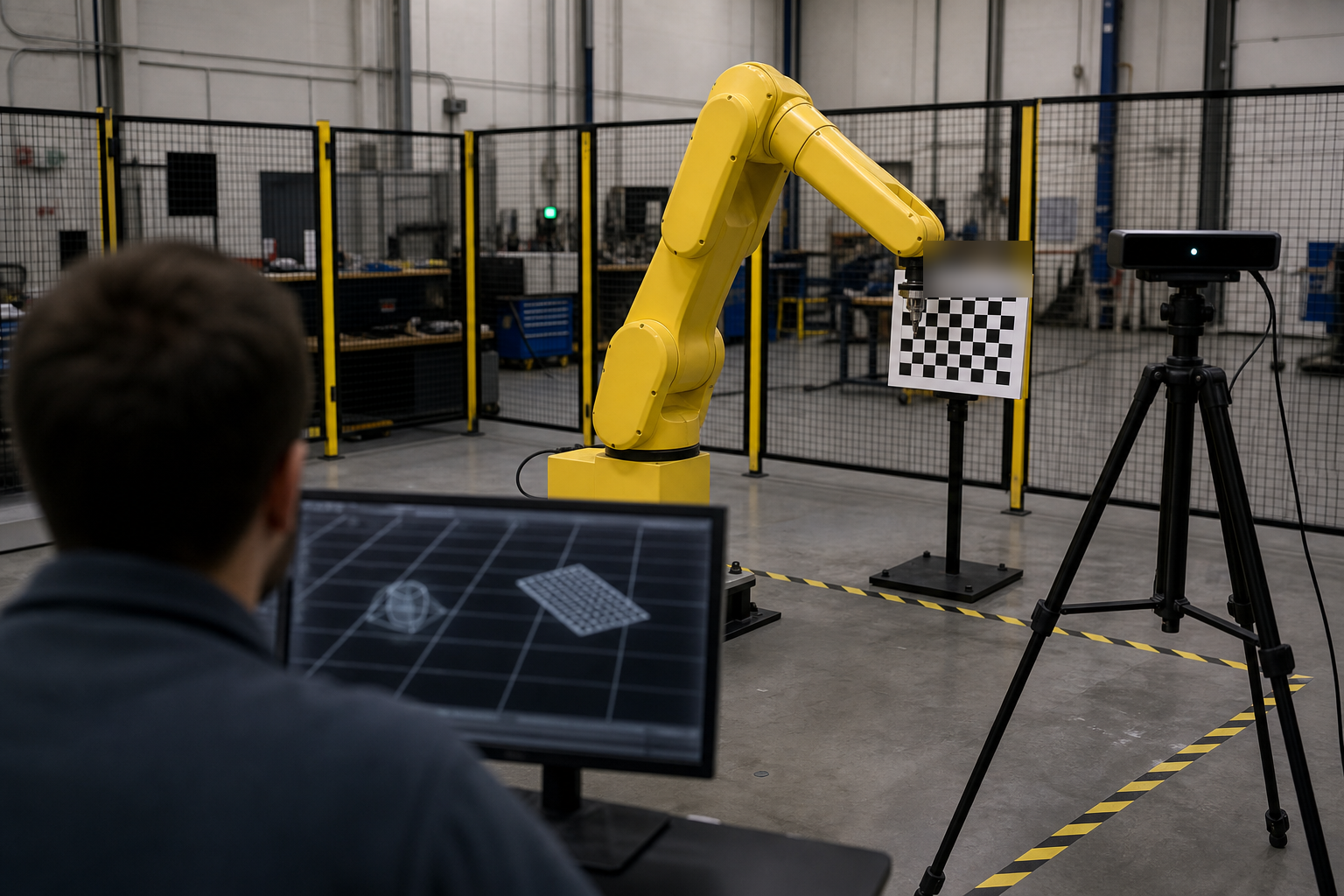
RobotStudio exports a fully parameterized robot station — including robots, sensors, lighting configurations, kinematics, and component parts — as a USD (Universal Scene Description) file. That file loads directly into Omniverse, where synthetic image data can be generated and fed into AI training pipelines. Vision models trained in this virtual environment can then be transferred to physical robots without requiring separate real-world data collection cycles.
The technical foundation of the sim-to-real improvement lies in ABB’s virtual robot controller — a software replica that runs the same firmware as ABB’s physical hardware. Because the simulated controller mirrors the actual control system precisely, motion paths and task behaviors validated in simulation carry over to physical robots with greater fidelity. This eliminates a common failure mode where robots trained in simulation encounter unexpected real-world variance in lighting, surface materials, or spatial geometry and produce inconsistent results.
ABB claims the approach can reduce production line setup times by up to 80% and cut deployment costs by as much as 40% by removing the need for physical prototypes during early development stages. Those figures reflect scenarios where manufacturers can fully validate automation systems in simulation before committing to hardware installation.
Nvidia’s Three-Layer Architecture for Robot AI
Deepu Talla, Nvidia’s VP of Robotics and Edge AI, outlined the company’s framework for building what he calls “generalist specialist robots” — systems capable of handling varied tasks rather than executing a single preprogrammed function repeatedly.
“Just as AI moved from basic recognition to deep thinking, robot intelligence is changing too,” Talla said during the announcement briefing. “Today, most robots are specialists. They are excellent at one single task, but they cannot adapt to anything else because they are preprogrammed. The future belongs to generalist specialist robots — think of them as the PhDs of the robot world, combining broad knowledge with deep expertise.”
Talla described three computing environments required to build these systems: infrastructure for training AI models, simulation platforms for virtual testing, and on-device computing that runs inference on physical hardware. Nvidia’s role in the ABB partnership focuses on the simulation layer. ABB covers the industrial robotics platform, development tooling, and the controller architecture that manufacturers deploy in production.
On the hardware side, ABB is also exploring integration of Nvidia’s Jetson edge AI platform directly into its Omnicore robot controller. If implemented, this would allow robots to run AI inference locally on their controllers — enabling real-time perception and decision-making without routing data to external compute systems, which reduces latency and eliminates network dependency in time-sensitive manufacturing operations.
Early Pilots: Foxconn and Workr
Two companies are already running pilot programs with the platform. Foxconn, the electronics contract manufacturer, is testing the system for consumer electronics assembly. The pilot involves training assembly robots in simulation using synthetic data generated through Omniverse, then transferring those trained models to live production lines.
Workr, a California-based robotics company focused on automation for small and mid-sized manufacturers, is integrating its WorkrCore platform with ABB robots trained via Omniverse-generated synthetic data. Workr plans to demonstrate the system at Nvidia’s GTC conference.
The small-to-mid-market focus is notable. Industrial robotics adoption has historically concentrated in high-volume manufacturing — automotive assembly being the clearest example — where the economics of programming and deployment scale favorably. Shorter production runs and higher task variability have made robotics cost-prohibitive for smaller operations. ABB and Nvidia argue that reducing setup time and eliminating physical prototyping could shift that calculus.
What ABB Says Makes This Different
ABB Robotics President Marc Segura framed the partnership’s core value around the unified platform rather than any single capability in isolation.
“We are offering a platform where you can close the sim-to-real gap at industrial grade,” Segura said. “With our RobotStudio and our virtual controller, we have for years been the reference for simulating something in a computer and deploying it with high accuracy in a robot. Now with Nvidia, we’re enhancing that and expanding that beyond the robot and the environment.”
RobotStudio HyperReality will be offered under a subscription model consistent with ABB’s existing RobotStudio Premium tier. A free version of RobotStudio with basic functionality will remain available.
The Editor’s Take: The sim-to-real gap has been a genuine engineering constraint — not a marketing problem — and this partnership addresses it at the controller firmware level, which is where it actually matters. For robotics engineers and automation integrators, the practical implication is significant: if the virtual controller runs identical firmware to the physical hardware, the simulation output stops being an approximation and starts being a functional test environment. The 80% setup time reduction claim will need independent validation at scale, but the architecture is sound. For developers building vision models for industrial applications, the synthetic data pipeline through Omniverse removes one of the most time-consuming bottlenecks in the training workflow — collecting and labeling real-world image data across variable factory conditions. Watch the Foxconn pilot closely; consumer electronics assembly involves high part variability and fine motor precision, making it one of the harder tests for sim-trained models.
Credit and Source: AIwire (HPCwire)
What to watch next
For readers tracking the same engineering lane, the next useful step is to compare this update with nearby coverage in TVG Report’s archive:
- Albert Shows How Cheap Quadruped Robots Can Teach Real Robotics
- NVIDIA’s Physical-AI Agent Skills Put the Focus on Robotics Workflow, Not Just Models
- ICRA 2026 Shows Robotics Is Becoming a Benchmark Discipline