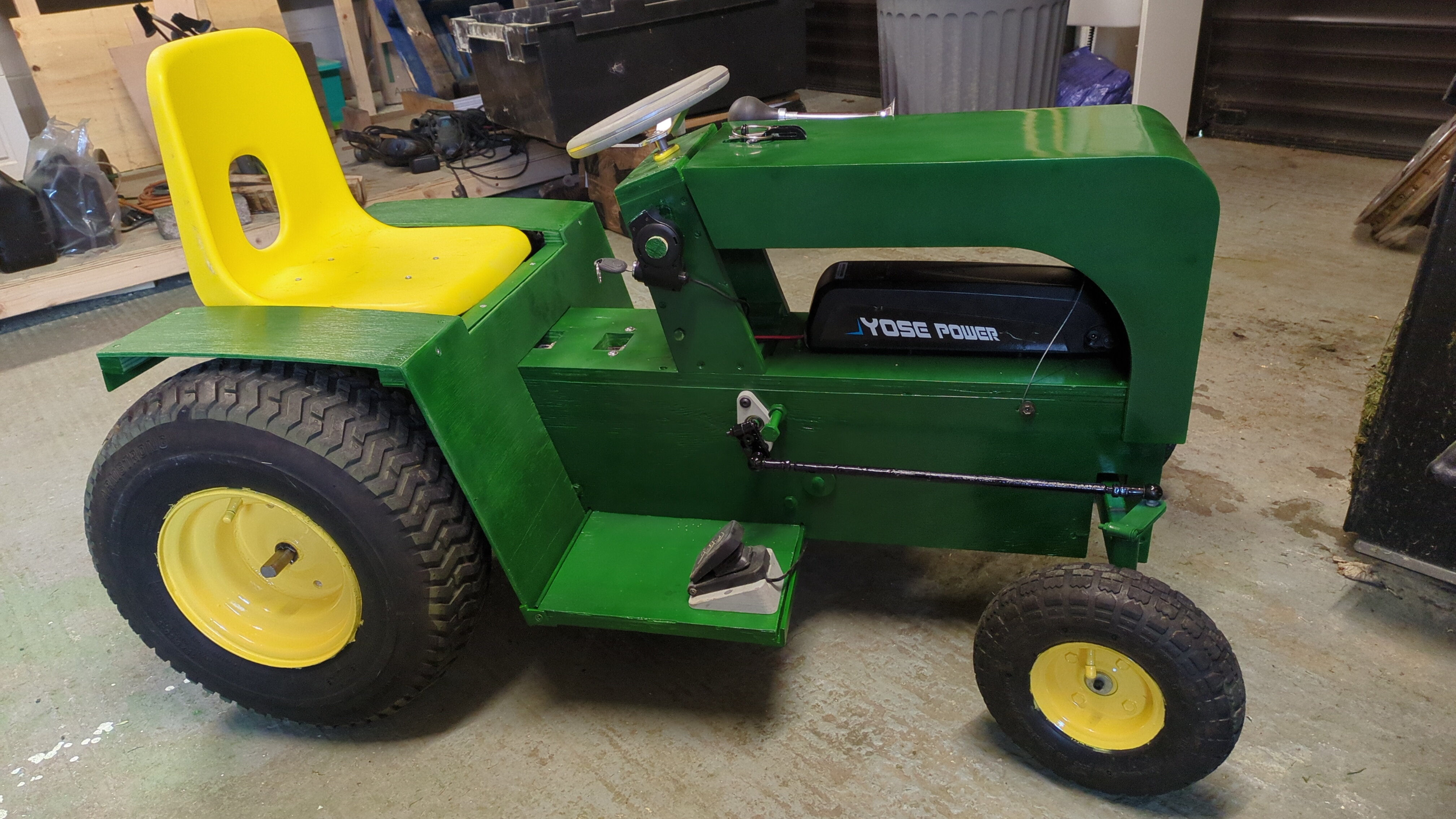
PORTSMOUTH, UK — When James set out to make a toy tractor that actually drives around the garden, he kept the design honest: simple lines, stout construction, and parts you can source without a full machine shop. The result looks like a toy you’d pull from a box but behaves like a proper small EV—good documentation, CAD files, and photos make it a useful project for the community.
Powertrain
- Motor: 350W DC motor salvaged or spec’d for small EV use.
- Battery: 36V Li-ion pack taken from an e-bike for range and voltage compatibility.
- Drive: Solid rear axle turning riding lawn mower wheels for traction and durability.
Chassis & body
- Frame: Plywood forms the bulk of the structure—stiff, easy to cut, and paintable.
- Bonnet: Curved plywood panels shaped with filler rather than sheet metal to hit that toy aesthetic.
- Finishing: Painted plywood gives it the toybox look while staying strong enough for off-road use.
Machining and fabrication hacks
- Custom axle: Turned on a mini-lathe despite shaft bore and length limits—James used a vice plus a block of wood as a makeshift tailstock to support the workpiece.
- Mix of processes: CAD for layout, 3D prints for small parts, and hand/bench tools for the rest.
Electronics & controls
- Speed and power managed by a suitable motor controller matched to the 36V pack.
- Wiring and switches kept accessible for maintenance and battery swaps.
This build is valuable because it shows pragmatic choices—plywood instead of bespoke metal panels, an e-bike battery instead of a custom pack, and a simple lathe hack that lets you turn a real axle without a bigger machine. For makers, that combination of documentation and smart compromises gives a clear path to replicate or adapt the design.
There’s nothing glamorous here—just solid maker work. If you’re after a joyfully practical project that blends woodworking, basic machining, and EV bits, James’ Toybox Tractor is worth the read and the follow-through.
toy tractor, 350W motor, e-bike battery, plywood chassis, lathe hack, DIY EV
Credit and Source: Hackaday
What to watch next
For more TVG Report context, see Build Pimmich: A Local-Only Raspberry Pi Smart Photo Frame, Play YouTube audio from the terminal with Shellbeats, and Bambu Lab’s A2L Makes the Desktop Printer Race About Build Volume and Workflow.